
Monthly Report on Human Rights Violations in the Republic of Karelia, Russian Federation
for March 2026
Researched and prepared by: Jana Tiihonen (Bystrova)
Developments in the Republic of Karelia during March 2026 continued to raise concerns regarding the implementation of economic, social, and civil rights. Media reports published during the month pointed to persistent structural problems affecting access to healthcare, food, and basic infrastructure, particularly in rural and remote settlements. At the same time, concerns emerged regarding public participation and increasing restrictions of freedom of expression through the application of broadly framed morality-based legislation. Taken together, the reported developments suggest continuing systemic shortcomings affecting the protection and equal enjoyment of human rights in the region.
Healthcare
The problems with the healthcare system in the Republic of Karelia in March followed the same pattern as the previous months. The lack of necessary medicine persisted, the hospitals remained understaffed, resulting in people being unable to get doctor appointments in time, the medical personnel were underpaid and often not qualified to provide adequate services, and in the rural areas the hospitals are not even available.
Concerning reports emerged regarding the funding for vital medicine emerged. According to a statement by a member of the regional parliament, Roine Iziumov, the federal programme allocated almost 50% less funding for state-subsidised medicines; out of the 986 million rubles required, only 498 million were provided. As a result, patients may not receive the full range of medicine to which they are entitled under subsidised programmes. The most notable case of such shortages affects diabetic patients, who for the sixth consecutive month, have been unable to acquire the insulin and test strips necessary for their treatment. The fact that the medicine shortage existed prior to the adoption of the budget for 2026 raises questions as to whether timely and adequate measures were taken to address the identified funding gap.
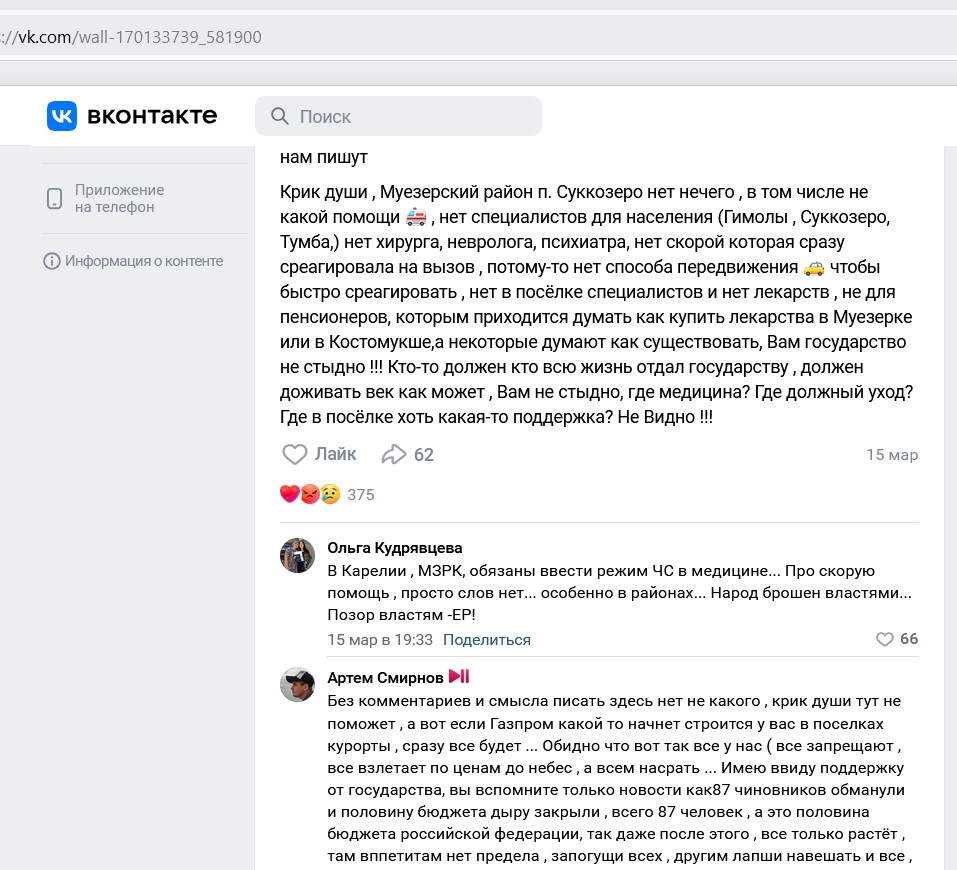
The underfunding of the healthcare system in Karelia manifests not only in medicine shortages, but also in the lack of hospitals and qualified doctors in rural settlements. According to online testimonies from residents of the settlements of Sukkozero, Gimbola, and Tumba in the Muezerskiy District, no doctors or medicine are available for the local population, which largely consists of elderly people, forcing them to travel long distances to obtain the required medical care and treatment. Additionally, due to the conditions of the roads and the lack of ambulances, residents may have to wait for hours for medical help to arrive in case of emergencies.
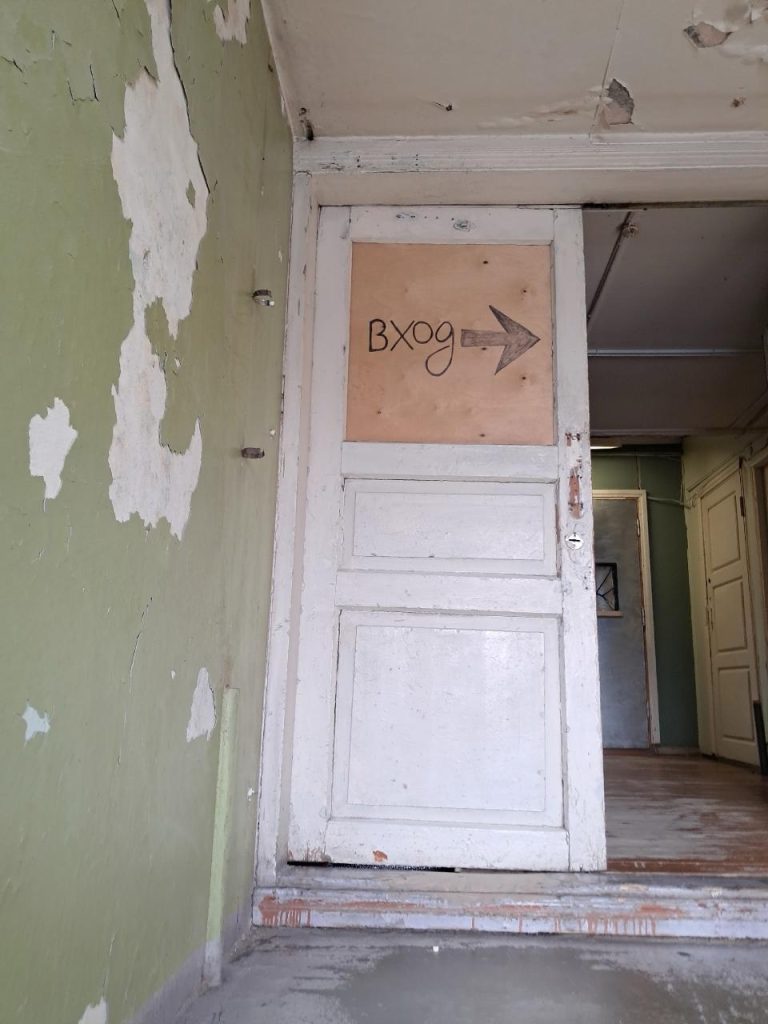
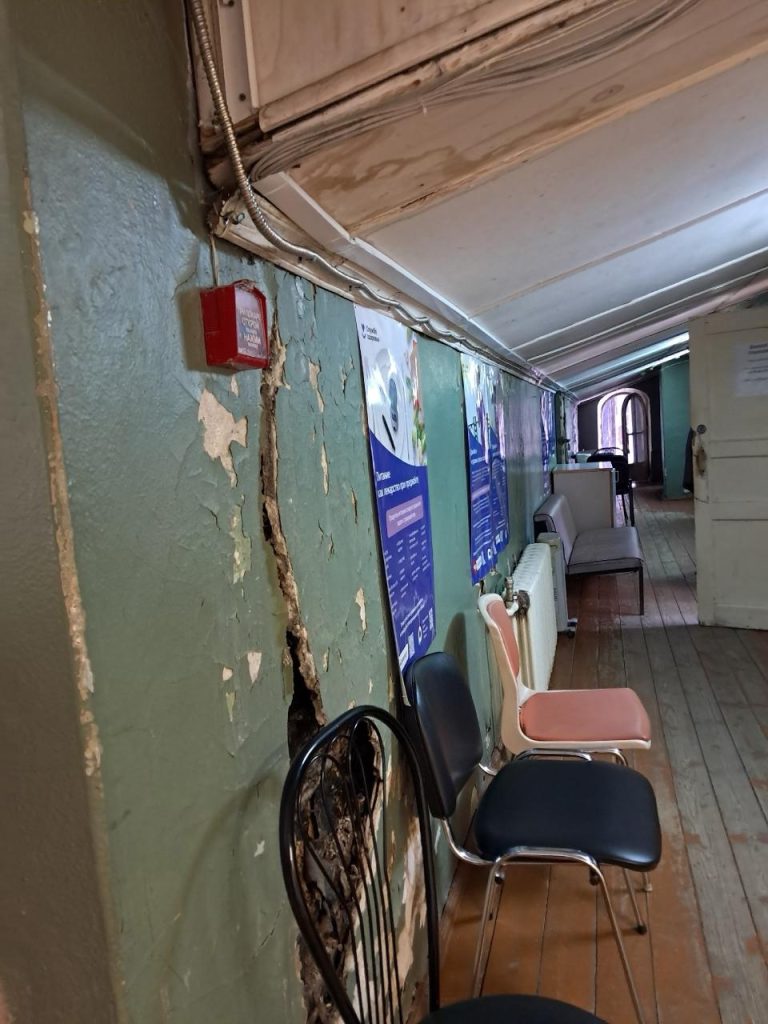
According to local activists, the systemic shortcomings in healthcare provision are the result of the “optimisation of healthcare” policy, implemented from the early 2010s. The new policy resulted in healthcare centres and hospitals that were not deemed “profitable” to be closed and merged with larger facilities, leaving smaller settlements without immediate access to medical care.
The problems with access to qualified medical personnel are not limited to the rural areas, however. As reflected in patient accounts shared on social media describing negative experiences with medical services, it is becoming increasingly difficult to find available doctors. Moreover, often times the services provided are of poor quality, leading patients to experience emotional distress during visits to doctors. Professionals in the field explain that this is due doctors and nurses being underpaid and overworked, which is reflected not only in the services they are able to provide, but also in the willingness of young professionals to remain in hospitals rather than seek employment in larger cities or other fields. Consequently, the hospitals are often staffed by an ageing workforce, potentially contributing to gaps in the quality and modernisation of care.
Yet problems in the healthcare system are not always linked to budget constraints, but also to poor management. A case that clearly illustrates this aspect is the new day-care inpatient department of the Sortavala District Hospital in Lakhdenpohja. The department was recently moved to a new building as a temporary solution pending the construction of a new medical facility. However, the temporary building does not meet the sanitary conditions required of a healthcare facility and fails to meet the basic standards of patient safety and comfort. The use of a facility that does not meet basic sanitary and safety standards raises questions as to whether appropriate inspections or compliance checks were undertaken before its approval for medical use. As such, the case of the Lakhdenpohja inpatient department reflects broader systemic challenges in ensuring adequate, safe, and properly managed healthcare services.
While large groups of the population continue to face significant barriers in accessing adequate healthcare services due to funding shortages, certain groups appear to benefit from preferential access to medical care and rehabilitation. In particular, veterans of the invasion of Ukraine and their families receive preferential access to healthcare services through the state-funded “Defenders of the Fatherland” foundation. The foundation’s support encompasses prioritised doctor appointments, access to qualified specialists, and modern, well-maintained medical facilities. Even though targeted support measures for specific groups may be permissible, concerns arise when such measures operate alongside systemic deficiencies affecting the broader population. In this context, the differential allocation of healthcare resources may undermine the equal enjoyment of the right to health.
Taken together, the conditions within the healthcare system in the Republic of Karelia raise concerns regarding the Russian Federation’s obligations under of the International Covenant on Economic, Social and Cultural Rights (ICESCR). Specifically, the systemic lack of medicine, qualified personnel, and proper medical facilities may be inconsistent with Article 12 of the ICESCR, which protects the right to enjoy the highest attainable standard of health. The preferential treatment of invasion veterans may be inconsistent with Article 2(2) of the ICESCR, which guarantees the equal enjoyment of rights without discrimination. Additionally, the inadequate remuneration of healthcare workers raises concerns under Article 7(a)(i) of the ICESCR.
Sources:
- https://spravedlivo.ru/15962710
- https://www.spb.kp.ru/online/news/6880903
- https://vk.com/wall-170133739_581900
- https://t.me/kalitki/19421
Food insecurity in rural settlement
Thousands of residents of rural settlements in Karelia are facing food insecurity. Available information suggests that limited access to retail infrastructure in remote settlements constitutes a long-standing systemic issue affecting rural communities across the republic. The scale of the issue became particularly apparent in media reports published in March 2026.
During a session of the Legislative Assembly of the Republic of Karelia, the Minister of Industry and Trade Svetlana Astakhova stated that as of the beginning of this year 388 settlements in Karelia lacked stationary retail stores. The residents of those settlements have to rely on mobile retail units to cover their basic needs. In recent months, however, there have been an increasing number of reports of mobile retail units being discontinued, leaving the residents of those settlements without reliable access to food.
The residents of such settlements are usually elderly people and people with disabilities, who often do not have the means to access retail stores. They instead have to rely on the help of their family members, who might be living in the closest town, or on “good Samaritans” who volunteer to bring food and other essentials to the settlements. Yet for the settlements that are located over a thousand of kilometres away from the closet retail store, such help is not easily found.
Additionally, many remote settlements lack access to properly maintained paved roads and can only be reached via dirt roads, which may become difficult or impossible to use during adverse weather conditions, particularly during snowfall or rainfall. Such conditions further hinder access to essential goods and food supplies.
The discontinuation of mobile retail store services to certain settlements is attributed to the conditions described above paired with insufficient or, in many cases, a complete lack of state subsidies for such services. Some owners, who operate such mobile retail stores, claim that due to the decreasing number of residents in small villages, they end up struggling to cover even the basic expenses for driver wages, fuel, and equipment maintenance, and without proper state support in some cases simply cannot afford to continue providing services for the settlements.
Notably, despite the stated aim of the Regional Programme “Development of Trade in the Territory of the Republic of Karelia” for 2025-2030 to improve access to retail infrastructure in remote settlements, official figures indicate that the number of settlements lacking stationary retail facilities increased from 374 in 2025 to 388 in 2026. Taken together with the limited information regarding concrete implementation measures of the regional programme and the continuing reduction in mobile retail services due to insufficient state funding, these developments raise concerns that the issue may not be effectively addressed, potentially leaving an increasing number of residents of Karelia without reliable access to food.
The persistent and worsening situation with retail store accessibility in rural areas of the Republic of Karelia may be inconsistent with Article 11 of the ICESCR, specifically regarding the provision of adequate food. According to CESCR General Comment No. 12, the right to adequate food is realised “when every man, woman and child, alone or in community with others, have physical … access all times to adequate food…”, while ‘Physical accessibility implies that adequate food must be accessible to everyone, including physically vulnerable individuals, such as … elderly, [and] the physically disabled.” In light of the continuing increase in the number of settlements, and thereby persons, lacking proper access to adequate food, despite official acknowledgment, concerns arise regarding the authorities’ willingness to effectively address the needs of vulnerable rural populations.
Sources:
- https://karel.mk.ru/social/2026/03/14/v-respublike-kareliya-naschityvaetsya-388-poseleniy-gde-otsutstvuyut-magaziny.html
- https://regaspect.info/2026/03/05/dazhe-odnogo-cheloveka-nelzya-brosat/
- https://minprom.gov10.ru/upload/iblock/cc0/p8s7e9ouogcc987detmdvb0m9kno4e93/305_P.pdf
Water infrastructure and public participation concerns in Kem
During the visit of Artur Parfenchikov, the Governor of Karelia, to Kem on 4 March 2026, organised as part of a public meeting with local residents regarding regional infrastructure and development issues, a local resident attempted to raise longstanding concerns relating to water supply and sanitation infrastructure in the area. The woman reportedly sought to formally submit a petition signed by approximately by 1,620 residents of Kem and the settlement of Rabocheostrovsk, calling for the urgent construction of water treatment and sewage treatment facilities in the region. However, the concerns raised by the residents were met with dismissive responses from the Governor, who interrupted the speaker and discouraged further discussion of the issue during the meeting. The incident raised concerns regarding the extent to which residents are able to meaningfully raise longstanding infrastructure and public health concerns before regional authorities.
The petition submitted by residents described a prolonged deterioration of water and sanitation infrastructure in Kem and surrounding settlements. According to the document, for decades local residents have reportedly been receiving water that does not comply with sanitary standards. The petition further alleged that untreated sewage is discharged directly into the river, while runoff from the local cemetery also enters the water system. Residents additionally stated that the city’s water treatment infrastructure is severely outdated and deteriorated. According to information cited in the petition, a filter scheduled for replacement in 2025 had remained in use since 2004 despite an expected service life of approximately 18 years. Residents also reported that, according to testing conducted by Rospotrebnadzor in 2025, all 24 water samples tested failed to meet sanitary requirements.
The petition further noted that the deterioration of the water supply system has resulted in rust, dirt, and other contaminants entering the water supply, negatively affecting the quality and safety of drinking water available to residents. According to the petition, local and regional authorities have, for approximately 30 years, failed to prepare the necessary project documentation and construct sewage treatment and water purification facilities in Kem. Residents argued that the continuing lack of proper water and sanitation infrastructure negatively affects public health and living conditions and violates sanitary regulations and environmental safety standards. The petition requested the immediate commencement of work on the development and construction of modern treatment facilities in order to ensure residents’ access to safe drinking water.
The reported conditions raise concerns regarding the implementation of Articles 11 and 12 of the ICESCR, relating to the right to an adequate standard of living and the right to the highest attainable standard of physical and mental health. According to CESCR General Comment No. 15, access to sufficient, safe, clean water constitutes an essential component of the right to an adequate standard of living and the right for the highest attainable standard of health. The prolonged absence of adequate water treatment and sanitation infrastructure, combined with allegations of contaminated drinking water and untreated sewage discharge, suggests persistent failures to ensure safe access to water and adequate sanitary conditions for the residents of Kem and surrounding settlements.
Additionally, the reported response of the regional authorities during the public meeting raises concerns regarding the effective exercise of rights protected under Article 19 of the International Covenant on Civil and Political Rights (ICCPR), which guarantees freedom of expression, including the ability to seek, receive, and impart information and concerns relating to public affairs. Considering that residents were attempting to raise longstanding public infrastructure concerns affecting a significant part of the local population, the dismissive treatment reportedly encountered during the meeting raises concerns regarding the effectiveness of public participation mechanisms and the willingness of regional authorities to meaningfully engage with residents on issues directly affecting their living conditions and health.
Sources:
Morality-based restriction on expression
In early March, it became known that authorities in Petroskoi (Petrozavodsk) initiated administrative proceedings against the owner of the local bookstore “Bukvoed” under Part 1 of Article 6.21 of the Code of Administrative Offences in the Russian Federation. According to media reports, the proceedings were initiated after law enforcement authorities identified a book allegedly containing information promoting ideas deemed inconsistent with “traditional family values.” The press service of the courts of Karelia stated that experts had concluded that the publication “challenged traditional Russian ideas about family and society” and was aimed at the “destruction of traditional family values.” Under Article 6.21. the bookstore owner faces significant administrative penalties, including fines of up to one million rubles.
Part 1 of Article 6.21 of the Code of Administrative Offences prohibits the dissemination of information allegedly promoting “non-traditional sexual relations”, “gender transition”, and “refusal of childbirth.” Particularly concerning is the broad and vague wording of the provision, which prohibits materials allegedly creating a “distorted understanding of the social equivalence of traditional and non- traditional sexual relations’ or the ‘social equivalence of childbirth and refusal of childbirth”. The law does not clearly define what constitutes “propaganda”, “traditional values”, or a “distorted understanding,” allowing for highly subjective interpretation and enforcement. Such vague terminology creates significant risks or arbitrary application and encourages self-censorship among booksellers, publishers, cultural institutions, and individuals distributing literature or expressing views perceived as inconsistent with state-supported ideological narratives. The broad scope of law additionally raises concerns that it may be used not only to restrict forms of expression, but also to suppress broader public discussion relating to social, cultural, and reproductive issues.
The case raises concerns regarding the compatibility of Article 6.21 and its application with Article 19 of the ICCPR, which guarantees the right to freedom of expression , including freedom to seek, receive, and impact information and ideas of all kinds. Restrictions to freedom of expression under international human rights law must be clearly defined, necessary, and proportionate to a legitimate aim. The vague and ideologically framed terminology contained in Article 6.21, together with its expanding application against literature, raises concerns regarding arbitrary enforcement and disproportionate restrictions on protected forms of expression.
Sources:
- https://t.me/sudpress10/4224
- https://www.fidh.org/en/issues/lgbtqi-rights/russia-ban-on-propaganda-in-favor-of-childfree-lifestyles
Detention and Interrogation of journalist Anna Yarovaya
According to media reports from early March, 2026, a journalist from Karelia, Anna Yarovaya, who arrived from Finland to visit family in Karelia, was detained near her parents’ home on 26 February. Law enforcement searched the premises of her parents’ apartment, seized her notebook and phone, and took her for questioning. During the interrogation, she was questioned about possible cooperation with the Finnish security services and was intimidated with the possibility of criminal prosecution under Article 275 of the Criminal Code of the Russian Federation, State Treason. Anna Yarovaya denied allegations and was released, and the same day decided to return to Finland.
Anna Yarovaya’s journalistic work focuses on what the Russian authorities consider to be politically sensitive issues in Karelia, including the history of Stalinist repression, attempts to reinterpret the history of the Sandarmokh memorial site, the criminal prosecution of the historian Yury Dmitriev, and the militarisation of society in the Russian Federation.
This case raises concerns regarding the use of security-related accusations and intimidation against journalists, particularly those working on issues that are not in line with state-oriented rhetoric. Even in the absence of formal charges, detention, interrogation, seizure of devices, and threats of prosecution under grave criminal provisions, may be interpreted as a threat to freedom of speech and expression. The incident may therefore raise concerns under Article 19 of the ICCPR, which protects the right to seek, receive, and impart information and ideas.
Sources:
Conclusion
These developments raise serious concerns regarding the Russian Federation’s compliance with its obligations under the ICESCR and ICCPR in relation to the situation in the Republic of Karelia. Given that many of the issues documented in March are not new, but reflect patterns that have persisted for months and, in some cases, years, these developments raise concerns that the situation cannot be attributed solely on isolated administrative failures or short-term policy shortcomings. Rather, the prolonged failure to address known deficiencies in healthcare, access to food, water and sanitation, and public participation may indicate a broader pattern of structural neglect by the imperial authorities, with particularly serious consequences for rural residents, elderly people, persons with disabilities, and other vulnerable groups of Karelian nation.
Researched and prepared by: Jana Tiihonen (Bystrova)