Monthly Report on Human Rights violations in the Republic of Karelia
Karelian human rights defender Yana
September 2025
Executive Summary
This report addresses recent developments in the Republic of Karelia, Russian Federation, in the month of September 2025. It highlights four key areas of concern: possible tempering and falsification of the election results in the Regional Elections in the Republic of Karelia, possible sabotage efforts against certain members of the opposition party “Yabloko” to exclude them from the candidate registry of the regional elections, violation of children rights in the school curricula, violation of cultural and linguistic rights in the school curricula.
The documented incidents reveal a consistent pattern of violations of political, social, cultural, children rights. These include the failure to provide effective remedies, breaches of official election procedures, disregard for the fundamental principles of the United Nations concerning the promotion of peaceful coexistence, and the militarization of the school curricula and extracurricular activities. Such practices are incompatible with the Russian Federation’s obligations under the International Covenant on Civil and Political Rights (ICCPR), the International Covenant on Economic, Social and Cultural Rights (ICESCR), the Convention on the Rights of the Child (CRC), as well as the foundational principles of the United Nations.
Total number of violations: 13
Methodology
The findings presented in this report are based on open-source information including official communications by Russian authorities, regional and federal legislation, credible media reporting, and research conducted by independent experts. Where possible, the report cross-references multiple sources to verify accuracy.
The report does not claim to be exhaustive. It focuses specifically on four sets of incidents in September 2025 which illustrate systemic patterns of international law violations and disregard for international standards.
Findings
A. Violation of basic democratic principles
On 14th September 2025, regional elections were held in the Republic of Karelia. These elections were accompanied by efforts that appeared to undermine the participation of candidates from the opposition party “Yabloko” and by potential irregularities in Electoral District No. 3 during the election of deputies to the Council of the Muyezersky Municipal District.
On 7th and 8th September, the Medvezhyehorsk and Lahdepohsky District Election Commission (TEC) removed four Yabloko candidates from the municipal elections (1). The TEC cited a QRcode included in the party’s campaign newspaper, linking to a video in which Yabloko party chair Nikolai Rybakov read a passage from a book authored by Yuri Shchekochikhin, published by Yabloko, accompanied by copyright-free music (2). The TEC alleged that this constituted a copyright violation. The Yabloko party presented evidence in court demonstrating that it held the necessary rights to both the text and the musical accompaniment. Despite this, district courts upheld the TEC decisions, confirming the removal of the candidates.
Following appeals, the Supreme Court of the Republic of Karelia overturned the lower court rulings and reinstated the candidates. On 12th September, the TEC appealed the Supreme Court’s decision to the Third Cassation Court in St. Petersburg (3). The Cassation Court ruled that, while the initial removal of the candidates had been legally valid, the candidates could not be removed from the ballots because the statutory deadline for annulling registrations had passed. Under the law of the Russian Federation, such decision must be made no later than five days before the first day of voting. In practice, the Cassation Court did not examine whether a copyright violation had occurred, but emphasized procedural timing as the basis for its decision.
It should be noted that, in both TEC and Cassation Court proceedings, the candidates were not adequately informed of hearings and had to travel long distances at short notice to participate. These legal proceedings raise significant concerns under Article 2(3) of the ICCPR, which obligates states to ensure effective remedies for rights violations. The combination of procedural deficiencies, including failure to examine substantive allegations and inadequate notice, suggests that the affected candidates were not provided with effective legal remedies to challenge decisions that directly impacted their right to stand for election.
Although the eventual court rulings were favorable to the candidates, the legal disputes had tangible impacts on their campaigns. Candidates devoted significant time during the final week to litigation rather than voter engagement. Media coverage and public announcements regarding the initial removals may have negatively affected voter participation. These factors likely influenced voter turnout and the overall electoral process.
A legal representative, requesting anonymity, expressed concern that the election commissions may have acted under administrative influence rather than in the interest of facilitating genuine voter choice (4). The procedural disruptions, which diverted candidates from campaigning and possibly impeded voter engagement, introduced uncertainty into the electoral process. These factors undermine both the integrity of the elections and the electorate’s ability to make informed choices. Consequently, the state may have failed to provide a fair and equitable framework for political participation, representing a potential violation of ICCPR Article 25. In the days following the election, further concerns arose regarding the integrity of vote tabulation in Electoral District No. 3 of the Muyezersky Municipal Council Elections. Candidate Sergey Yerkoev reported discrepancies between the official polling station protocol produced by the electronic counting machine (KOIB) and the versions recorded in the federal election system (GAS “Vybory”). The KOIB protocol, signed by precinct commission members, indicated that 254 ballots had been issued, yet the combined total of valid and invalid ballots was only 212, leaving 42 ballots unaccounted for (5).
Additional concerns emerged when Yerkoev received two different versions of the official protocol for the same polling station (UIK No. 331). The first protocol, signed at 21:15 on 14th September 2025, reported 226 canceled ballots and 254 issued. A second protocol, signed at 21:47 on the same day and also marked as “Copy No. 1”, recorded 268 canceled ballots and 212 issued. (annex, Figure 1,2)
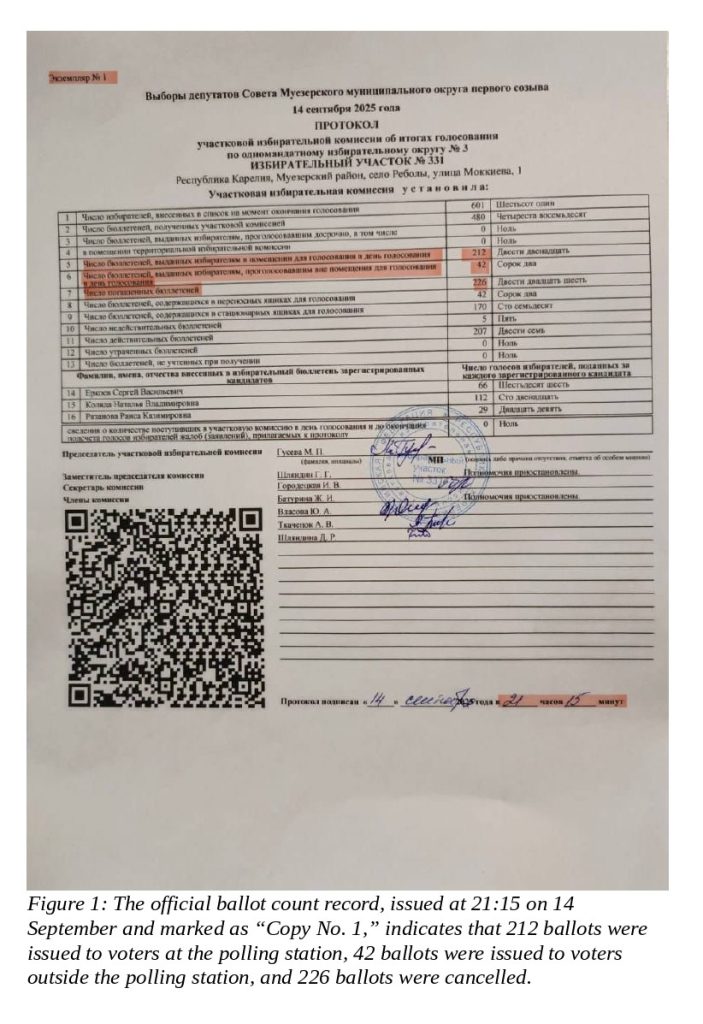
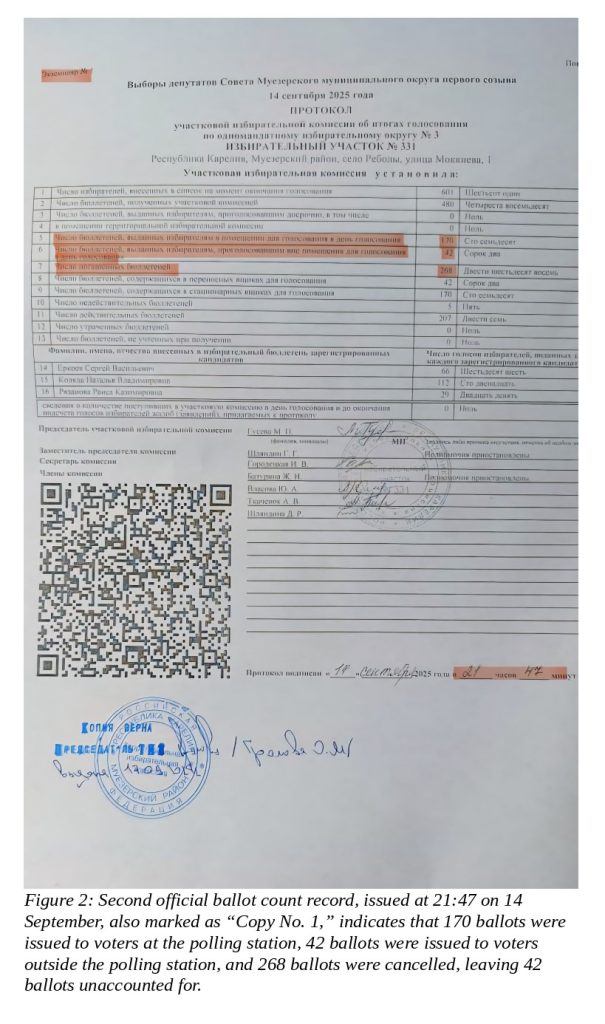
These documented inconsistencies in ballot accounting and the issuance of conflicting official protocols undermine the transparency and reliability of the electoral process. Such irregularities may constitute a breach of the Russian Federation’s obligation under Article 25 of the ICCPR, which requires States to ensure genuine periodic elections that guarantee the free expression of the will of the people.
1 https://www.yabloko.ru/regnews/Karelia/2025/09/11
2 https://t.me/Slabunova/4758
3 https://www.yabloko.ru/regnews/Karelia/2025/09/13
4 https://t.me/Slabunova/4774
5 https://t.me/Slabunova/4780
B. Violation of Fundamental Human rights of the Native peoples of Karelia
On 8th September 2025, a public statement by Russian official Dmitry Medvedev was published by the news agency TASS (6), reviving historically inaccurate accusations against Finland. The statement portrayed Finland as the principal perpetrator of atrocities in Karelia during World War II. These narratives go beyond historical revisionism, as they deliberately seek to turn the Karelian population against Finland by falsely emphasizing alleged Finnish “plans” for expansion into East Karelia and by accusing Finland of attempting to forcibly “Finnicize” Karelians. The rhetoric portrays Finland as an existential threat to Karelian identity and undermines the historical record of the region. Such framing poses serious risks to the Republic of Karelia. It revives hostile stereotypes, deepens division between Karelians and Finns, and implicitly threatens Karelia’s cultural autonomy by positioning its population as a tool of the Russian Federation’s confrontation with Finland and NATO. The manipulation of Karelian wartime suffering to justify current militarization and hostility exposes the Republic to internal polarization, external isolation, and potential involvement in geopolitical escalations beyond its control. The statements also pose a direct threat to the cultural identity of the Karelian people. Much of Karelia’s cultural preservation of scholarly research has historically depended on cooperation with Finnish institutions, universities, and cultural centers. Joint projects in linguistics, ethnography, and folklore studies have been critical in sustaining the Karelian language and heritage. By deliberately fostering division and hostility between Karelia and Finland, these statements risk severing partnerships essential to maintaining cultural continuity. Such a rupture would accelerate cultural erosion by depriving Karelians of access to vital resources and international cooperation necessary for sustaining their distinct identity.
In addition to cultural consequences, the economic stability of the Republic of Karelia is threatened. Prior to 2022, Finland was a key partner in cross-border economic cooperation, significantly contributing to the Republic’s livelihood. These ties were disrupted following the Russian Federation’s central authorities’ decision to launch a full-scale invasion of Ukraine, which led to the breakdown of collaboration between Karelian businesses and Finnish counterparts. Renewed efforts to deepen hostility toward Finland would further isolate Karelia, limiting opportunities for future economic engagement, and risking marginalization from its closest historical partner.
The hostile statements and the accompanying manipulation of historical memory constitute a violation of the rights of the Karelian people. As a federal republic, Karelia is compelled to follow the policies of the Russian Federation and cannot independently abstain from hostility toward Finland, or any other State. In practice, this deprives Karelians of the ability to maintain peaceful relations with their neighbor. The use of propaganda portraying Finland as an existential threat forces Karelians into confrontation contrary to their heritage and aspirations, thereby infringing upon their right to peaceful existence.
These actions undermine the Karelian people’s right to self-determination, as protected under Article 1 of the ICCPR, the ICESCR, and the UN Charter, which guarantees all peoples the freedom to pursue cultural and social development without external coercion. Furthermore, severing cultural and academic cooperation with Finland, as a result of hostile rhetoric, threatens Karelians’ ability to sustain their cultural identity. This constitutes a violation of Article 27 of the ICCPR, which protects minority rights to enjoy their culture in community with other members of their group. By obstructing Karelians’ capacity to preserve their cultural development, maintain international partnerships, and live in peaceful relations with other Finnic nations, these policies and statements violate the fundamental rights of the Karelian people under international law.
6 https://tass.ru/opinions/24989035
C. Militarization of education
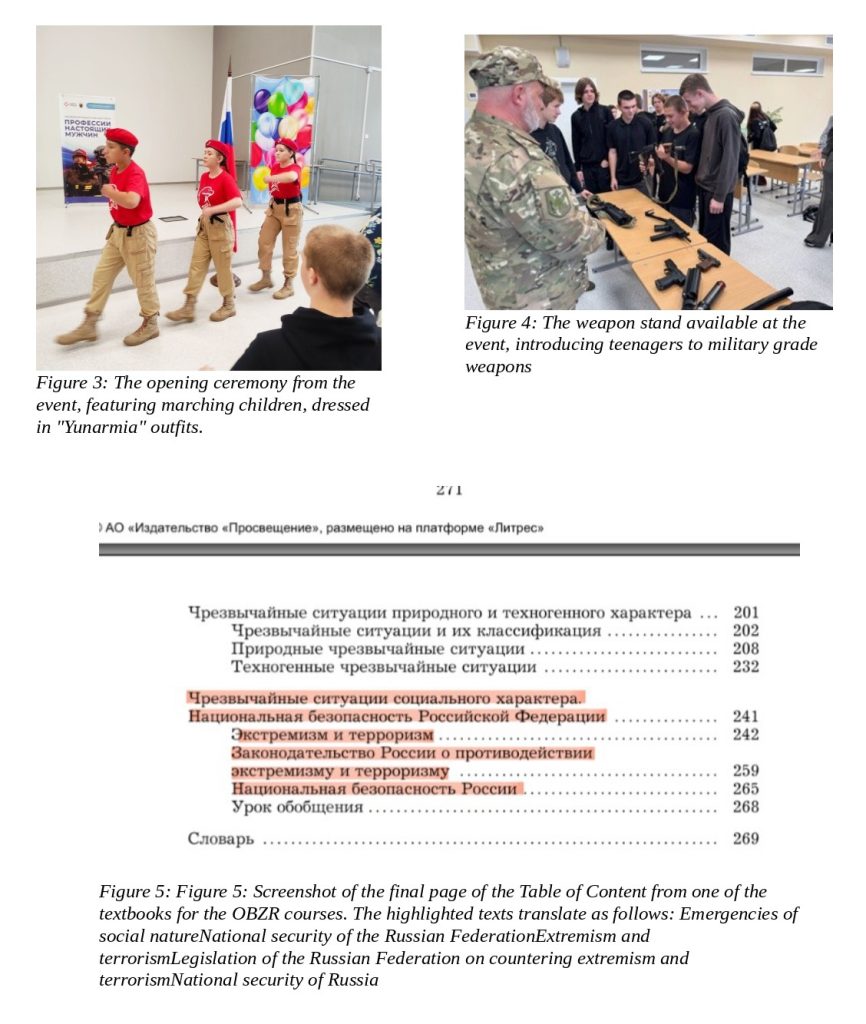
On 10th September 2025, at Suoyarvi Secondary School named after F.A. Shelshakov, local authorities and affiliated organizations held a municipal career-orientation event under the slogan “There is such a profession – to defend the Motherland” (7). The official opening ceremony included the carrying of the national flag of the Russian Federation by members of the “Yunarmia” (Youth Army) (8). (annex 1, figure 3)
The program emphasized professions in the security and military sectors, featuring representatives of the Ministry of Internal Affairs, the Federal Security Service (FSB), the Border Service, the Military Commissariat, and other law-enforcement and defense bodies. Students from grades 8th to 10th were introduced to military and paramilitary career pathways, service conditions, and admission requirements for departmental educational institutions. The event included displays of military and police equipment, weapons, special devices, and demonstrations by forensic specialists. (annex 1, figure 4) The Ministry of Emergency Situations presented firefighting equipment and tools.
The initiative was explicitly framed within the national campaign marking the “Year of the Defender of the Fatherland”. Officials stressed the importance of “power-structure professions” and encouraged students to prepare for admission to military and law-enforcement academies. This event is not an isolated occurrence but part of a broader systemic pattern in the Republic of Karelia aimed at normalizing war, military service, and the use of violence as a legitimate and expected societal function. Within the formal education system, this trend is reflected in the introduction, in 2024, of the compulsory subject “Fundamentals of Security and Defense of the Fatherland” (OBZR) (9). This course includes modules in which children are instructed on the operation of military-grade weapons and tactics, thereby blurring the line between general civic education and pre-conscription military training. (annex 1, figure 5) Furthermore, mandatory weekly extracurricular lessons entitled “Talks abut Important Matters” are increasingly militarized. These sessions present ideological content on topics such as “What it means to serve the Fatherland”, framing military service as a central civic duty. The program promotes historical revisionism and the normalization of foreign land occupation, for example by celebrating the “Day of the Reunification of Crimea and Sevastopol with Russia”. The militarized atmosphere extends beyond the classroom. In numerous schools across Karelia, classrooms and hallways are decorated with information boards (annex 1, figure 6) and displays glorifying the so-called “special military operation” in Ukraine, including portraits of local participants in the conflict. Extracurricular reading lists include explicitly militaristic literature such as “On guard of Russian Land” and “For the Motherland” (“Zа Родину”)1010. The latter title incorporates the Latin letter “Z”, a symbol widely associated with the Russian Federation’s invasion of Ukraine and increasingly regarded as equivalent to the Nazi swastika due it its propagandistic use.
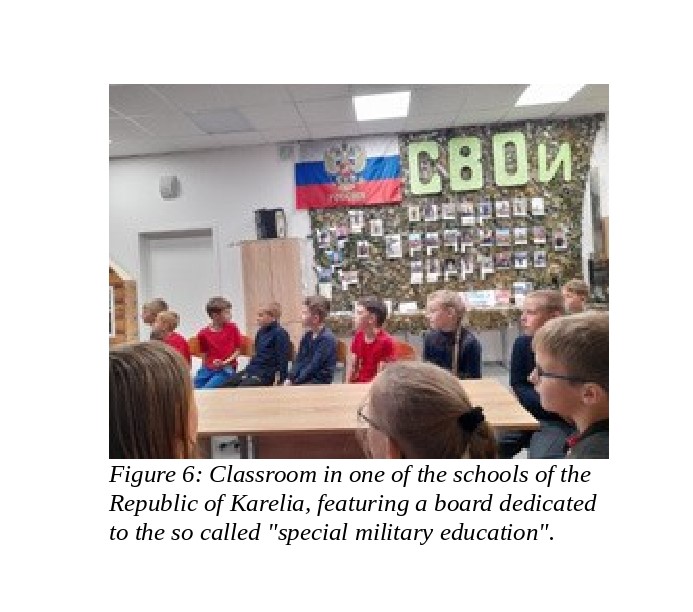
Taken together, these practices demonstrate a systemic state policy to normalize armed conflict and military identity among schoolchildren. Such practices violate the Russia Federation’s obligations under the CRC. By subordinating education to militarized indoctrination at the expense of children’s right to a peaceful upbringing, access to unbiased knowledge, and preservation of moral autonomy, the state contravenes Article 28(2) and 29(b),(d) of the CR, as well as Article 20 of the ICCPR and Article 13 of the ICESCR.
In addition to militarization, independent activist organizations raised concerns about the broader cultural and linguistic orientation of schooling in Karelia. The educational framework prioritizes promotion of Russian culture, language, and state ideology, while substantially neglecting Karelian culture, language and history. Although some exposure to local traditions is provided, it remains superficial and insufficient to foster a strong sense of Karelian identity. Instruction in the Karelian language is minimal and often unavailable, further undermining the preservation of the region’s linguistic heritage.
When viewed together, militarization and cultural assimilation within the education system suggest a dual process of ideological indoctrination and erosion of minority identity. These practices violate Articles 29(c) and 30 of the CRC, which guarantee children’s rights to an education that respects their cultural identity and heritage, as well as their right to enjoy their own culture in community with other members of their group.
7 https://m.vk.com/wall27203305_8349?
z=photo27203305_457266826%2Fwall27203305_8349&from=search
8 https://yunarmy.ru/
9 https://www.obrazov.org/articles/obuchenie/chto-takoe-obzr-i-zachem-on-nuzhen-v-obrazovatelnoy-
programme/
10 https://m.vk.com/wall-195478367_4748?from=group
Recommendations
It is recommended that the United Nations call upon the Russian Federation to bring its education system, administrative practice, and public policy into full conformity with its obligations under the ICCPR, ICESCR, and CRC, as well as the UN Charter, with specific regards to the situation in the Republic of Karelia.
The Russian Federation should ensure the full realization of the right to participate in public affairs and to vote and be elected in genuine periodic elections, as required by Article 25 of the ICCPR. In particular:
The State should guarantee equal participation for all political parties and candidates, including opposition groups, and refrain from arbitrary disqualification, censorship, or interference in electoral registration and campaigning.
Authorities should ensure the independence and impartiality of electoral commissions at all levels and guarantee candidates’ right to an effective legal remedy in cases of unlawful exclusion or procedural irregularities, in accordance with Article 2(3) of the ICCPR.
Measures should be adopted to prevent manipulation of electronic voting systems, falsification of results, and discrepancies in ballot tabulation.
The State should strengthen transparency by publishing all electoral data, protocols, and appeals decisions, and by permitting national and international observers full access to all stages of the electoral process.
The authorities should cooperate with international observers and investigate and remedy reported cases of interference, including missing ballots and duplicate protocols.
The Russian Federation should cease the dissemination of false or inflammatory narratives by public officials and state-controlled media that incite hostility toward neighboring States or ethnic groups. In particular:
The State should bring its media and public communication policies into conformity with Articles 19 and 20(2) of the ICCPR by prohibiting the use of disinformation and hate speech that targets Finland or misrepresents the history of the Republic of Karelia.
Authorities, under the surveillance of international observers, should adopt measures to protect academic freedom and ensure that historians, journalists, and educators can research and publish without political pressure or censorship.
The State should prevent stigmatization or coercion of the Karelian population through propaganda portraying Finland, or any other State, as an existential threat, thereby safeguarding the right to self-determination and peaceful existence.
The Russian Federation should take immediate steps to end the militarization of education and ensure that all teaching conforms to the principles of peace, cultural respect, and the best interests of the child. In particular:
The State should discontinue the compulsory militarized curricula and activities in schools including those conducted by the “Yunarmia” movement and under the “Year of the Defender of the Fatherland” campaign.
The State should discontinue the “Fundamentals of Security and Defense of the Fatherland” course and replace it with the previous “Fundamentals of Life Safety” course to focus on civic education and human rights, rather than pre-conscription military training.
The use of militaristic symbols, and propaganda materials, such as the “Z” symbol associated with the invasion of Ukraine, as well as ideological narratives, should be prohibited in educational institutions and educational materials.
The State should ensure that education fosters respect for peace, diversity, and cultural identity, in accordance with the CRC and the ICCPR.
The State should guarantee the right of Karelian children to receive instruction in their native language and culture, in line with the CRC and the ICESCR.
Policies should be adopted to protect the cultural and linguistic heritage of the Karelian people, ensuring that education does not serve as a toll for assimilation or ideological indoctrination.
To ensure the effective implementation of these recommendations, it is further recommended that the United Nations:
Request the Russian Federation to include detailed information in its next periodic reports to the Human Rights Committee, the Committee on the Rights of the Child, and the Committee on Economic, Social and Cultural Rights on the measures taken to implement the above recommendations.
Establish periodic monitoring and reporting mechanisms, including engagement with relevant Special Rapporteurs to independently asses developments in the Republic of Karelia.
Encourage cooperation between UN agencies, international partners, and civil society to provide protection and development for cultural and educational institutions in Karelia.