
Quarterly Report on Human Rights violations in the Altay Republic
Summer 2025
In the summer of 2025, numerous cases of human rights violations were recorded in the Altai Republic, including the criminalization of activism and the persecution of citizens for political or human rights activities. Below are key cases, analysis, and recommendations.
Chronicle of Altay protests
April 2025. The risk of amendments to the Altay Constitution that would destroy the integrity of the Republic
In April 2025, Russian authorities decided to amend the Constitution of the Altai Republic, removing provisions on the integrity of the Republic and the inalienability of its territory. Residents of the Republic fear that the Altai Republic could first lose its republican status and then be annexed or divided among other regions. The authorities are also attempting to completely eliminate village councils and deprive the Republic’s residents of any opportunity for self-government.
June protests
On June 11, a rally was held in Gorno-Altaisk dedicated to the former head of the Republic, Valery Chaptynov. His widow sharply criticized amendments promoted by the current head of the Republic, Turchak, who is not a representative of the Altai people and is effectively an outsider appointed by Moscow. On June 12, residents of the Republic blocked the Chike-Taman Pass in protest against the appointment of Alexander Prokopyev as Prime Minister of the Republic and the abolition of village councils.
https://doxa.team/news/2025-06-12-altai
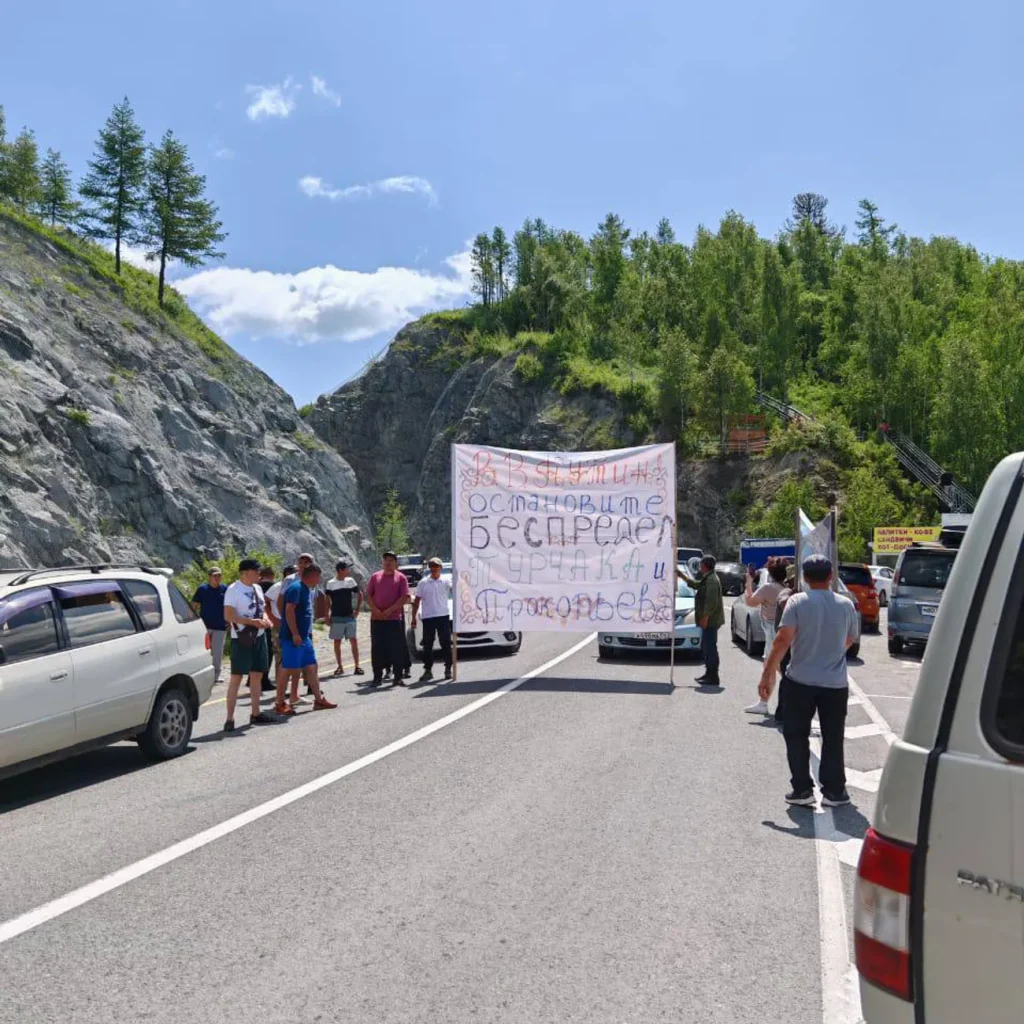
Police filed charges against eight residents of the Republic, whom they deemed to be the organizers of the unauthorized protest. Evgeny Tarbaev and Maxim Kukhaev were deemed the organizers of the rally and were charged under Part 3 of Article 20.2 of the Code of Administrative Offenses of the Russian Federation. Amada Yakshimaev, Ayas Didrukov, Gennady Taylonov, Mikhail Yeldoshev, Yuri Bochkin, and Radion Bashpakov were charged as participants in the unauthorized rally under Part 6.1 of Article 20.2 of the Code of Administrative Offenses of the Russian Federation. Administrative protocols were subsequently issued against eight of them, and Turchak labeled the protesters “provocateurs” who disturbed the “peace of spirits.”
https://meduza.io/news/2025/06/13/na-vosmeryh-zhiteley-altaya-sostavili-protokoly-iz-za-mitinga-na-trasse-protiv-reform-v-respublike-glava-regiona-turchak-nazval-ih-provokatorami-narushivshimi-pokoy-duhov
https://t.me/prokgorny04/11462
Over the next week, numerous solo pickets followed, and banners in support of the people of Altai were written by many truck drivers in the Republic.
https://t.me/activatica/52518
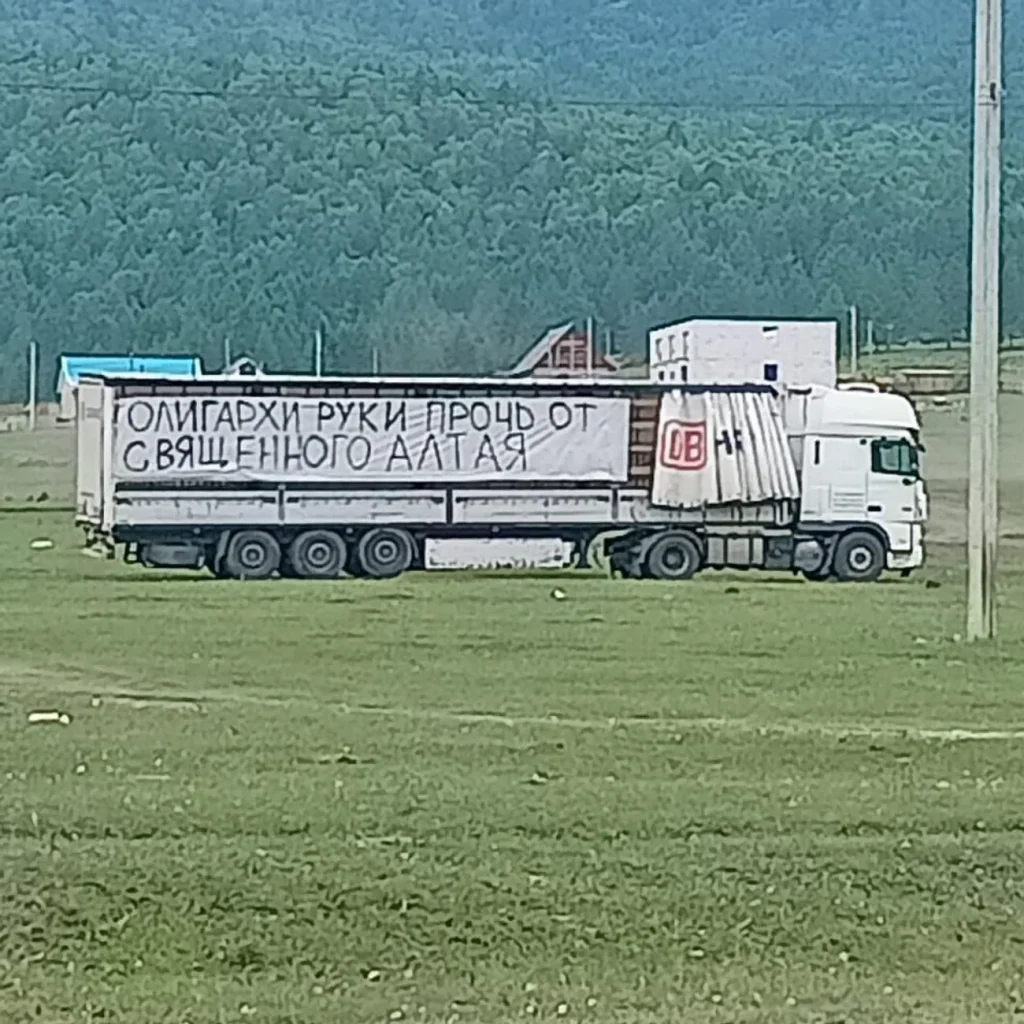
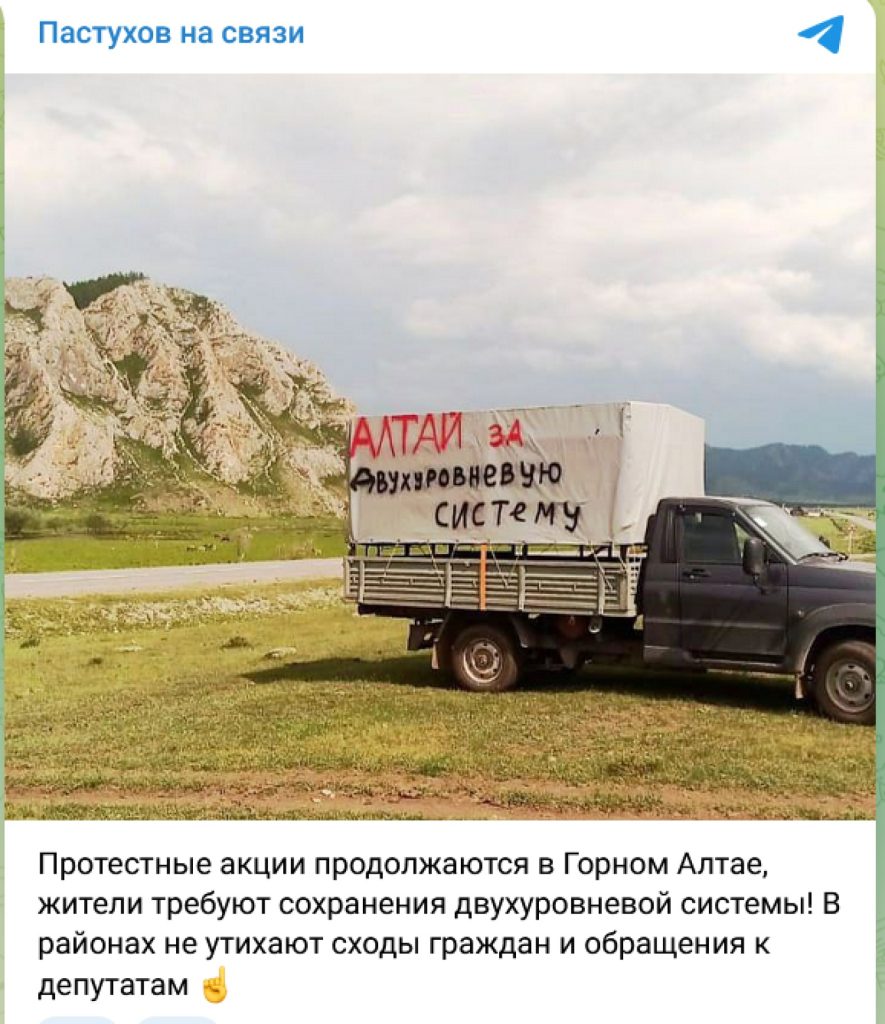
On June 21, a large rally was held, at which the Altai people once again voiced their will: to leave the two-tier system of self-government and village councils in the Altai Republic alone. According to media estimates, approximately 4,000 people participated in the rally.
https://t.me/PastuhovGA/818
A decision against the will of the Altay people
On June 24, 2025, against the will of the people, the parliament of the Altai Republic adopted a bill introducing a single-tier system of local self-government in the Republic, thereby eliminating village councils (and local councils of deputies). Even though just the day before, many members of parliament had approached protesting activists and publicly declared their opposition to such a reform. This discrepancy between their beliefs and the adopted decision may indicate pressure exerted by the central government to suppress dissent among parliamentarians.
https://www.kommersant.ru/doc/7833776
Prohibition of protests and persecution of activists
On July 11, the Gorno-Altaisk City Court, the capital of the Republic, ruled that the authorities’ ban on a mass protest against municipal reform planned for July 12 by local residents was legal. On the same day, July 11, with astonishing speed, an appeal was filed, also upholding the authorities’ decision. The authorities cited “emergency maintenance on the city’s power grid and acaricide treatment of the area” as the formal reason for the ban. However, in violation of the law, they failed to offer an alternative time or location for the protest. At the same time, pressure began to be exerted on activists opposing the abolition of self-government.
In July, three local residents of Altai were charged under Article 20.2 (unauthorized rally) for recording a video message to the head of the Republic, Turchak, asking him to preserve village councils in the region.
https://t.me/horizontal_russia/47703
https://t.me/horizontal_russia/47916
Also on July 10, a report was drawn up against activist and one of the protest leaders, Aruna Arna, under Article 13.15, Part 10, for “abuse (misuse) of the media”:
https://t.me/aruna_altayleader/5551
Also in the Ongudai district, district council deputy Arzhan Achimov was demanded to fire from his job (he works for the budget organization “Ongudai Forest”) for protesting the liquidation of village councils.
Recommendations to the Altay authorities
To suspend reform implementation until public consultations with communities in all rural and regional districts, as well as with representatives of indigenous peoples, are completed.
To organize an independent review of the draft law, particularly in terms of its constitutionality and the legal and social heritage of the Altay people.
To guarantee the ability of local residents to challenge government decisions through the courts or through oversight bodies in cases of violation of their rights to self-government.
To provide legal and material support to activists and participants in peaceful protests who have been subjected to administrative prosecution.
To make public information review: publish the texts of laws, explain the changes, and present alternatives for possible reductions to the two-tier system.
To monitor the protection of protesters’ rights, protect freedom of assembly, and counteract unreasonable repression and sanctions.