
Monthly Report on Human Rights Violations in the Republic of Mari El and Mari people
March 2026
Prepared by: Liza (the name is pseudonymized for safety reasons)
Executive Summary
The human rights situation in the Republic of Mari El in March 2026 reflects continued systemic shortcomings in public administration, transparency, and protection of fundamental rights. Reported cases indicate concerns regarding potentially misleading public communication in military recruitment, as well as ongoing restrictions on freedom of expression, including administrative prosecution for engagement with independent media.
At the same time, persistent failures in municipal governance are evident in the rising number of injuries and fatalities linked to inadequate snow removal and infrastructure maintenance. Additionally, the death of a young serviceman highlights broader concerns related to recruitment practices and the voluntariness of military service.
Across all documented cases, common patterns include lack of transparency, weak accountability mechanisms, and insufficient safeguards for both civic freedoms and public safety. These trends continue to undermine public trust in institutions and limit effective protection of basic human rights.
Methodology
The findings presented in this report are based on open-source monitoring of regional media, social media publications, and statements from local residents. Where possible, multiple sources and contextual legal frameworks are used to assess potential human rights implications. The report does not claim to be exhaustive and focuses on three incidents illustrating broader systemic patterns of administrative overreach, environmental and land-use violations, and municipal service failure.
Findings
Case 1: Potentially Misleading Military Recruitment Advertising and Lack of Transparency
In March 2026, a public concern was raised by a local legal professional regarding a military recruitment advertisement displayed inside a public bus in Yoshkar-Ola1. The advertisement promoted contract-based military service in unmanned systems units and highlighted significant financial incentives, including payments of over 5 million RUB during the first year of service and a one-time bonus of 2.5 million RUB.
The advertisement also listed additional benefits, including debt relief, increased salary coefficients, and the “guaranteed termination of contract upon its completion.”
The claim regarding “guaranteed termination” was publicly questioned, as it may contradict existing legal provisions under Presidential Decree No. 647, which provides for the extension of military personnel’s contracts for the period of mobilization or until the end of active military operations. This raises concerns about the accuracy and completeness of the information provided to potential recruits.
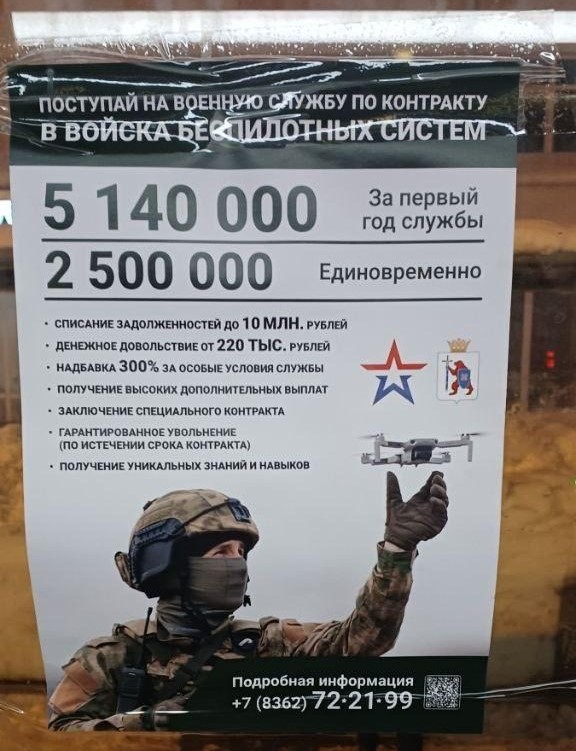
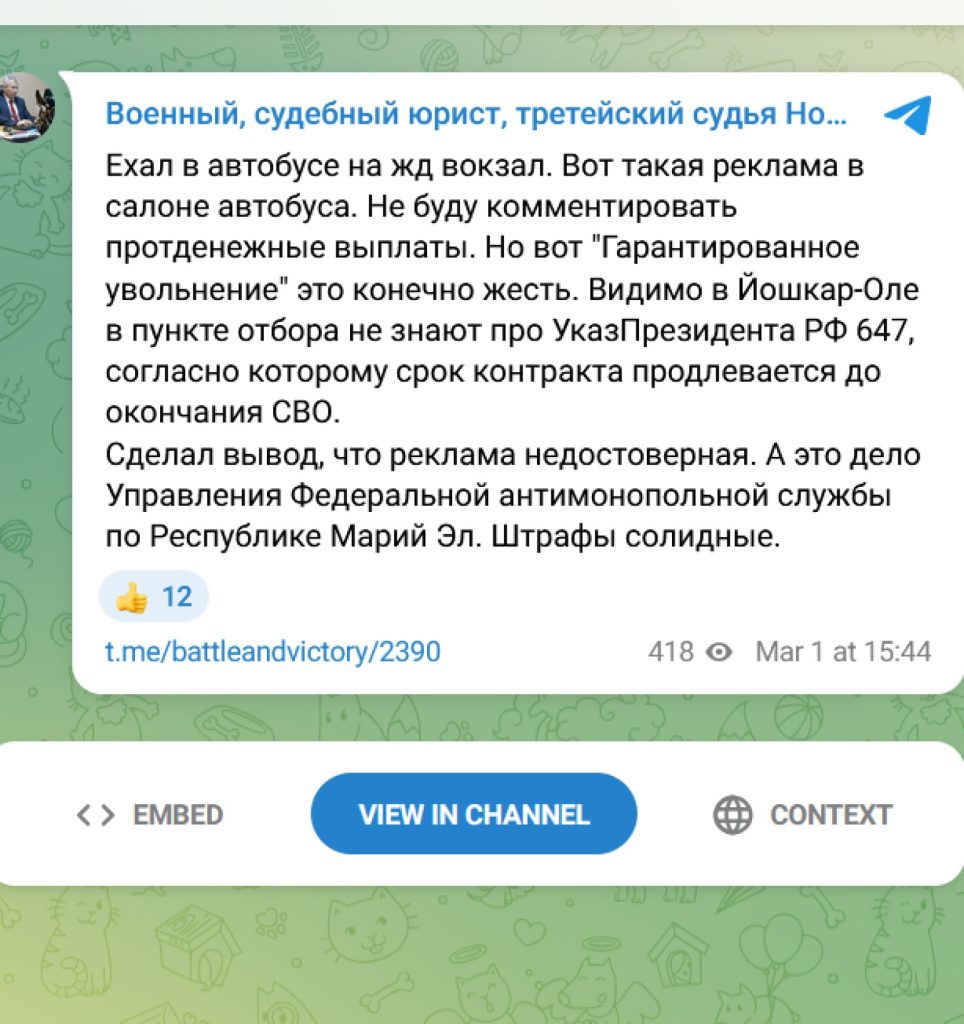
The issue was highlighted as potentially falling under the jurisdiction of the regional Federal Antimonopoly Service (FAS), which is responsible for overseeing compliance with advertising regulations, including misleading or deceptive claims.
The placement of such advertisements in public transportation suggests broad exposure to the general population, including potentially vulnerable individuals.
https://t.me/battleandvictory/2390
Human Rights and Governance Concerns:
– Potential dissemination of misleading or incomplete information in military recruitment advertising;
– Lack of transparency regarding actual terms and conditions of military service;
– Risk of manipulation of economically vulnerable individuals through emphasis on financial incentives;
– Limited access to accurate legal information necessary for informed decision-making;
– Concerns regarding state accountability in public communication practices.
Relevant Legal and International Standards:
– Article 19 ICCPR – Right to access information;
– UN Guiding Principles on Business and Human Rights;
– Right to informed consent and transparency;
– Article 37 Constitution of the Russian Federation;
– Freedom of labor and choice of occupation;
– Federal Law on Advertising;
– Prohibition of misleading advertising.
Case 2: Administrative Prosecution for Interview with “Undesirable Organization”
In March 2026, it was reported that the regional office of the Ministry of Justice in the Republic of Mari El initiated administrative proceedings against former Yoshkar-Ola City Assembly deputy Anton Sokolov, who is currently residing in Germany2.
According to available information, on 11 March 2026 the authorities notified Sokolov via email of an administrative protocol for alleged cooperation with an “undesirable organization.” The charges are reportedly linked to his participation in an interview given on 5 February 2026 to the television channel “Dozhd,” which has been designated as an “undesirable organization” in the Russian Federation. Sokolov publicly stated that he does not intend to pay any imposed fine, emphasizing that the charges stem from what he describes as a standard journalistic interview.
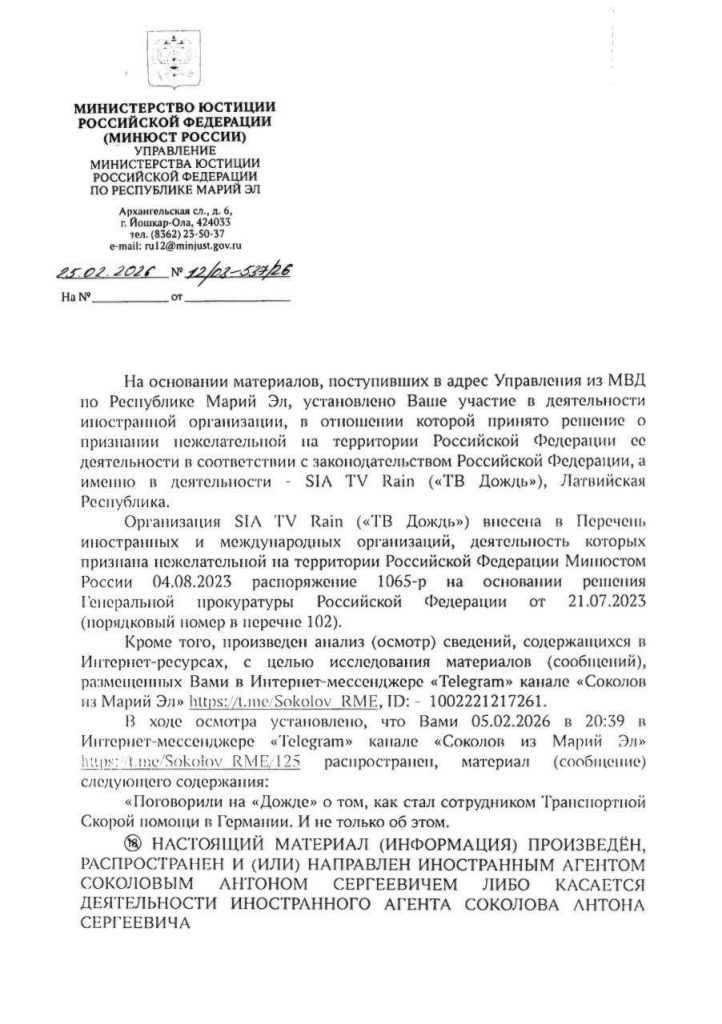
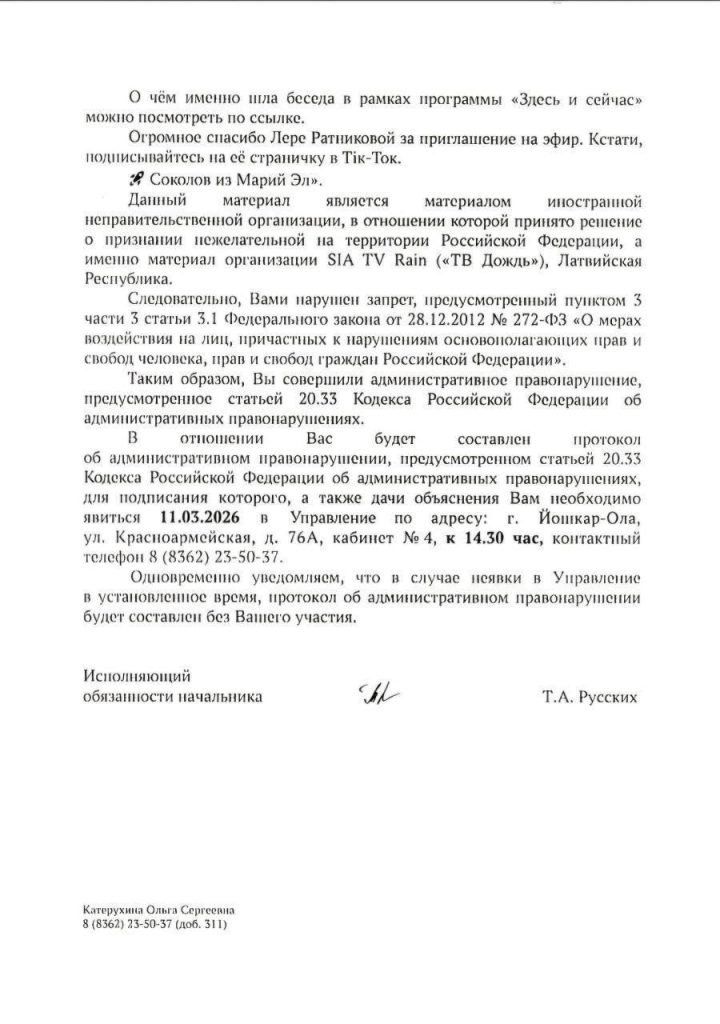
The case reflects a broader pattern of enforcement of legislation on “undesirable organizations,” which extends liability to individuals for communication, including media appearances, with entities designated under this framework.
https://t.me/I_want_to_understand/33003
Human Rights and Environmental Concerns:
– Restriction of freedom of expression, including participation in media interviews;
– Expansion of liability for interaction with designated organizations, including indirect or journalistic engagement;
– Disproportionate application of administrative penalties for non-violent forms of expression;
– Extraterritorial implications, as proceedings target an individual residing abroad;
– Chilling effect on public discourse and engagement with independent media.
Relevant Legal and International Standards
– Article 19 ICCPR – Freedom of expression;
– Article 10 ECHR – Freedom of expression, including the right to impart information;
– Article 29 Constitution of the Russian Federation – Freedom of thought and speech;
– UN Human Rights Committee General Comment No. 34 – Protection of political expression and media engagement.
Case 3. Fatal Incident and Rising Injuries Linked to Snow Removal Practices
In early March 2026, local sources reported a fatal incident in the settlement of Kujar (Republic of Mari El), where a 61-year-old man died after a mass of snow collapsed from a roof, completely burying him. Emergency services recovered the body and transferred it to law enforcement authorities. This incident occurred against the backdrop of a broader increase in accidents related to snow accumulation and roof clearing practices across the region. According to available reports, during the last week of February and the first days of March, more than 30 individuals sustained serious injuries in similar incidents, and at least five fatalities were recorded.
The frequency and severity of such incidents raise concerns regarding the adequacy of preventive measures, enforcement of safety regulations, and the responsibility of municipal services and property management entities for timely snow removal.
https://t.me/marireporter/4876
Human Rights Concerns:
– Threats to the right to life due to preventable infrastructure-related hazards;
– Failure to ensure safe public and residential environments;
– Inadequate regulation and oversight of snow removal and roof maintenance practices;
– Lack of timely municipal response to seasonal risks;
– Insufficient public safety measures and awareness.
Relevant Legal and International Standards
– Article 6 ICCPR – Right to life;
– Article 11 ICESCR – Right to adequate housing and safe living conditions;
– Article 2 Constitution of the Russian Federation – Obligation of the state to protect human life and safety;
– International guidelines on occupational and public safety standards.
Case 4: Death of a Young Contract Soldier and Concerns Over Possible
Coercion into Military Service
In March 2026, local sources reported the death of 21-year-old Savva Zinoviev, a native of the Republic of Mari El. According to publicly available information, he died on 10 February 2026 while carrying out combat-related tasks in the context of the armed conflict in Ukraine4. Zinoviev had completed secondary education in 2020 and later enrolled in a vocational training institution. In 2023, he was conscripted for mandatory military service and served in a motorized rifle unit in Ussuriysk (Primorsky Krai). In 2024, he signed a contract with the Armed Forces of the Russian Federation and was subsequently deployed to the Zaporizhzhia region.
While official and community sources describe his service in positive and commemorative terms, the case raises broader concerns in light of publicly reported allegations regarding practices in certain military units, including in Ussuriysk, where conscripts have allegedly been pressured to sign contracts for continued service and deployment.
Given the young age of the individual and the transition from conscription to contract service within a relatively short period, questions arise as to whether the decision to enter contract service was fully voluntary and informed.
https://vk.ru/wall-225991763_2020
Human Rights Concerns:
– Potential coercion or undue pressure on conscripts to transition into contract military service;
– Risks to the right to life in the context of armed conflict;
– Lack of transparency regarding recruitment and contract-signing practices within military units;
– Possible exploitation of young individuals with limited access to independent legal advice;
– Broader concerns regarding voluntariness of military service in practice.
Relevant Legal and International Standards:
– Article 6 ICCPR – Right to life;
– Article 8 ICCPR – Prohibition of forced or compulsory labor (relevant to coercion concerns);
– Article 37 Constitution of the Russian Federation – Freedom of labor;
– International humanitarian law – Protection of individuals in armed conflict.
Recommendations
Based on the documented developments in March 2026, the following measures are recommended:
1. Ensure Transparency in Public Communication and Recruitment Practices: Authorities should guarantee that all public advertising, particularly related to military service, provides accurate, complete, and verifiable information. Independent oversight mechanisms should be strengthened to prevent misleading claims.
2. Protect Freedom of Expression and Media Engagement:
Review and revise the application of legislation on “undesirable organizations” to ensure that individuals are not penalized for non-violent expression, including participation in interviews and journalistic activities.
3. Strengthen Public Safety and Municipal Accountability:
Implement effective monitoring and enforcement of building maintenance and snow removal regulations. Ensure timely risk mitigation measures to prevent injuries and fatalities associated with falling snow and ice.
4. Ensure Voluntary Nature of Military Service Contracts:
Establish safeguards to guarantee that conscripts are not subjected to coercion or undue pressure when signing military contracts. Provide access to independent legal consultation and transparent information about service conditions.
5. Improve Access to Information and Public Oversight:
Enhance mechanisms for public scrutiny of government actions, including access to legal information, complaint procedures, and protection for individuals raising concerns.
6. Strengthen Protection of the Right to Life and Safe Living Conditions: Prioritize preventive measures in public infrastructure management and ensure accountability for failures that result in harm to individuals