
Monthly Report on Human Rights Violations in the Republic of Karelia, Russian Federation
April 2026
Researched and prepared by: Jana Tiihonen (Bystrova)
Developments in the Republic of Karelia during April 2026 continued to raise concerns regarding the implementation of civil, political, economic, social, and environmental rights. Reported developments during the month pointed to the continued use of legal and administrative mechanisms against opposition political representatives, alongside persistent failures to address long-standing problems affecting access to clean water, safe housing, environmental protection, and basic infrastructure. Taken together, these developments suggest that the situation in Karelia reflects not only isolated administrative shortcomings, but a broader pattern of structural neglect and restrictive governance affecting the equal enjoyment of human rights in the region.
Suppression of Political self-determination
On 21 April 2026, Emilia Slabunova, a member of the Legislative Assembly of the Republic of Karelia, was detained near her home and later fined 1,000 rubles by the Petroskoi (Petrozavodsk) City Court under Article 20.3 of the Russian Code of Administrative Offences, concerning the alleged “display of extremist symbols”. The case was reportedly based on screenshots of a Telegram post allegedly published on 20 August 2020 on Emilia Slabunova’s official Telegram channel, although her channel does not contain any posts on that date.
The complaint was filed by Ivan Poteryaev, a member of the “Russkaya Obshchina” (Russian Community), a far-right Russian nationalist organisation. This is not the first time that members of Russkaya Obshchina have targeted political representatives of the “Yabloko” party in Karelia. The group was also involved the intimidation and disruption campaign during the annual memorial ceremony in Sandarmokh on 5 August 2025, where Emilia Slabunova, alongside other members of the Karelian Yabloko faction.
The proceedings against Emilia Slabunova appear to fit a broader pattern of efforts to restrict Yabloko’s participation in elections in Karelia. Since the 2025 regional elections, Karelian representatives of the Yabloko party have faced mounting pressure, including through legal and administrative proceedings that appear designed to obstruct their participation in future elections. The most notable cases were the removal of Yabloko candidates in Karelia from the municipal elections of September 2025 for alleged copyright violations on their promotional video and the disproportionate rejection of Yabloko nominees to Territorial Election Commissions, despite their meeting the necessary qualifications.
The case of Emilia Slabunova, therefore, has significance beyond the 1,000-ruble fine. A conviction under Article 20.3 may prevent a person from standing for election, turning a minor administrative penalty into a tool of political exclusion. Against the backdrop of the overall targeting of Yabloko representatives in Karelia, the prosecution of Emilia Slabunova can be understood as part of a wider attempt to weaken independent political representation in Karelia ahead of the 2026 State Duma and regional legislative elections.
The timing of the detention is notable in light of Emilia Slabunova’s recent public criticism of regional governance in Karelia during a session of the Legislative Assembly of the Republic of Karelia. Shortly before the case was initiated, she criticised the Head of Karelia, Artur Parfenchikov and the regional authorities over a range of social, economic, and environmental problems, including inadequate access to clean water and food, poor infrastructure, and quarry-related issues. She also highlighted low wages for teachers and workers of the cultural and sports sectors. Referring to official and public indicators, Slabunova noted Karelia’s low ranking in quality of life, the consequences of which include high levels of alcohol consumption, antidepressant use, and serious environmental problems. Against this background, the proceedings against her appear connected to a broader pattern of pressure on opposition politicians who publicly challenge regional policy and advocate for local residents’ interests.
The case raises serious concerns under Articles 14 and 25 of the ICCPR. Under Article 14, the proceedings raise fair-trial concerns, particularly because the case reportedly relied on a screenshot of a non-existent Telegram post, while the court refused the defence’s request for expert verification of its authenticity. Under Article 25, any administrative conviction that restricts Slabunova’s eligibility to stand election may interfere not only with her individual right to be elected, but also with the right of voters of Karelia to take part in public affairs.
Sources:
- https://www.yabloko.ru/regnews/Karelia/2026/04/21
- https://ombudsman.media/report-september-2025-karelia/
- https://ombudsman.media/report-december-2025-karelia/
- https://t.me/Slabunova/5587
Water Pollution
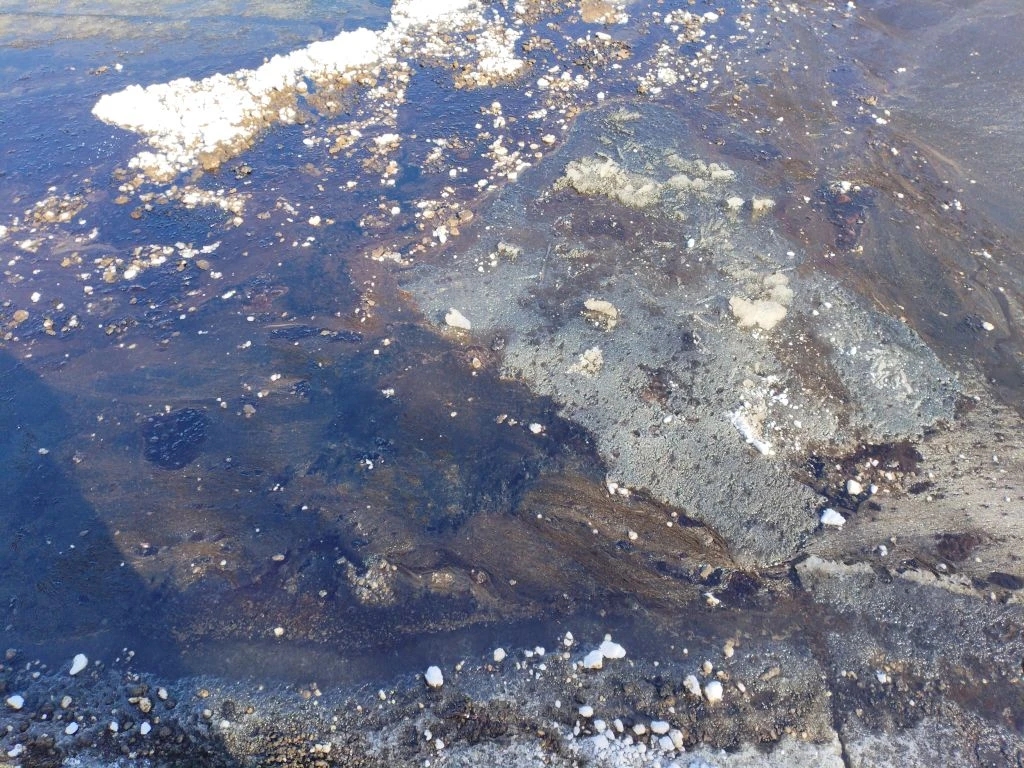
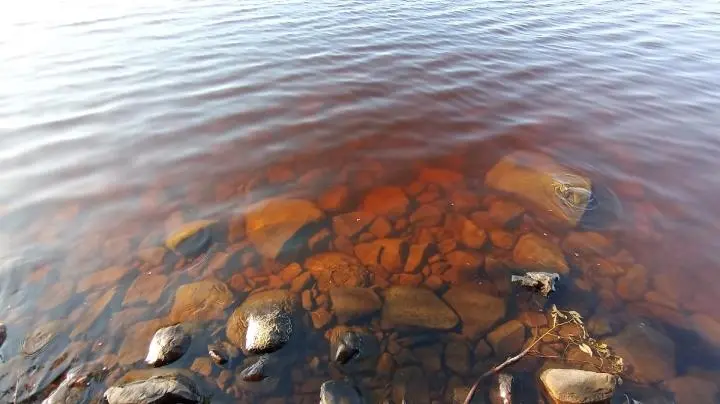
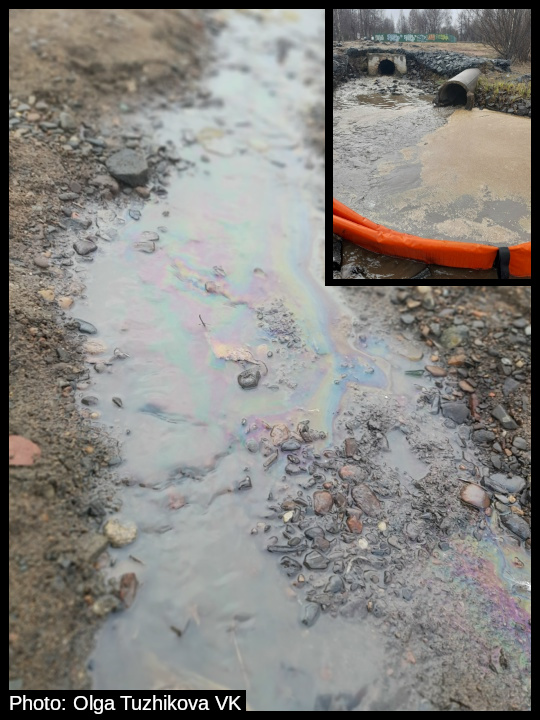
On 5 April 2026, the city council deputy Olga Tuzhikova reported cloudy water contaminated with fuel-oil flowing from a pipe into Lake Onega, near the Shayba beach on Monskovskaya Street. According to her description the water had an oily rainbow film, dark-brown flakes, and a heavy persistent smell. The pollution area was approximately 200-250 m2. Drawing on her environmental expertise and experience at an oil-depot laboratory, she identified the discharge as industrial rather than ordinary road runoff. An official complaint was filed with the prosecutor’s office regarding the issue.
The city’s response raises serious concerns. According to media reports, boom barriers and sorbent were installed only on 8 April, three days after the pollution was publicly reported. Officials described the measures as “preventative”, despite the already documented contamination. The main concern however, is that this is not the first time oil contamination has been reported in the location. Complaints of contamination near Moskovskaya Street have periodically been submitted to supervisory authorities, with reported incidents dating back to 2013, demonstrating the longevity of the problem. A more recent media report from February 2026, which stated that MKU “Sluzhba Zakazchika”, the municipal body under the Petroskoi (Petrozavodsk) city administration responsible for maintaining parts of the city’s infrastructure, including stormwater drainage systems, was requested by Rosprirodnadzor to compensate for the 2.2 million rubles in ecological damage caused to the lake, indicates that the authorities of the city were aware of the existing pollution problem, yet took no proper action to address it.
Taken together, the evidence points to systemic neglect by the city’s authorities in providing a sustainable and long-term solution to the water pollution near Moskovskaya street. Besides the cumulative and long-lasting environmental damage done to the area, the situation created health risks for local residents. As per Tuzhikova’s expertise, the oil discharge found in the area may contain hazardous substances, including PAHs such as benzo[a]pyrene, a recognized human carcinogen. In a public area, especially one used by winter swimmers, this should have prompted an immediate precautionary response such as a public warning and temporary restrictions on access to the area, until testing of the water and the air near the discharge point could properly assess the levels of health hazards. However, such measures were not only not taken, but reportedly the construction of recreational facility was approved near the area of the spill, a decision that risks sending the message that the city is normalising the site before resolving the pollution.
In this setting, the improper management of the long-standing water pollution may be in breach of the provision of Article 12 of the ICESCR, as evidence suggests that necessary steps were not taken to “prevent threats from unsafe and toxic water conditions”, as stated in the UN Committee on CESCR General Comment No. 15, “Right to water”, paragraph 8.
At approximately the same time, another oil spill was spotted in Lake Vygozero, Segezha District. Late in the evening of 3 April, an oil-slick was detected at Vygozero Bay, which was later confirmed to be tall-oil spill from the Segezha Pulp and Paper Mill Factory. The spill entered the water through the strormwater drainage system, due to a leak from a pipeline on the mill’s territory. The oil slick was contained the same day with boom barriers and treated with sorbent. Additionally, water samples were taken from the area by the Pulp and Paper Mill’s production laboratory and the Center for Laboratory Analysis and Technical Measurements (TsLATI) for environmental damage assessment. On 17 April, the regional Ministry of Natural Resources reported that the spill had been liquidated and that no traces of oil were found in the bay.
However, even though the tall-oil spill was contained and reportedly liquidated, to date there have not been any publicly available records of the lab results from TsLATI. Public records only show the cleanup conclusion and mill-lab reassurances. There is no published independent regulator report with sampling data, measured concentrations, damage calculations, or any enforcement decision related to the specific spill.
A public enforcement decision is crucial in the Vygozero case as emergency cleanup alone does not establish accountability. Boom barriers and sorbent may remove visible slick, but they do not answer the spill violated environmental requirements, whether the body of water suffered compensable damage, whether the factory’s infrastructure failed to meet safety or pollution-prevention obligations, or whether measures were ordered to prevent recurrence. Under Article 55 of the Water Code of the Russian Federation, it is not only required to eliminate the consequences of pollution, but take measures to protect water bodies and prevent pollution. Therefore, the absence of a publicly available Rosprirodnadzor or TsLATI conclusion leaves a major transparency gap. Without a public enforcement decision, the case remains unresolved from an accountability perspective.
Public transparency is especially important in the Vygozero case, as this is not the first incident of the Segezha Pulp and Paper Mill factory’s negative environmental impact. In 2019, Rosprirodnadzor inspection identified numerous violations. In 2020, local residents reported foul odour in the area, ginger snow, and bird deaths, indicating systemic environmental risks potentially linked to the factory’s operations. The current tall-oil spill raises renewed questions about whether those systemic environmental risks have been fully addressed.
While available information may not be sufficient to establish a direct violation of international norms, the repeated environmental disturbances associated with the Segezha Pulp and Paper Mill factory raise concerns under Articles 11 and 12 of the ICESCR. In particular, the apparent gaps in preventative oversight, which can potentially impact local residents’ health, may call into question whether authorities are taking adequate steps to protect the populations’ right to the highest attainable standard of physical health and the right to clean water.
Sources:
- https://vk.com/wall-209605780_1711
- https://ptzgovorit.ru/news/posle-zhalob-na-radugu-v-vode-na-plyazhe-postavili-bonovye-zagrazhdeniya
- https://karel.mk.ru/social/2026/04/23/v-petrozavodske-ochistyat-zagryaznennoe-nefteproduktami-ozero-i-plyazh.html
- https://rpn.gov.ru/press/news/rosprirodnadzor_dobivaetsya_vozmeshcheniya_vreda_prichinennogo_onezhskomu_ozeru/
- https://mustoi.ru/chyornoe-pyatno-na-ozere/
- https://start.sampo.ru/news/stolica/1306711736
- https://sampotv360.ru/2026/04/17/razliv-tallovogo-masla-v-zalive-vygozera-likvidirovan
- https://greenfond.ru/post/v-karelii-lokalizovan-razliv-tallovogo-masla-v-vyigozere-posle-avarii-na-segejskom-tsbk
Socio-Economic issues
During the annual report of the Head of the Republic of Karelia, Artur Parfenchikov, to the Legislative Assembly of the Republic of Karelia, held on 16 April 2016 in Petroskoi, it was revealed that only 56.7% of Karelia’s population has access to clean water. The settlements identified by the authorities as the most problematic are Segezha, Pudozh, Suoyarvi and Belomorsk. The report further indicates that solutions remain incomplete: in some municipalities, only project documentation exists; financing still needs to be secured; design work is ongoing; or authorities are still monitoring water quality in order to choose treatment technology.
Considering that issues with access to water in these areas have persisted for several years, the situation points to prolonged failure to adequately address the populations’ needs. Such conditions may indicate non-compliance by the State with Articles 11 and 12 of the ICESCR, particularly with regards to the rights to water and sanitation.
The same report acknowledges that Karelia has one of the highest ratios of unsafe housing to total housing stock in the Russian Federation. It states, that the authorities identified housing rights concerns of 62,000 residents living in unsafe housing conditions, corresponding to approximately 11.6% of the total population of the Republic. While the report states that 963 families were resettled in 2025, it does not disclose the exact number of individuals rehoused. Even under a relatively generous estimate of three to four persons per family, this resettlement would cover only around 2,900-3,900 people, or approximately 0.5-0.7% of Karelia’s total population.
As with access to lean water, unsafe housing appears to be another long-standing problem in Karelia. Multiple reports from previous months have addressed this issue, providing information on the conditions in which many families are forced to live in. The duration and extent of the problem, raises additional concerns under Article 11 of the ICESCR, which recognizes the right of everyone to an adequate standard of living, including adequate housing, and the continuous improvement of living conditions.
Finally, the report refers to alleged ongoing efforts to develop and modernise Karelia’s rural settlements. However, available evidence from local communities suggest that these efforts have not adequately addressed the basic needs of residents. One such example is the situation in the Hiideselga village, Pitkaranta Disrtict, as described by Emilia Slabunova in posts on her official Telegram channel. The village has 1,019 residents, including children. The local school lacks proper bathroom facilities for the children and the teaching staff. The local kindergarten is located in an old building and is reportedly maintained largely through the efforts and support of the local residents. The village also lacks access to running tap water, and the local residents rely on four wells, that have not been properly maintained and often do not contain water, and on water that is brought into the village. Many residents live in unsafe houses, as the authorities have failed to provide adequate alternative housing options. The provisions for the development of Hiideselga village appear to focus primarily on the village’s tourism potential, while the basic needs of local residents remain insufficiently addressed.
Hiideselga Village is only one example among many rural villages and settlements that appear to have been neglected by the authorities, despite repeated efforts to draw attention to their problems. The continued failure of both the regional authorities of Karelia and federal authorities of the Russian Federation to adequately address these conditions raises additional concerns under Article 11 of the ICESCR and Article 27 of the Convention on the Rights of the Child (CRC).
Sources:
- https://gov10.ru/power/executive/leader/reports/
- https://ombudsman.media/report-december-2025-karelia/
- https://ombudsman.media/report-january-2026-karelia/
- https://ombudsman.media/report-february-2026-karelia/
- https://t.me/Slabunova/5515
- https://vk.com/wall-109838296_11410
- https://t.me/Slabunova/1654
Conclusion:
The cases documented in the Republic of Karelia in April 2026 indicate continued disregard for international human rights standards and for the protection of fundamental rights in the region. The pressure placed on independent political representatives, including Emilia Slabunova, is particularly concerning in this context. Her public criticism of regional authorities has focused precisely on the issues affecting the daily lives of Karelia’s residents, including access to clean water, unsafe housing, environmental degradation, poor infrastructure, and the neglect of settlements. Any attempt to remove or restrict such political figures from public life therefore has consequences beyond the individual case. It risks weakening the ability of local residents to have their concerns represented through political institutions and may further reduce public accountability for long-standing socio-economic problems.
Many of the issues presented in this report are not new, but reflect patterns that have continued over months and, in several cases, years. The repeated failure to address known environmental risks, unsafe housing conditions, inadequate water infrastructure, and the needs of the rural settlements suggest that the situation cannot be attributed solely to isolated incidents or short-term administrative failures. Rather, the developments documented during the month indicate a broader pattern of structural neglect by the authorities. Under such conditions, restrictions on independent political participation may deepen existing socio-economic vulnerability by limiting one of the few available channels through which affected residents can challenge official inaction and seek protection for their rights.
Researched and prepared by:
Jana Tiihonen (Bystrova)