
Report on Human Rights Violations in the Kabardino-Balkarian Republic
May 2026
Human Rights Defender Hava Beshtoeva
An analysis of open sources for May 2026, including media reports, online resources, and statements by private individuals, reveals a continuing trend of violations of human rights and fundamental freedoms by the authorities and security structures of the Kabardino-Balkarian Republic. These violations are primarily linked to actions aimed at erasing historical memory, politically motivated pressure on activists, the persecution of citizens for their public activities, infringements on religious rights in places of detention, repression and judicial falsification, as well as violations of the right to a fair trial. The documented incidents underscore the continued relevance of further efforts to protect human rights in the republic.
A resident of Nalchik has been accused of promoting terrorism and has been placed on the wanted list
Investigators in Kabardino-Balkaria have placed a Nalchik resident on the wanted list on suspicion of promoting terrorism over posts published in a messaging app.
The charge of public propaganda or justification of terrorism via the internet, under Part 2 of Article 205.2 of the Criminal Code of the Russian Federation, carries a sentence of five to seven years’ imprisonment.
According to investigators, in October 2025 a Nalchik resident, born in 1977, published unspecified materials in a channel on a messaging app. Security officials reportedly found in them “signs of justification and propaganda of terrorism, as well as a positive assessment of the activities of members of an international terrorist organisation,” the Investigative Committee’s department for Kabardino-Balkaria stated.
The agency did not specify which materials the suspect had published or which terrorist organisation they allegedly concerned. The man has not yet been detained. According to investigators, he has been placed on the wanted list, while the investigation and the collection of evidence are ongoing.
In the southern Russian Federation, local residents are regularly sentenced to actual prison terms for social media posts. For example, in April, a court in Rostov-on-Don sentenced Dagestani resident Ramazan Musaev after finding him guilty of calls to terrorism over posts that allegedly approved of the activities of Caucasus resistance forces. It is not possible to determine the actual number of such convictions, as not all cases involving the justification of terrorism appear in publicly accessible court databases.
https://www.kommersant.ru/doc/8670276
https://www.instagram.com/p/DYXvXD-SwEG
A resident of Kabardino-Balkaria has been fined for Telegram comments “discrediting the army.”
A court is Nalchik fined Kirill Kotlyarov 30,000 rubles after finding that his comments on Telegram “discredited the army.”
According to the court ruling, the defendant posted comments on Telegram “with the aim of discrediting the use of the armed forces.” As indicated in the case file on the website of the Nalchik City Court, the defendant was Kirill Kotlyatov. He was charged under Part 1 of Article 20.3.3 of the Code of Administrative Offenses of the Russian Federation, which provides for fines of 30,000 to 50,000 rubles for individuals.
“At the court hearing, FIO2 [the defendant] admitted guilt in committing the administrative offense and stated that he regretted his actions and would not commit any further violations. […] As a mitigating circumstance, the court took into account the admission of guilt and remorse for the offence committed. The court found no aggravating circumstances in the case,” says the anonymised copy of the court ruling published in the case file.
It should be noted that in March 2022, after the start of Russia’s operation in Ukraine, the Russian Criminal Code was supplemented with Article 207.3, which provides punishment for “false information” about the army of the Russian Federation.
The Code of Administrative Offences was also supplemented with Article 20.3.3, concerning the “discrediting of the armed forces.” For individuals, this article provides for fines ranging from 30,000 to 100,000 rubles, while a repeat violation within one year may lead to criminal prosecution.
Since then, residents of the Caucasus have regularly been prosecuted under these articles. For example, at the end of 2025, a court in Cherkessk sentenced lawyer and activist Ramazan Mkhtse in Absentia to eight years in a penal colony after finding him guilty of disseminating false information about Russian military personnel.
This article of the Criminal Code of the Russian Federation contradicts the Constitution, as well as fundamental principles of law: the wording of the article does not make it possible to determine in advance which statements are lawful and which are prohibited. A citizen cannot know in advance which of their statements, or what information, may be deemed false in a given context.
Notably, alongside male citizens, women form the North Caucasus and southern regions of the Russian Federation have increasingly been prosecuted in cases related to military censorship since the start of the full-scale invasion of Ukraine. The most common charges include “justification of terrorism”, “false information about the army”, and “discrediting the armed forces.”
Prosecution statistics show steady growth. While in 2022, 174 women became defendants in politically motivated cases, by 2024 this number had risen to 330, and in 2025 it stood at 322. In the first five months of 2026 alone, human rights defenders recorded more than 60 new cases. The regional dynamics also point to increasing pressure.
Memorial’s lists include 120 female political prisoners, while the total number of women persecuted on political grounds has reached 523. The charges most often brought against them concern treason, “false information about the army”, justification of terrorism”, and participation in activities of “extremist” organisation. Memorial’s information is corroborated by data from the human rights project OVD-Info. At the same time, in the national republics of the North Caucasus, the most common charge remains participation in the activities of an “extremist organisation”. Karachay-Cherkessia recorded the highest number of such cases, with human rights defenders documenting 14 cases there. It was followed by Stavropol Krai, with seven cases, Dagestan with six, and Kabardino-Balkaria with fine.
One of the most recent high-profile cases was the sentence against Dagestan resident Aisha Navruzbekova, which entered into force in February 2026. She was found guilty of “justifying terrorism” over a Telegram post. The court fined Navruzbekova 360,000 rubles and banned her from administering online resources.
In Kabardino-Balkaria, even private correspondence has served as grounds for prosecution. In 2025, a local resident, whose name has not been disclosed, was fined for “discrediting” the army over a video sent via WhatsApp. Earlier, Rameta Lakunova was held liable in the republic for anti-war statements made in a parents’ chat. Another convicted woman, Zukhra Malukhova, was fined 15,000 rubles for an Instagram comment: “There are a great many bodies there. It is not in the state’s interest to retrieve them, so as not to pay compensation.”
In the southern Russian Federation, one of the harshest sentences was handed down to 38-year-old Krasnodar resident Svetlana Denisenko, who was sentenced to 13 years in a penal colony on charges of treason. According to investigators, she transferred 100,000 rubles for the needs of the Armed Forces of Ukraine.
In Stavropol Krai, Anna Vorobyova was sentenced to six years’ imprisonment. The “false information” case was opened over posts on VKontakte about strikes on residential neighbourhoods and the killings of residents in Bucha; a court of the Russian Federation declared this information to be “false”.
A teenager was arrested in Nalchik for possession of a grenade
Rosgvardia special forces seized a live grenade from a teenager in Nalchik. According to the press service of the agency’s department for Kabardino-Balkaria, the munition had been illegally stored in a residential building.
The grenade was discovered by officers of the Ministry of Internal Affairs and the FSB, while the seizure itself was carried out jointly with officers of the OMON “Vershina” unit.
“An expert examination established that the seized item was a ready-to-use F-1 hand fragmentation grenade, which, according to preliminary information, had been illegally stored by a 17-year-old teenager,” the agency’s press service stated.
A criminal case was opened over the illegal acquisition, transportation, and storage of an explosive device.
It later emerged that the detainee was Tamir Akimenko, a 16-year-old student at an agricultural university in Nalchik. After he had spent more than half a month in custody, the defence succeeded in securing the ruling from the Supreme Court of Kabardino-Balkaria ordering his release. The defence argues that the investigator questioned the minor without his legal representatives present, and that the materials submitted to the court do not in any way substantiate his possible guilt: Akimenko’s fingerprints were not even found on the explosive device.
An investigator from the local department of the Investigative Committee allegedly seized the grenade from the student on April 23; the details of the arrest are unknown. On April 24, a criminal case was opened against Akimenko over the illegal storage an explosives, and the following day the Nalchik City Court ordered his arrest.
At the same time, an assistant prosecutor in Nalchik asked the court to uphold the arrest, but the prosecution did not provide a single argument in support of this request.
In the Caucasus, minors are increasingly being accused of crimes against the state and society. Law enforcement agencies and security services report such cases, often adding that the detainees allegedly acted “on instructions from curators from Ukraine”, while providing no evidence.
https://tass.ru/proisshestviya/27407551
https://vs–kbr.sudrf.ru/modules.php?name=sud_delo&srv_num=1&name_op=case&case_id=34031755&case_uid=8cb35993-ba72-40b5-983a-6934183de87c&delo_id=4&new=4
The Deputy Prosecutor General has filed a cassation appeal against the second acquittal of lawyer Diana Tsipinova
Tsipinova’s defence criticised the new request to review the case, arguing that the Prosecutor’s Office is challenging facts already established by the courts, which falls outside the scope of cassation review.
Earlier, on February 20, the Supreme Court of the Kabardino-Balkaria refused to grant the prosecution’s request to review the case of Diana Tsipinova, who had been accused of assaulting a security officer, and upheld the second acquittal.
The incident took place in May 2020. Diana Tsipinova was among three lawyers who volunteered to provide legal assistance to their colleague Ratmir Zhilokov after he was detained in Nartkala. They arrived at the police department and for 40 minutes were unable to secure access to Zhilokov. Security officers objected to the lawyers filming and forcibly removed them from the building.
The use of force against lawyers in Kabardino-Balkaria and their subsequent criminal prosecution are regarded by the professional community as an extraordinary situation, although not an isolated case. Violations of the right to legal defence pose a potential threat to every citizen.
According to lawyer Suren Natanov, the case contains no evidence that the police officer who prevented Tsipinova from entering the police department was acting lawfully: he did not identify himself, did not explain her rights to her, and pushed her out of the premises “using unjustified force”.
According to the defence’s objections, the court correctly established that Diana Tsipinova struck police officer Timure Nagoev in response to his unlawful actions, while affected by her unjustified detention and unaware of his official status at the time of the conflict.
In May 2026, Deputy Prosecutor General Igor Tkachyov filed a cassation submission with the Fifth Cassation Court against Diana Tsipinova’s acquittal.
The cassation court had already sided with the prosecution in Tsipinova’s case. On July 7, 2023, the Urnansky District Court, which considered the case for the first time, found no elements of a crime in Tsipinova’s actions and acquitted her. The Supreme Court of Kabardino-Balkaria upheld the verdict, but the cassation court in Pyatigorsk granted the prosecution’s request and returned the case for a new trial. The cassation ruling had a clearly accusatory orientation; the court exceeded its powers by assessing the evidence and its credibility.
On December 1, 2025, the Urvansky District Court, having reconsidered the case, again acquitted Tsipinova. The prosecution had sought a sentence of two and a half years in a settlement colony.
The Prosecutor’s Office also challenged the second acquittal, demanding that the case be returned for a new trial. The appellate instance, the Supreme Court of Kabardino-Balkaria, reviewed video footage from the scene of the incident at the Ministry of Internal Affairs department and again upheld the acquittal.
Tsipinova’s case has become an example of the prosecution’s abuse of the right to appeal. Unlike the defence, the prosecution can initiate repeated cycles of review until a conviction is obtained or procedural options are exhausted, and this imbalance is being used by the Prosecutor’s Office in Tsipinova’s case. The prosecutor is attempting the impossible: the reinterpret the factual circumstances of the case at the cassation stage.
Andzor Khalilov’s case has been referred to the Nalchik City Court. He has complained about the lack of medical care and conditions in the pre-trial detention centre
The case against developer Andzor Khalilov, who is accused of unlawfully attracting citizens’ funds, has been sent to court separately from the charge of financing terrorism. Khalilov’s lawyer described his prosecution as “legal absurdity”, while Khalilov himself complained about conditions in the detention facility.
The case against Kabardino-Balkarian developer Andzor Khalilov, who was arrested after being deported from the UAE to Russia, is based on testimony by a witness named Kardanov, whom Khalilov himself describes as fictitious. Another defendant in the case concerning the collection of money for militants also denies the charges. At a hearing before the Supreme Court of Kabardino-Balkaria, Khalilov stated that he “had not been hiding or fleeing.” The defence believes that the case under the article on financing terrorism should be terminated.
The case concerning the unlawful attraction of citizens’ funds for construction, opened against Andzor Khalilov, has been submitted for consideration to the Nalchik City Court. According to information on the court’s website, the case has been assigned to Judge Fatime Dumanova. Khalilov is also accused of financing terrorism, but the two cases have not been joined into a single proceeding. Andzor Khalilov remains in custody in the Nalchik pre-trial detention centre.
During the most recent court hearing on the extension of his pre-trial detention, Khalilov stated that evidence of his innocence was “of no use to anyone.” He participated in the hearing by video link from the detention facility.
“It is in someone’s interest for me to remain here. Meanwhile, people cannot get their apartments, and thousands of people are panicking because of this. If I were free, I would finish the construction faster. But no one is thinking about either the people of justice,” he said.
According to Khalilov, everything on the pre-trial detention centre is being done to worsen his situation: he was twice placed in a disciplinary isolation cell, allegedly for certain violations, but when he asked what specific violations he had committed, he received no answer. Khalilov is ill, but he says he has not been given the medicines brought to him by his relatives; the detention facility itself has no medicines and medical care is not being provided.
“The whole republic is afraid of something; no one wants justice. You are Circassians, you are Caucasians, what are you afraid of? I am giving you all the evidence. I simply want to be treated fairly. I have never refused help to anyone who turned to me. All of this is happening simply because someone wanted something from me and I did not give it. And everyone is watching, staying silent, and supporting it,” he complained.
Khalilov’s lawyer, Vyacheslav Blazhko, called the situation involving Khalilov, whom the court left in custody, outrageous. “I do not know of another such case in legal practice: putting the same person in jail twice. He is detained in two different cases, these cases have not been joined, he whs two preventive measures, and he is supposed to remain in custody. This is a kind of legal absurdity,” the lawyer told the publication Caucasian Knot.
The second charge brought against Khalilov, financing terrorism, concerns a transfer to a certain Sabanchiev, whom security officials consider to be involved in terrorist activity. However, the money was sent as part of a public fundraiser for medical treatment for Sabanchiev’s relative, who had cancer. According to Khalilov, he has all the evidence proving his innocence and is also willing to undergo a polygraph examination.
https://t.me/The_Circassian_Times/14814
Akhmed Balkarov has been transferred out of the penal colony, and his family has been unable to contact him
Akhmed Balkarov, a native of Kabardino-Balkaria, whom the administration of a penal colony in Penza Oblast had planned to send to a psychiatric hospital more than 1,000 kilometres away, has “departed” from the facility, the administration told his mother.
Akhmed Balkarov has faced religiously motivated harassment in the penal colony and has repeatedly been subjected to disciplinary penalties, as a result of which he is almost never held in the residential unit. Balkarov’s relatives fear for his health and life, especially given that the authorities intend to send him to a psychiatric hospital more than 1,000 kilometres away, despite the absence of any diagnosed conditions. The Human Rights Center of Kabardino-Balkaria has appealed to Russia’s Prosecutor General in connection with numerous violations of Balkarov’s rights.
Earlier, on May 31, 2017, the North Caucasus District Military Court in Rostov-on-Don sentenced the defendants in the Kabardino-Balkaria “caliphate” case to lengthy prison terms. Oleg Mikhozhev, Akhmed Balkarov, Islam Shogenov, Ruslan Kipshiyev, Kantemir Zheldashev, Artur Karov, Zaur Tekushev, and Ruslan Zhugov received sentences ranging from 6 to 16 years’ imprisonment. Akhmed Balkarov was sentenced to 15 years in a penal colony. The Supreme Court of the Russian Federation upheld the verdict against the natives of Kabardino-Balkaria convicted in the case concerning an alleged attempt to establish a caliphate with an independent form of government in the republic.
Balkarov’s relatives are convinced that claims that he allegedly has a “mental illness” do not correspond to reality and are being used to exert pressure on him. According to them, Akhmed has already been transferred out of the penal colony in Penza Oblast, and his current whereabouts are unknown.
Balkarov’s lawyer visited the penal colony but was unable to obtain any documents.
Appeals to the Prosecutor General’s Office and the Presidential Administration have produced no results.
According to Zaur Shokuyev, a representative of the Human Rights Center of Kabardino-Balkaria, requests were sent to the Prosecutor General’s Office, the Federal Penitentiary Service, the Human Rights Commissioner, and the head of the republic. In addition, requests were sent to the regional human rights commissioner in Yaroslavl Oblast, where Balkarov had been transferred, asking that the convicted prisoner be visited, as well as to the chair of the Public Monitoring Commission. No responses followed.
Earlier, after reviewing an application submitted by Akhmed Balkarov’s mother, Arina Balkarova, the Human Rights Center of Kabardino-Balkaria, appealed to Russia’s Prosecutor General in connection with numerous and systemic violations of the rights of convicted prisoner Akhmed Balkarov.
According to human rights defenders, the facts set out in the letter indicate serious violations that contradict both the Constitution of the Russian Federation and penal enforcement legislation. In particular, the Russian Constitution guarantees everyone the right to freedom of conscience and religion. Any violation of these rights constitutes a grave infringement of constitutional guarantees. In addition, an urgent transfer without compliance with established procedures contradicts the procedure for moving convicted prisoners set out in regulatory legal acts of Russia’s Federal Penitentiary Service, and may indicate an attempt to evade oversight by public monitoring commissions and relatives.
Human rights defenders therefore asked federal and regional oversight bodies and authorities to conduct a comprehensive review of the reported violations of Balkarov’s rights, including discrimination on ethnic and religious grounds, the unjustified imposition of disciplinary penalties, and his placement in a disciplinary isolation cell. They also asked that Balkarov’s transfer to a psychiatric hospital in the city of Rybinsk be suspended pending completion of the review. In addition, they requested that the Human Rights Center of Kabardino-Balkaria be informed of the outcome of the appeal within the established time-frame.
Similar appeals were also sent to the chair of the Presidential Council for Civil Society and Human Rights; the Human Rights Commissioner of the Russian Federation; the head of the Kabardino-Balkarian Republic; the director of Russia’s Federal Penitentiary Service; the Human Rights Commisioner in Yaroslavl Oblast; and the chair of the Public Monitoring Commission of Yaroslavl Oblast.
Notably, Zalimkhan Tkhamokov, who died during the investigation in the “caliphate” case, and Ibragim Gugo, who was killed during his arrest, were also found guilty. Most of the defendants stated that they had given testimony to investigators under torture.
Ten Muslim prisoners declared a dry hunger strike in the Taganrog pre-trial detention centre in protest against harassment by the facility’s administration. In particular, their personal belongings were confiscated, they were denied outdoor walks, and they were refused phone calls. Ukrainian prisoners of war were also held in the same pre-trial detention centre and have reported torture-like conditions of detention.
Pressure in the Taganrog detention centre intensified after the facility came under FSB control. At the same time, violations often go unaddressed and are effectively ignored by oversight bodies.
https://www.svoboda.org/a/pozhalovavshegosya-na-pritesneniya-urozhentsa-kabardino-balkarii-vyvezli-iz-kolonii-semjya-ne-mozhet-s-nim-svyazatjsya/33750249.html
https://newdosh.media/news/podvergavsegosa-presledovaniam-na-religioznoj-pocve-urozenca-kbr-vyvezli-iz-kolonii?categoryAlias=
https://zapravakbr.ru/pravozashitnyi-centr-kbr-po-zhalobe-materi-osuzhdennogo-ahmeda-balkarova-napravil-zaprosy-v-federalnye-i-regionalnye-nadzornye-organy-i-instancii/
The person convicted of killing an elderly Nalchik resident avoided a sentence in a penal colony
A former participant in the hostilities in Ukraine, Rustam Nogmov, who was convicted of killing pensioner Nina Selezneva in Nalchik, signed a contract with the Ministry of Defence and was sent back to the front.
On January 30, 2025, while in a park area in Nalchik and under the influence of alcohol and drugs, Rustam Nogmov, without any apparent reason, repeatedly struck an unfamiliar 86-year-old woman with his hands and feet, causing multiple bodily injuries from which the victim died at the scene. He then desecrated the deceased woman’s body.
In late November 2025, the Supreme Court of Kabardino-Balkaria began hearing the criminal case against Nogmov, a 24-year-old Nalchik resident.
Rustam Nogmov fully admitted guilt in the killing of pensioner Nina Selezneva and, in his final statement, asked the court “not to punish him harshly.”
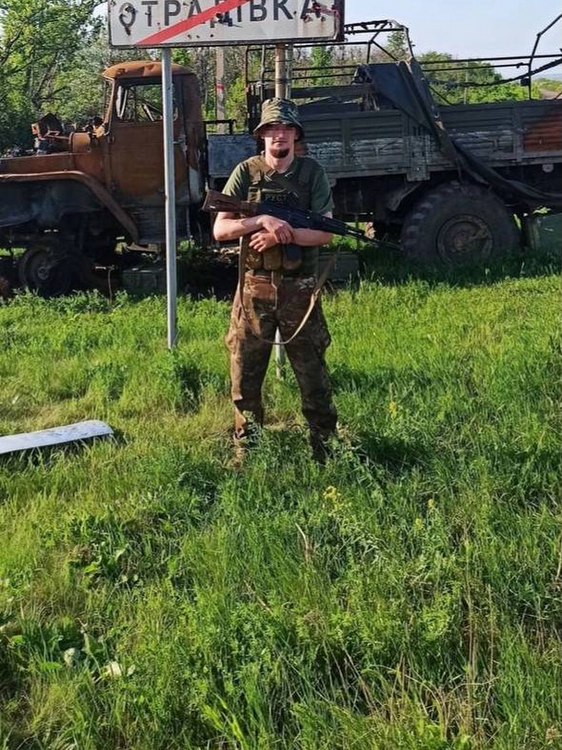
His lawyer urged the court not to take Nogmov’s awards into account in the case concerning the killing of the Nalchik pensioner. In February, the court sentenced Nogmov to 15 years’ imprisonment and ordered him to pay three million roubles in compensation for moral harm. Counsel for the victims at the time called the sentence fair.
However, Rustam Nogmov will not serve his sentence in a penal colony for the killing of Nina Selezneva, as he has signed a contract with the Ministry of Defence and gone to the zone of the special military operation.
In effect, Nogmov received no punishment, although after the high-profile crime, residents of Kabardino-Balkaria, discussing the killing on social media, demanded the harshest possible punishment for the perpetrator. Nogmov’s father, who holds the position of assistant to the head of the Federal Penitentiary Service for Kabardino-Balkaria, was also not suspended from service.
Notably, the Chair of the Investigative Committee of the Russian Federation, Alexander Bastrykin, had earlier requested that Alexey Potapov, head of the Investigative Committee’s investigative department for the Kabardino-Balkarian Republic, submit a report on the circumstances established during the initial investigative actions and, upon completion of the investigation, on its results.
The execution of the instruction was placed under the control of the agency’s central office. Nevertheless, the situation ended without Nogmov serving an actual prison term and with his signing a contract with the Ministry of Defence.
In February 2024, Putin stated that “the true, real elite are all those who serve Russia,” Interfax reported. In December of the same year, he repeated this point, calling veterans of the hostilities in Ukraine “Russia’s real elite,” according to a TASS publication. In April 2025, speaking about participants in the special military operation, Putin again stated that “they are the elite, the golden fund of the state; the country can be safely entrusted to them,” the state news agency RIA Novosti reported.
https://stav.aif.ru/society/law/byl-pod-kayfom-paren-v-nalchike-ubil-i-nadrugalsya-nad-86-letney-babushkoy
https://t.me/infocentrskrf/32034
https://www.instagram.com/p/DX-BRaeyzas
The Circassian Day of Remembrance was accompanied by pressure on activists
May 21 is the Day of Remembrance of the Adyghe, or Circassians. It is an annual day of mourning and grief for the victims of the nineteenth-century Caucasian War of 1763-1864. On May 21, 1864, according to the old calendar, or June 2 according to the new calendar, a solemn prayer service and parade of Russian troops were held in the mountain village of Kbaada, now Krasnaya Polyana, to mark the victory over the mountain peoples. For the tsarist government, this day officially marked the end of the bloody Caucasian War, which had lasted for more than a century, and the consolidation of Russia’s full domination over the Caucasus. For the Adyghe-Abkhaz peoples who inhabited the Western Caucasus, May 21 became a day of remembrance and mourning, marking the expulsion of hundreds of thousands of mountain peoples from their native land, their forced deportation to Turkey, their deaths, and, in some cases, the complete disappearance of entire peoples.
In 2026, ahead of the Day of Remembrance, security forces issued mass warnings to residents of Kabardino-Balkaria against participating in a procession marking the end of the Caucasian War. Human rights defenders called on the head of the republic to intervene.
Last year, during a procession with Circassian flags dedicated to the 161st anniversary of the end of the Caucasian War, held on May 21, 2025, in Nalchik, at least eight people were detained. They received administrative arrests of three to ten days under the article on participation in an unauthorised public event and obstruction of traffic. The only woman among the eight detainees, Marina Kalmykova, was released on May 25 after three days of arrest. Khusein Gugov, Zuber Euaz, Timur Nakhushev, Kazbek Mamikov, and Bashir Erokov were released on May 27, while Idar Tsipinov and Beslan Gedgafov remained in custody. Timur Nakhushev and Zuber Euaz appealed the decisions of the Nalchik City Court.
The Caucasian War, which lasted from 1763 to 1864, brought the Adyghe peoples to the brink of extinction. By the time the war ended and the mass deportation of Adyghe to the Ottoman Empire took place, just over 50,000 remained in their homeland, out of more than two million at the beginning of the war. The Russian authorities have still not adopted a decision recognising the genocide of the Circassians during the war.
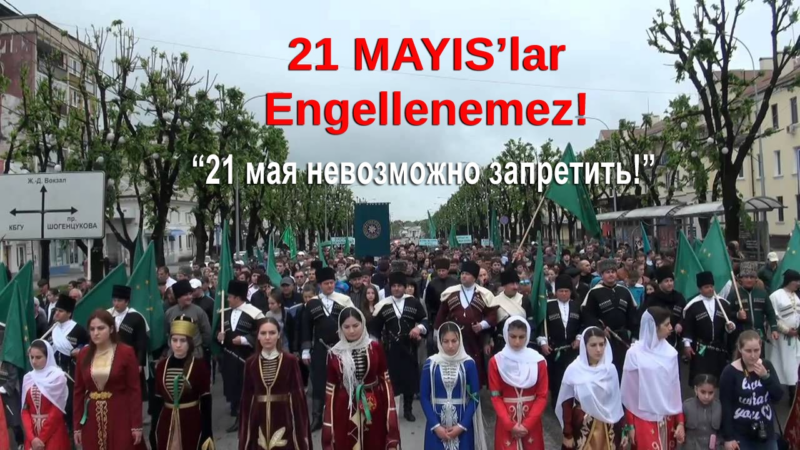
This event has been held in the republic since 2006. It is a mass public event, and its main organiser and initiator is the people themselves. The format of the event has also remained unchanged: it follows a standard programme in the form of a procession in national dress, with participants bringing symbols of their family lineages and carrying Circassian flags. People attend with their families, including the older generation, children, and young people. Today, it is a gathering of many thousands, held exclusively at the initiative of the Circassian people.
This year, one week before the day of mourning on May 21, security forces began issuing mass warnings against participation in the procession.
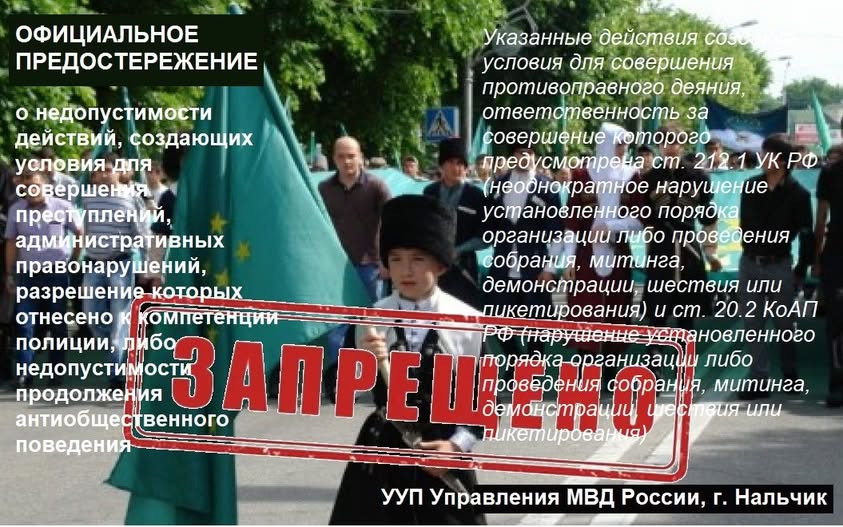
One version of the letter handed to activists stated that the Prosecutor’s Office had received information about the preparation of “mass public events” in Nalchik. The text contained no specific reference to a date or organisers, but cited articles of the Russian Code of Administrative Offences and criminal legislation. Another version stated more specifically that the warning had been issued to the activist “in connection with the fact that this citizen intends to participate in a procession dedicated to the genocide of the Circassian people on May 21, 2026.”
In both cases, the warnings contained a detailed list of legal and regulatory acts and specific articles whose violation would entail liability. In particular, they referred to Federal Law No. 54-FZ “On Assemblies, Rallies, Demonstrations, Processions, and Pickets,” concerning the prohibition on holding unauthorised public events, and Article 20.2 of the Code of Administrative Offences of the Russian Federation, “Violation of the Established Procedure for Organising or Holding an Assembly, Rally, Demonstration, Procession, or Picket.”
In warning of the risk of criminal prosecution, the Prosecutor’s Office referred to Article 212.1 of the Russian Criminal Code, “Repeated Violation of the Established Procedure for the Organising or Holding an Assembly, Rally, Demonstration, Procession, or Picket,” as well as general provisions on liability for manifestations of extremism.
The document, signed by Zalikhanov, an officer of the Russian Ministry of Internal Affairs for Kabardino-Balkaria, ended with an official warning: “If the requirements are ignored and the person to whom the warning has been issued participates in unauthorised mass actions, that person will be held liable in accordance with the legislation of the Russian Federation.”
“The situation surrounding the Day of Remembrance of the Adyghe, or Circassians, victims of the Russo-Caucasian War, observed annually on May 21, has reached a critical point. The persecution of and pressure on citizens over their intention to honour the memory of their ancestors have become systematic, planned and ongoing. One week before the day of mourning, citizens began being summoned to police departments to receive “formal warnings” about the inadmissibility of violating the law when participating in mass events. These warnings are unfounded and serve an exclusively intimidating and preventive purpose. There is already credible information that law enforcement agencies in Kabardino-Balkaria have issued formal warnings to dozens of residents of the republic. At the same time, over the many years during which mourning processions have been held on May 21, not a single case of unrest or other unlawful actions has ever been recorded. Participants have never violated public order or entered into conflicts with law enforcement officers. The procession has always been exclusively peaceful and organised,” the Human Rights Center of Kabardino-Balkaria stated in its appeal to the head of the republic, Kazbek, Kokov.
https://www.youtube.com/post/UgkxEs40rTJEGcwt1y64ot5GHNdvW3b2n4f1
They emphasised that the restrictions on and cancellation of the procession in connection with the coronavirus pandemic had been met with understanding. “But after life returned to normal and all restrictions were lifted, the ban on the May 21 mourning procession was the only one that remained. […] Since then, the Nalchik city authorities and republican officials, while refusing to approve the May 21 procession, have begun putting forward entirely contrived and politically motivated arguments, citing events in Ukraine,” the statement says.
“The May 21 mourning procession is not a political action, nor is it a demonstration of loyalty or disloyalty to anyone,” the authors of the appeal stated.
“This day was declared a non-working day by the Supreme Soviet of the Kabardino-Balkarian ASSR in 1992 precisely as a day of remembrance, without any connection to the current political situation. Instead of supporting the mourning event and taking the initiative to hold it in the established traditional manner, the republican authorities are effectively condoning the unlawful actions of security structures. In this context, the very fact of double standards on the part of the authorities is especially revealing and egregious: at the same time, other mass events, including entertainment events, are being held in Nalchik without obstruction and without any references to “events in Ukraine” or the “need to demonstrate solidarity”. A logical and non-rhetorical question arises: why are festive processions possible, while the May 21 mourning procession is not?” the authors emphasised.
The day of mourning on May 21 has become an “undesirable” date for the local authorities, one they intend to eradicate under any pretext. Human rights defenders noted that this reflects a selective, politically motivated approach to citizens’ constitutional rights, which is unacceptable.
“We are forced to state that such actions by security structures destabilise the situation in the republic rather than stabilise it. Instead of easing tensions, law enforcement agencies are creating additional tension. There is a deliberate and calculated attempt to delegitimise the Day of Mourning itself and to criminalise any participation in it by threatening the recipients of these “formal warnings” with administrative and criminal measures,” they emphasised.
First, a ban was introduced on the horseback procession, followed by a ban on the foot procession along Nalchik’s central street. “Only one step remains: to prohibit people from gathering at the “Tree of Life”, where the mourning events traditionally conclude,” the authors stated.
On May 21, mourning events are held around the world whenever large Adyghe, or Circassian, diasporas live, including Turkey, Syria, Germany, the United States, France, Israel, and other countries. Yet in those places, no one obstructs people who wish to honour the memory of the victims of the Caucasian War on that day. People are free to gather and hold processions. Only in the historical homeland of the Adyghe, in Nalchik, does the same thing happen every year: bans, formal warnings, detentions, and arrests, human rights defenders emphasised.
Khadzhumurat Khakuashev, chair of the public organisation “The Republic Is a Common Cause,” also personally appealed to the republic’s leadership.
“As an ordinary resident of our republic, I cannot remain silent. Every year on May 21, we, Circassians, or Adyghe, and all those who care about historical truth, seek to honour the memory of our ancestors, the victims of the Caucasian War, with dignity. There is nothing political in this. This is our pain, our historical memory, and our duty to those who died or were expelled from their land in 1864. Millions of Adyghe ended up in the diaspora, while our villages and lands were emptied. May 21 is the official Day of Remembrance for the victims of the Caucasian War in Kabardino-Balkaria, recognised back in the 1990s. And this is not “extremism”, but respect for one’s roots.
But in recent years, we have seen an alarming picture: intimidation, “preventative conversations,” refusals to approve the traditional memorial procession, and administrative arrests. Last year, eight participants were detained. In October 2025, the republic’s Supreme Court upheld such bans. Instead of respect and dialogue, there is pressure. This has caused deep indignation not only among us, but also among the entire Circassian and Caucasian diaspora abroad.
The right to peaceful assembly and freedom of expression is guaranteed by the Russian Constitution. Historical memory is the foundation of our identity. By prohibiting traditional forms of commemoration, we only weaken the bond between generations and interethnic trust, and hand over the immense energy of memory to enemies of Russia’s peoples. Such restrictions breed resentment instead of unity in out multiethnic republic.
I appeal directly to the leadership of the Kabardino-Balkarian Republic: stop the practice of intimidation and pressure!” he stated in his appeal.
In addition, representatives of the Caucasian diaspora in Turkey also appealed to the head of the Kabardino-Balkarian Republic, Kazbek Kokov, in connection with pressure on the participants in the May 21 Day of Remembrance.
“We categorically reject the practice whereby individuals seeking to honour the memory of their ancestors are summoned to law enforcement agencies and subjected to pressure under the pretext of “warnings.” Obstructing peaceful memorial processions and portraying citizens’ exercise of their constitutional rights as unlawful actions is also unacceptable. Such measures undermine the fundamental principles of respect for historical memory and human rights.
May 21 is not a political action, but a day of mourning dedicated to the genocide and expulsion of the Circassian people during the Russo-Caucasian War. This event was recognised as genocide by a decision of the Parliament of the Kabardino-Balkarian Republic dated February 7, 1992. Thus, peaceful commemoration on May 21 is not only an act of respect for historical memory, but also the exercise of fundamental human rights enshrined in the Constitution of the Russian Federation and international legal norms.
Despite the absence of acts of violence or breaches of public order during the events held on May 21 in recent years, the practice of intimidation and restrictions by law enforcement agencies has caused deep indignation in society and among representatives of the diaspora. Last year, eight participants in the memorial procession were detained and subjected to administrative arrest, and in October 2025 the Supreme Court of the Kabardino-Balkarian Republic upheld the lawfulness of such bans, indicating a trend toward increasing pressure on citizens.
In light of the above, we insist on the need to ensure that citizens of the Kabardino-Balkarian Republic are able to exercise their right to protect their historical memory and the memory of their ancestors. We demand an immediate end to the practice of intimidation, pressure, and obstruction of memorial events held on May 21. This demand is consistent with citizens’ constitutional rights, as well as with the principles of respect for historical heritage and human rights,” they wrote in the appeal.
The activists in Nalchik themselves refused to change their plans for the Day of Remembrance of the Adyghe because of the formal warnings issued by security forces. Many refused to meet with district police officers in order not to receive the notices in person. According to reports, the notices were drafted by officers of the republic’s Center “E” of the Ministry of Internal Affairs. At the same time, in private conversations, district police officers justified themselves by saying that they were “under pressure from above.” Human rights defenders described the visits by security forces as intimidation.
Particular indignation and outrage are caused by the fact that the authorities are resorting to pressure against Circassian activists in the historical homeland of the Adyghe, where their ancestors lived for centuries and where their culture, language, and traditions were formed. Around the world, including in Turkey, Syria, Jordan, Germany, and the United States, Adyghe are able to freely express respect for the victims of the Caucasian War. Yet it is only in their own native land that they face obstacles every year.
In theory, a formal warning against participation in an unauthorised public event can be appealed to a prosecutor or in court, but due to time constraints, it was not possible to do so before the event took place.
In the end, the procession in Nalchik on the 162nd anniversary of the end of the Caucasian War passed without incident, with participants walking only on the sidewalks. The traditional evening event was held at the “Tree of Life” memorial in Nalchik, where those gathered lit 101 mourning candles.
The authorities in Kabardino-Balkaria are artificially restricting the procession marking the end of the Caucasian War, but the bans and warnings only contribute to an increase in the number of participants.
Circassian activists in Istanbul were prohibited from laying a wreath at the Russian consulate
The commemorative event in Istanbul marking the 162nd anniversary of the end of the Caucasian War took place under strict restrictions: for the first time in many years, Circassian activists were not allowed to approach the building of the Russian Consulate General to lay a mourning wreath. Police also demanded that some of the banners be removed from the display.
The memorial event, dedicated to the 162nd anniversary of the end of the Caucasian War, was held on May 21 in Istanbul near the municipality building in the Beyoğlu district. The event, scheduled for 7:30 p.m., began almost an hour and a half late, at around 9:00 p.m.
The perimeter of the site was fenced off with metal barriers. There were noticeably fewer officers in the cordon than the previous year, and fewer participants as well. After the programme began, the number of people gathered increased: Circassians who had shortly before attended a conference marking the Day of Remembrance and Mourning at a nearby municipal cultural centre joined the event. In total, no more than 500 people took part.
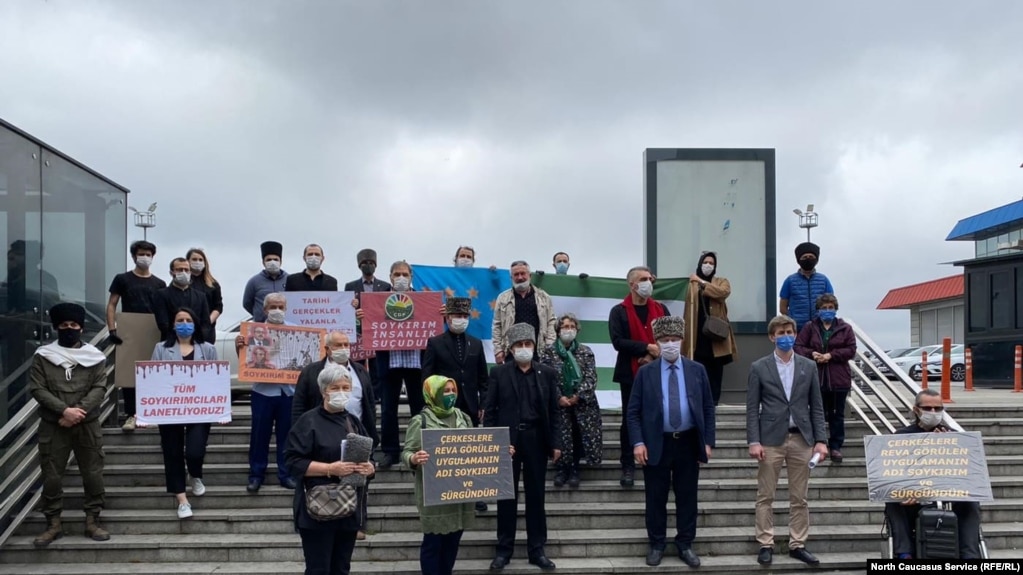
Banners and posters with quotations from historical figures and researchers who had visited the North Caucasus were placed around the perimeter of the barriers; the statements concerned atrocities committed by Russian troops during the Caucasian War. According to participants, police demanded that some of the banners be removed. As a result, only those banners facing inward toward the site and not visible to tourists and passers-by outside remained on the barriers.
The duration of the event was significantly reduced compared with previous years. For the first time in the many-year history of the commemorative events, Circassian activists were not allowed to approach the building of the Russian Consulate General in Istanbul to lay a mourning wreath.
The organisers read out four specific demands: Russia’s official recognition of the genocide and deportation of the Circassians, accompanied by an apology; the rehabilitation of the ancestors who suffered; the unconditional granting to the diaspora of the right to return to their historical homeland; and the maintenance of conditions for peaceful coexistence in the Caucasus. The appeal ended with the words that have become the motto of the Circassian remembrance movement: “We have not forgotten, we will not forget, and we will not let it be forgotten.”
https://www.svoboda.org/a/30625795.html
https://www.instagram.com/reels/DYrCAiCMfGp
The death of Nalchik’s mayor has drawn the attention of investigators
Nalchik Mayor Taimuraz Akhokhov was found dead, and investigators are establishing the circumstances of his death.
Taimuraz Akhokhov was appointed acting mayor of Nalchik in April 2018. Before that, he had served as First Deputy Minister of Kabardino-Balkaria. Akhokhov was confirmed in the post in June of the same year, following elections in which six other candidates also took part.
Taimuraz Akhokhov, the head of the administration of the Nalchik urban district, died at the age of 54, the administration of the head of Kabardino-Balkaria reported on its Telegram channel on May 24, 2026.
Taimuraz Akhokhov was born in Baksan in 1971. He began his career in 1996 as a lead specialist in the administration of the “Kabardino-Balkaria” free economic zone. From 1998, he worked in the tax authorities, and in March 2015 he was appointed Deputy Minister of Labour, Employment, and Social Protection of the republic, according to the publication.
Investigators are establishing the circumstances of the Nalchik mayor’s death, the Investigative Committee’s department for Kabardino-Balkaria reported on its Telegram channel.
“According to preliminary information, on May 24, 2026, Taimuraz Akhokhov, born in 1971, was found with no signs of life. […] Investigators are carrying out a set of preliminary inquiries aimed at establishing all the circumstances of what happened. Relatives, colleagues, and people from the deceased’s close circle are being questioned. A procedural decision will be made based on the results of the inquiry,” the publication stated.
https://www.rbc.ru/rbcfreenews/6a12b5289a79477e3bf10911?utm_referrer=https%3A%2F%2Fwww.google.com%2F
A lawsuit over the destruction of burial mounds in Kabardino-Balkaria has reached the court
According to the publication Caucasian Knot, the Prosecutor’s Office of Kabardino-Balkaria has demanded that the contractor and the republic’s Ministry of Construction ensure the preservation of ancient burial mounds during construction of the Baksan group water pipeline.
As Caucasian Knot previously reported, officials failed, in violation of the law, to organise archaeological work at the burial mound cemeteries before construction of the Baksan group water pipeline began, and after these sites were destroyed, they did not allocate funds for the announced protective and rescue measures, historians stated.
On June 23, the author of the blog “Nalchik and Neighbours. The Caucasus in Search of Justice” on Caucasian Knot wrote that the construction of the Baksan water pipeline had led to the destruction of archaeological sites of regional and federal significance. During the work, burial mound cemeteries near the village of Islamey, the Baksan and Kyzburum fortified settlements, the Zayukovo and Kyzburum burial mound groups of the late medieval period, Alan fortified settlements, and Kabardian burials dating from the fourteenth to seventeenth centuries were damaged.
“In places where heavy machinery passed, shards of ceramic vessels and other artefacts are lying around. […] The expert review found the safety assurance plan to be compliant with legal requirements; however, as later became clear, construction had begun before the results of the expert review were received, without fieldwork being carried out and without arranging for the presence of an archaeologist,” the publication stated.
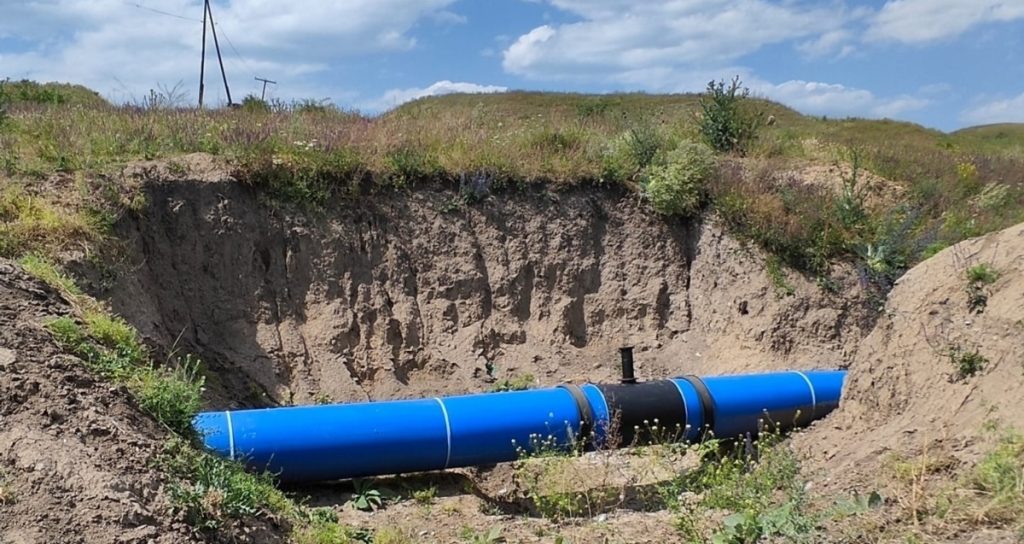
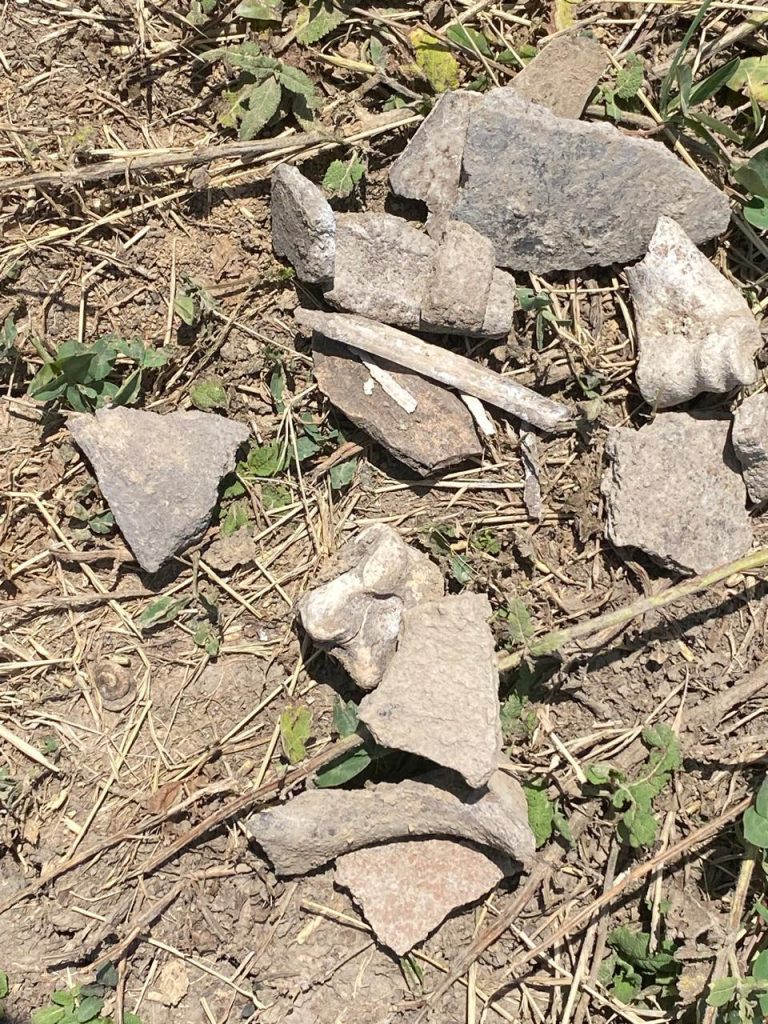

The Nalchik City Court for Civil Cases has received a lawsuit filed by the Prosecutor’s Office of Kabardino-Balkaria against the State Public Institution “Capital Construction Department” and the Ministry of Construction, Housing, and Utilities of Kabardino-Balkaria over the destruction of ancient burial mounds during construction of the Baksan group water pipeline.
The construction company ASSO LLC and the Department for the State Protection of Cultural Heritage Sites of Kabardino-Balkaria have been joined to the case as third parties. According to information on the court’s website, the hearing has been scheduled for May 19.
The Prosecutor’s Office states in the lawsuit that, during implementation of the project, the necessary measures were not taken to ensure the preservation of cultural heritage sites, including burial mound cemeteries, burial mound groups, and fortified settlements, creating a risk of their loss.
https://www.kavkaz-uzel.eu/articles/422919
In May 2026, 12 people were sentenced by the Nalchik Garrison Military Court to actual prison terms for unauthorised absence from their military units during the period of mobilisation*
In particular:
- Valery Tyshchenko was found guilty of evading military service during the period of mobilisation and sentenced to five years’ imprisonment.
A serviceman with the surname Tyshchenko was found guilty of failing to report for duty without valid reasons for a period exceeding one month, the Nalchik Garrison Military Court reported on its VKontakte page.
According to the court, on September 18, 2025, during the period of mobilisation, the serviceman failed to report for duty at his military unit without valid reasons. “On December 9, 2025, Tyshchenko was found by police officers in the settlement of Sovetsky in the Mozdok District of North Ossetia, and from September 18 to December 9, Tyshchenko spent his time at his own discretion at his place of residence,” the publication stated.
- Alan Doguzov was found guilty under Part 5 of Article 337 of the Criminal Code of the Russian Federation, the Nalchik Garrison Military Court reported on its VKontakte page.
According to the court, on January 29, 2026, “during the period of mobilisation,” the serviceman left his military unit in Mozdok without authorisation and without valid reasons.
“On March 4, 2026, Doguzov voluntarily appeared at the military investigative department stationed in the Republic of North Ossetia-Alania, and from January 29 to March 4, 2026, Doguzov spent his time at his own discretion at his place of residence,” the statement said.
The defendant was sentenced to five years’ imprisonment.
- Salman Ozdoyev was found guilty on two counts of absence from military service for more than one month during the period of mobilisation, the Nalchik Garrison Military Court reported on its VKontakte page.
According to the court, on May 7, 2024, the serviceman, “without valid reasons,” failed to report for duty at the location of his military unit by the established time, and on February 6, 2025, he left his place of service without authorisation. In both cases, he went home and remained there, in the first case until August 17, 2024, and in the second until March 11, 2026.
“In the first case, Ozdoyev voluntarily arrived at the temporary deployment point of the military unit, and in the second case, he voluntarily arrived at the military unit in the stanitsa of Troitskaya in Ingushetia,” the statement said.
Based on the cumulative offences, he was given a final sentence of six years’ imprisonment. The convicted man will serve his sentence in a general-regime correctional colony.
- Rustam Bariyev was found guilty under Part 5 of Article 337 of the Criminal Code of the Russian Federation, the Nalchik Garrison Military Court reported on its VKontakte page.
According to the court, on May 16, 2025, “that is, during the period of mobilisation,” Bariyev left his military unit without authorisation and without valid reasons. He spent his time at his own discretion, including at his place of residence.
“On March 6, 2026, Bariyev was found by police officers in the city of Nalchik in the Kabardino-Balkarian Republic, and from May 16, 2025, to March 6, 2026, Bariyev spent his time at his own discretion, including at his place of residence,” the publication stated.
The defendant was sentenced to five years in a general-regime colony.
- Kholmurod Rasulov was found guilty under Part 3.1 of Article 337 of the Criminal Code of the Russian Federation, the Nalchik Garrison Military Court reported on its VKontakte page.
According to the court, on July 23, 2025, “that is, during the period of mobilisation,” Rasulov left his military unit without authorisation and without valid reasons.
“On August 20, 2025, Rasulov was found in Baksan by police officers, and from July 23 to August 20, 2025, he spent his time at his own discretion at his place of residence,” the publication stated.
The defendant was sentenced to two years’ imprisonment. He will serve his sentence in a general-regime colony.
- Aslan Fidarov was found guilty under Part 3.1 of Article 337 of the Criminal Code of the Russian Federation, the Nalchik Garrison Military Court reported on its VKontakte page.
According to the court, on February 18, 2026, “during the period of mobilisation,” the serviceman left his military unit without authorisation and without valid reasons.
“On March 10, 2026, Fidarov voluntarily appeared at the military investigative department stationed in the city of Nalchik in the Kabardino-Balkarian Republic, and from February 18 to March 10, 2026, Fidarov spent his time at his own discretion at his place of residence,” the publication stated.
In court, Fidarov admitted guilt and “expressed regret for what he had done.” However, the court noted that on February 3, 2026, the serviceman had already been convicted under the same article and given a suspended sentence of two and a half years’ imprisonment.
The court revoked the suspended sentence imposed under the previous verdict.
“In connection with the commission of a serious crime, the court revoked the suspended sentence under the previous verdict. Thus, taking into account the factual circumstances of the case and information about the defendant Fidarov’s character, the defendant was given a final sentence, based on the cumulative verdicts, of four years’ actual imprisonment in a general-regime correctional colony. The convicted man was taken into custody in the courtroom.” the court reported.
- Khizir Shaipov was found guilty under Part 5 of Article 337 of the Criminal Code of the Russian Federation, the Nalchik Garrison Military Court reported on its VKontakte page.
According to the court, on January 5, 2026, “during the period of mobilisation,” the serviceman left his military unit without authorisation and without valid reasons.
“On March 11, 2026, Shaipov was detained by a police officer at the federal checkpoint in the Zolsky District of Kabardino-Balkaria, and from January 5 to March 11, Shaipov spent his time at his own discretion, including at his place of residence,” the publication stated.
The defendant was sentenced to five years’ imprisonment. He will serve his sentence in a general-regime correctional colony.
- Astemir Maremukov was found guilty under Part 5 of Article 337 of the Criminal Code of the Russian Federation, the Nalchik Garrison Military Court reported on its VKontakte page.
According to the court, on December 9, 2025, “that is, during the period of mobilisation,” Maremukov failed to report to his military unit without valid reasons.
“On February 17, 2026, Maremukov voluntarily appeared at the military investigative department in Nalchik, and from December 9, 2025, to February 17, 2026, he spent his time at his own discretion at his place of residence,” the publication stated.
Maremukov was sentenced to five years’ imprisonment. He will serve his sentence in a general-regime colony.
- Islam Teshev was found guilty under Part 5 of Article 337 of the Criminal Code of the Russian Federation, the Nalchik Garrison Military Court reported on its VKontakte page.
On April 19, 2024, Teshev failed to report for duty by the established time without valid reasons, and on November 1, 2025, he left his place of service without authorisation. Both incidents occurred during the period of mobilisation, the court noted.
“On May 3, 2024, Teshev voluntarily appeared at the temporary deployment point on the military unit, and on March 19, 2026, he was found by a police officer in Nalchik,” the publication stated.
Teshev had already been convicted on charges of unlawful sale of firearms and sentenced to three years’ imprisonment, suspended, with a probationary period of two years. Based on the cumulative offences and verdicts, serviceman Teshev was sentenced to seven years’ imprisonment. He will serve his sentence in a general-regime colony.
- Ruslan Chakhkiyev was found guilty under Part 5 of Article 337 of the Criminal Code of the Russian Federation, the Nalchik Garrison Military Court reported on its VKontakte page.
On August 11, 2025, Chakhkiyev failed to report for duty by the established time without valid reasons, and on October 31 of the same year, he was found by police officers in Magas, Ingushetia. Thus, “from August 11 to October 31, 2025, Chakhkiyev spent his time at his own discretion,” the court press service stated.
The court sentenced Chakhkiyev to five years’ imprisonment. The convicted man will serve his sentence in a general-regime correctional colony.
- Islam Shogenov was found guilty under Part 5 of Article 337 of the Criminal Code of the Russian Federation, the Nalchik Garrison Military Court reported on its VKontakte page.
According to the court, on February 27, 2026, “during the period of mobilisation,” Shogenov left his place of service, the temporary deployment point of his military unit, without authorisation and without valid reasons.
“On April 10, 2026, Shogenov voluntarily appeared at the military commandant’s office stationed in the city of Mozdok in the Republic of North Ossetia-Alania, and from February 27 to April 10, 2026, Shogenov spent his time at his own discretion at his place of residence,” the publication stated.
The defendant was sentenced to five years in a general-regime colony.
- Ashad Zambatov was found guilty under Part 5 of Article 337 of the Criminal Code of the Russian Federation, the Nalchik Garrison Military Court reported on its VKontakte page.
According to the court, on August 6, 2025, “during the period of mobilisation,” Zambatov failed to report for duty at his military unit in North Ossetia by the established time and without valid reasons.
“On April 11, 2026, Zambatov voluntarily appeared at the military investigative department stationed in Mozdok, and from August 6, 2025, to April 11, 2026, Zambatov spent his time at his own discretion at his place of residence,” the publication stated.
The court sentenced the defendant to five years’ imprisonment. He will serve his sentence in a general-regime colony.
https://vk.com/public215822488
In total, in May 2026 alone, 12 people in Kabardino-Balkaria were sentenced to actual prison terms for unauthorised absence from their military units during the period of mobilisation.*
At the same time, on September 21, 2022, Vladimir Putin announced a partial mobilisation, and on October 28 of the same year, the Minister of Defence reported to the president that it had been completed; however, no corresponding decree followed. Lawyers concluded that a presidential decree was not required to end the partial mobilisation, Putin’s press secretary explained.
Notably, all of the incidents described above occurred long after October 28, 2022, that is, after the completion of the partial mobilisation.
On September 24, 2022, Parts 2.1, 3.1, and 5 of Article 337 of the Criminal Code of the Russian Federation, concerning unauthorised absence from a military unit or place of service during the period of mobilisation, were introduced into the Criminal Code. The amendments provide for imprisonment for up to 10 years. The tightening of legislation after the announcement of mobilisation led to harsher sentences for absence from a military unit.
At the same time, as of the end of May 2026, at least 399 servicemen from Kabardino-Balkaria had been officially confirmed killed since the start of the military operation in Ukraine.
In May 2026, it became known that the following servicemen would not return from Ukraine:
- Dmitry Drobot, Prokhladny
- Alexander Drobitko, Prokhladny
- Viktor Daalov, Prokhladny
- Islam Kandrokov, Verkhny Akbash
- Akhmed Teuvazhukov, Baksan
- Ruslan Nagoyev, Baksan
- Islam Sizhazhev, Baksan
- Valery Pavliy, Baksan
- Aslanbek Shogenov, Baksan District
- Andrey Podgorny, Baksan District
- Murat Liyev, Baksan District
- Timur Shikhalakhov, Baksan District
- Asker Shibzukhov, Baksan District
- Ruslan Ashev, Baksan District
By the end of May 2026, representatives of the authorities and security agencies had officially confirmed the deaths in Ukraine of at least 9,153 fighters from the southern Russian Federation: 4,533 from the North Caucasus Federal District and 4,624 from the Southern Federal District.
Dagestan continued to account for the highest number of confirmed deaths, with 1,948. The deaths of 946 fighters from Stavropol Krai, 586 from North Ossetia, 399 from Kabardino-Balkaria, 264 from Chechnya, 195 from Karachay-Cherkessia, and 195 from Ingushetia have also been confirmed.
It should be noted that actual losses among combatants from the North Caucasus may be significantly higher than those officially acknowledged. This situation is characteristic of all regions of the North Caucasus Federal District, but is especially relevant for Chechnya. In February 2023, Ramzan Kadyrov called on regional leaders not to disclose the number of those killed.
Activists opposing the so-called “Special Military Operation”
Many national activists have spoken out against the participation of their people in the invasion of Ukraine. The first to state this was leading Circassian activist Ibragim Yaganov, who said that “this is not our war.” In March 2026, Aydamir Kazanokov voiced similar conclusions: “Circassians are not allowed to be people, but they are allowed to be expendable material.
In Nalchik, in Kabardino-Balkaria, Circassians are prohibited from holding rallies, processions, and any forms of self-organisation. We are not allowed to be a people in our own home: we are not allowed to hold Adyghe Dzhegu, traditional games; we are not allowed to fully mark March 14, Circassian Language Day; we are not allowed to celebrate April 25, Circassian Flag Day; we are not allowed to honour the memory of those who fell for the freedom of Circassia on May 20; and we are not allowed to join a procession on May 21, the anniversary of the end of the Russo-Circassian War of 1763-1864.
But under the same national-ideological and religious pretext, one is allowed to go to someone else’s war. One may die for the interests of a state that destroyed our country, scattered our people, and still forbids us from restoring our historical memory and developing our own culture. The only question is: why are we not allowed to live as a people, but are allowed to die as a resource?”
https://t.me/The_Circassian_Times/14514
He also noted: “Recently, calls to join volunteer battalions have been heard increasingly often. Newspapers, advertisements for contract military service, and interviews with frontline soldiers create the impression that young people are expected to become even more willing to go to war.
The head of the Elbrus volunteer unit calls on people to follow him and speaks of “comfortable conditions” at the front. When a combat zone is described as a “sanatorium with a religious emphasis,” it creates a sense of absurdity. Halal food and prayer rooms are decent living conditions, but can they really be an argument for taking part in an extremely severe military conflict?
The national environment, language, and faith should unite and preserve a people, not serve as attractive packaging for drawing people into a combat zone.”
https://t.me/The_Circassian_Times/14515
Conclusion:
The events documented in the May 2026 report on Kabardino-Balkaria illustrate a sustained pattern of systemic violations of fundamental human rights. A particularly alarming aspect of these repressive practices is the increasing pressure on national activists in the context of a policy of prolonged cultural colonialism.