
Report on Human Rights Violations in the Chechen Republic
Period: April 2026
Introduction and Methodology of the Report
The present report is dedicated to the analysis of the human rights situation in the Chechen Republic (Russian Federation) during the period of April 2026. The document records a sharp escalation of repressive practices, manifested in the systematic violation of fundamental freedoms guaranteed both by the Constitution of the Russian Federation and by the international obligations of Russia under the UN Charter and applicable conventions.
Sources of Information
The conclusions and factual part of the report are based on comprehensive monitoring of open data, including:
- Official acts: Published decisions of regional and federal courts, registers of Rosfinmonitoring, and official statements of officials from the law enforcement structures of the Chechen Republic.
- Regulatory and legal analysis: Assessment of the impact of new federal laws (in particular, Article 13.53 of the Code of Administrative Offences of the Russian Federation and legislation on countering terrorism) on law enforcement practice in the region.
- Verified evidence: Reports from independent media, data from human rights organizations (the project “SK SOS”, the movement “NIYSO”, “Kavkazsky Uzel”), and the results of investigations by independent experts.
- Cross-checking: In order to ensure maximum reliability, each incident underwent a cross-verification procedure through several independent information channels.
Subject Matter and Limitations of the Report
This report does not constitute an exhaustive inventory of all offenses in the region. Its purpose is to focus on the key incidents of April 2026 that most clearly illustrate the persistent models of systemic disregard for international standards of justice. These include:
- The practice of “cross-border abductions” and extrajudicial executions.
- The use of digital surveillance of citizens’ search traffic as a tool of criminal prosecution.
- The institutionalization of collective responsibility and the taking of relatives as hostages.
- The use of military mobilization as a form of extrajudicial punishment for dissent.
The presented materials testify to a profound erosion of the legal field and the transformation of the region into a zone of “legal exception”, where administrative tasks and personal orders of the leadership prevail over the procedures established by law.
Obstruction and Persecution of Human Rights Activities
Status of the “Memorial” Organization
On April 9, 2026, the Supreme Court of the Russian Federation recognized the movement “Memorial” (which for decades had documented crimes in the Chechen Republic) as an “extremist organization”. This became the culmination of many years of pressure. Now any connection with this structure can result in a real prison sentence for residents of the Chechen Republic (up to 12 years for participation or financing).
Unlawful Detentions
The active phase of raids began in mid-April 2026 and continues in May. Reports of mass detentions are coming from several districts, but the epicenter was the Kurchaloy District. Abductions were also recorded in the settlement of Sheikh Iznura (former Prigorodnoye, outskirts of Grozny), where, according to NIYSO data from April 19, at least six people were taken away, including elderly individuals. The detentions are of an extraprocedural nature (abductions). People are taken away without charges being presented, often at night.
Rustam Aguev is known for extremely harsh methods and public threats against “undesirables”. During the days of the detentions, the following entry appeared in his WhatsApp status: “Let no one write to me with a request to release someone until I complete my task. I know whom I must obey. The rest — stand down. No offense.” Human rights defenders regard this as a public admission of refusal to follow legal procedures. Aguev openly states that he is guided not by the Criminal Procedure Code, but by personal instructions from the leadership (Kadyrov’s vertical), and that appeals from relatives or lawyers do not affect him.
Relatives of the abducted are told directly that attempts to publicize the situation or contact human rights defenders will result in the detainees “disappearing forever”. This creates an “information vacuum”, as families, intimidated by Aguev and other heads of departments, are afraid to file official reports of abduction.
The NIYSO movement links this wave to several factors:
- Search for the “unreliable”: identification of those subscribed to opposition channels (continuation of the practice of monitoring gadgets).
- Replenishment of the “exchange fund” or mobilization resource: detainees may be forced to be sent to the war in Ukraine in exchange for freedom or the safety of their families.
- Recognition of NIYSO as an extremist organization: the Supreme Court of Chechnya made this decision at the end of 2025, which gave security forces carte blanche to persecute anyone who at least simply views their content.
This case perfectly illustrates the collapse of the legal law enforcement system in Chechnya in 2026. The official recognition of opposition movements as extremist turns any resident of the republic into a potential victim of a “raid”.
https://www.kavkazr.com/a/v-chechne-soobschayut-o-novoy-volne-massovyh-zaderzhaniy-zhiteley-respubliki-niyso/33740611.html https://oc-media.org/activists-report-abduction-of-six-chechen-residents/
Administrative Arbitrariness and the Use of War as a Universal Tool of Intimidation of the Population
In the first half of 2026, the practice of using the threat of forced mobilization to resolve minor administrative and everyday issues was recorded in the Chechen Republic.
A characteristic example is the incident in the village of Duba-Yurt, where the head of the local administration, Magomed Muzaev, publicly threatened residents with sending them to the front in Ukraine for using tinted windows on their cars. This case demonstrates:
- Substitution of law by arbitrariness: Administrative offenses (traffic rules), for which the law provides only a fine (for violation of car tinting the fine is 500 rubles (about 6 US dollars)), are punished in the region by the threat of deprivation of life (sending to the combat zone).
- Direct violation of property rights: The threat of confiscation of property (cars) by the head of the administration without a court decision is a gross violation of Article 35 of the Constitution of the Russian Federation.
- Degradation of legal institutions: Participation in an armed conflict is positioned by the authorities not as a civic duty or professional service, but as a punitive measure or a form of exile (penitentiary mobilization).
This case confirms that in 2026, any contact between a citizen and a representative of the authorities in Chechnya can end with forced sending to war, regardless of the severity of the offense committed.
https://oc-media.org/chechen-officials-threaten-to-force-those-caught-with-tinted-car-windows-to-fight-in-ukraine/ https://t.me/niysoo/30031
Use of the State Apparatus to Violate the Rights of Women and Children in Chechnya
The situation with women’s rights in the Chechen Republic remains extremely difficult. This topic is covered in a DW publication titled “Women in Chechnya: No One Is Insured Against ‘Honor Killing’”.
Case of Belkisa Mintsaева
This case is an example of the intersection of family law, domestic violence, and political pressure (“SVO blackmail”).
- Identity: Belkisa Mintsaева, 33 years old, native of Chechnya.
- Background: Mintsaева was in a prolonged conflict with her ex-husband over custody of her daughters. Previously, she was forced to leave the republic.
- Mechanism of forced return: according to human rights defenders (Lidia Mikhalchenko, “Caucasus Without a Mother”), security forces used blackmail through male relatives. Belkisa was threatened that if she did not return to Chechnya, her brother would be forcibly sent to the war in Ukraine (“SVO”).
- Detention: On April 14, 2026, after returning to the Nadterechny District, she was detained “without any grounds”.
- Legal violations:
- Incommunicado: there is no communication with the detainee. She is being held in one of the district police departments of the republic.
- Violation of the right to defense: independent lawyers are not allowed to see Mintsaева; defenders who tried to join the case are being intimidated.
- Absence of procedural status: no official charges have been brought, no court hearings on the measure of restraint have been held (or they were held in closed session without notifying the defense).
The case of Belkisa Mintsaева demonstrates a new repressive model of 2026: the use of the threat of mobilizing relatives as a tool to force “undesirable” women who are in conflict with pro-government ex-husbands to return to the region. This is a classic example of state complicity in domestic violence and a systemic violation of the right to a fair trial and protection.
https://www.dw.com/ru/zensiny-v-cecne-nikto-ne-zastrahovan-ot-pohisenia-ili-ubijstva/a-77083581 https://www.kavkaz-uzel.eu/articles/423017 https://www.kavkaz-uzel.eu/articles/422570
Report on the Murder of a Daughter by a Military Serviceman on “Honor” Grounds
In April 2026, another probable “honor killing” was recorded in the village of Kurchaloy. According to investigations by independent journalists and human rights monitoring groups, a 25-year-old local resident was killed by her own father (a military serviceman who participated in the military aggression against Ukraine). This incident reveals the following critical problems in the region:
- Institutional ignoring: law enforcement agencies of the Chechen Republic effectively sabotage investigations under Article 105 of the Criminal Code of the Russian Federation (“Murder”) if it was committed on the grounds of “protecting honor”, or by a pro-government participant of the “SVO”. Instead of initiating criminal cases, security forces often contribute to covering up the facts, issuing certificates of death from “natural causes”.
- Atmosphere of mutual cover-up: the collective silence surrounding the crime in rural communities is supported by the official rhetoric of the republic’s leadership, which has repeatedly publicly justified both violence against women in order to preserve “traditional foundations” and the aggressive behavior of loyal military personnel.
- Absence of protection mechanisms: in 2026, no system of shelters or independent hotlines has been created in the republic that would be independent of the regional authorities. Any attempt by a woman to report domestic violence leads to her return to the family under the supervision of the same people who threaten her life.
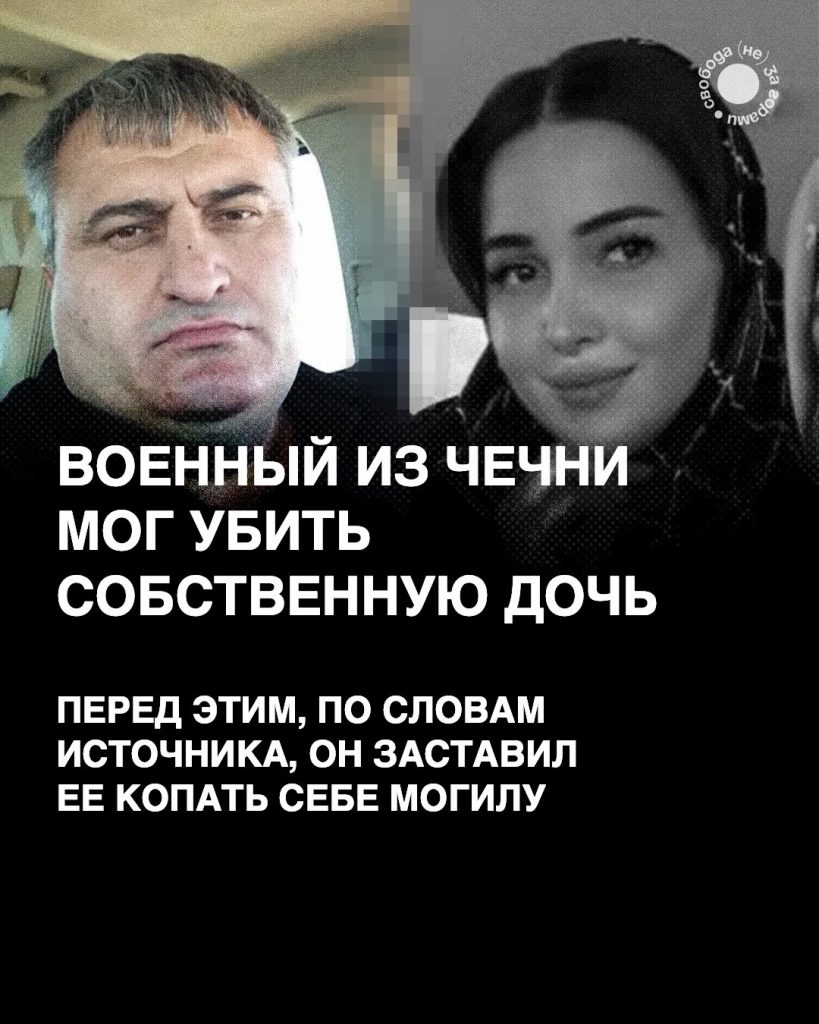
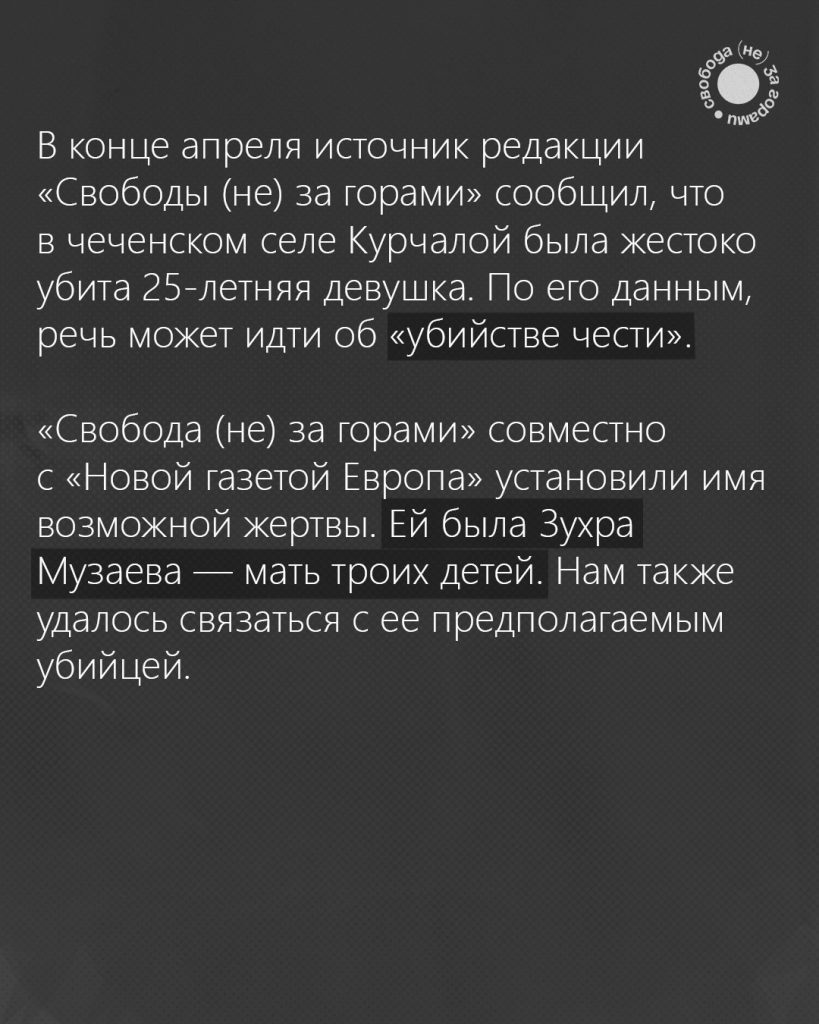
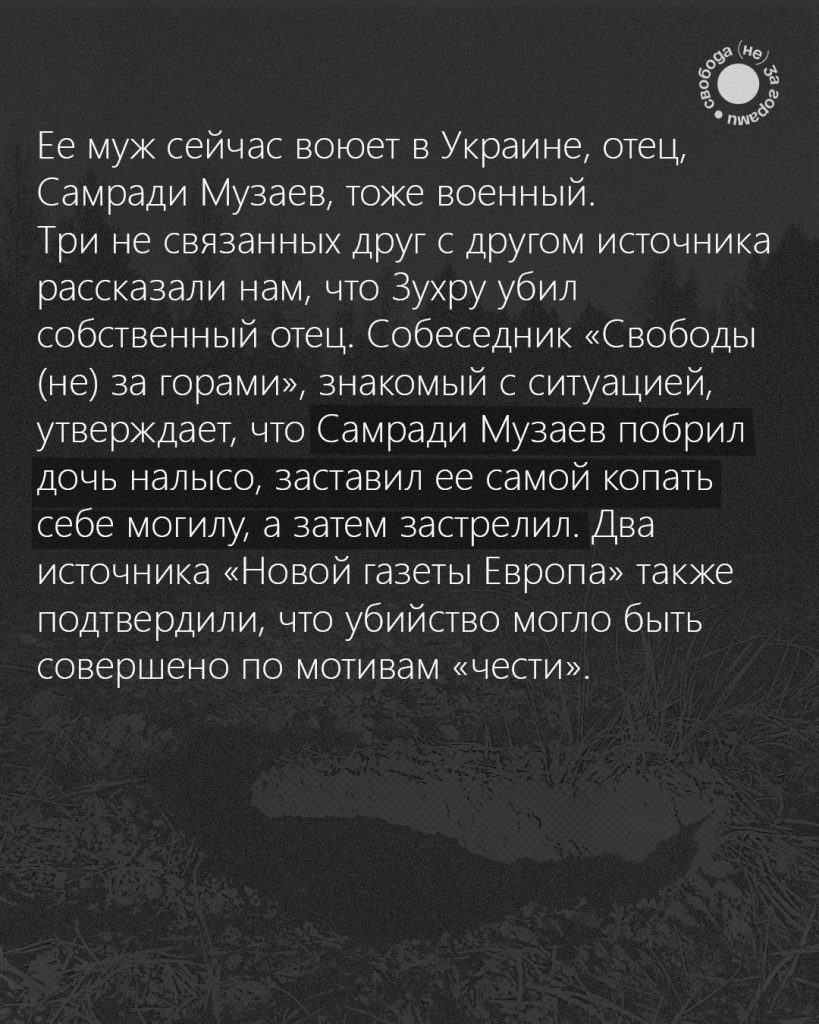
This case emphasizes that the right to life in the Chechen Republic (Article 2 of the ECHR) is not guaranteed to women even in the presence of clear signs of a serious crime committed.
It is important to note that the Kurchaloy District (the birthplace of Ramzan Kadyrov) is a zone of special influence of security forces (recall the audio recordings of Aguev). The fact that the “honor killing” occurred precisely there testifies to the complete merging of archaic tribal customs and the modern repressive state apparatus.
Status as of May 2026: Official investigation into this fact has either not been initiated or is being conducted formally, without the detention of suspects, which is a direct violation of the Russian Federation’s international obligations in the field of human rights and combating discrimination against women.
https://t.me/heda_media/2884 https://nezagorami.media/post/honor-killing
Case of Sophie
The story of 13-year-old Sophie is a unique and extremely alarming case that demonstrates how tools of state search and administrative resources can be used in Chechnya within the framework of family conflicts.
Essence of the Conflict: “Involuntary Debtor”
The conflict began with a prolonged divorce of the parents and a dispute over alimony.
- The girl’s father, according to available information, connected with law enforcement structures or power circles of Chechnya, refused to pay alimony.
- In response to the mother’s demands for payments, the situation was “turned upside down”: a case was initiated in Chechnya according to which the mother allegedly illegally keeps the child.
- As a result, the 13-year-old girl was put on the federal and international wanted list by bailiffs of the Chechen Republic. The formal reason is “search for the child within the framework of enforcement proceedings”, but in fact the child is being searched for as a criminal in order to seize her from the mother.
Public Bullying and the Authorities’ Reaction
The peculiarity of this case is that Sophie turned out to be incredibly brave and began recording video appeals, demanding to be removed from the wanted list.
- Reaction of officials: instead of investigating the legality of searching a minor, Chechen officials and pro-government bloggers launched an information attack. The girl is accused of “bad upbringing”, “shaming the family” and working for “Western intelligence services”.
- Pressure through social networks: organized harassment began in the comments under her posts and in Chechen public pages. The thirteen-year-old child received direct threats and demands to “shut up” and “return to her father”.
Legal Absurdity
This case exposed several legal gaps at once:
- Search as a tool of abduction: human rights defenders point out that the wanted card in the database of the Ministry of Internal Affairs / Federal Bailiff Service is used as a legal pretext for any patrol officer to detain the girl at the airport or on the street in any region of the Russian Federation and hand her over to the “initiator of the search” — that is, Chechen security forces.
- Ignoring the child’s opinion: according to the legislation, from the age of 10 the court is obliged to take into account the child’s opinion on whom she wants to live with. Sophie has repeatedly stated that she is afraid of her father and wants to live with her mother, but the bailiffs ignore these statements.
- Abuse of the database: photographs and personal data of the child are posted on official websites next to the names of dangerous criminals, which is a gross violation of the rights of a minor.
Despite the wide resonance in independent media (such as Heda, SK SOS, and others), Sophie’s card periodically disappears and then reappears in the wanted database.