
Report on Human Rights Violations in the Kabardino-Balkarian Republic
April 2026
Hava Beshtoeva
Analysis of open sources for April 2026, including media reports, internet resources, and statements by private individuals, reveals the persistence of a trend toward violations of human rights and freedoms by the authorities and security structures of the Kabardino-Balkarian Republic. These violations are primarily associated with the politically motivated distortion of historical reality, the criminalisation of activism, the persecution of citizens for political activity, repression and judicial falsifications, as well as encroachments on the right to a fair trial. The documented incidents underscore the relevance of further efforts to protect human rights in the republic.
Circassian Activists Opposed the Distortion of History
Circassian diasporas, consisting of forced migrants, are actively opposing systemic attempts to distort the history of Circassia, raising the issue of the deliberate rewriting of historical facts, as reported in April 2026. Activists emphasize the importance of preserving historical memory of the Caucasian War and the genocide of the Circassians. Organisations state that downplaying or altering facts concerning the Russo-Circassians War and its consequences is unacceptable. The diasporas preserve the memory of «muhajirism», the mass displacement of Circassians from their historical homeland in the nineteenth century. Such initiatives are aimed at uniting the Circassian diaspora to protect its historical heritage.
In particular, Circassian organisations in Turkey noted the «dissemination of a narrative that distorts historical facts about the Circassian people, diverging significantly from the scholarly understanding of the nineteenth-century tragedy and their current situation.
They stated: «The distortion of historical reality is unacceptable. The genocide and deportation of the Circassians by Tsarist Russia in the nineteenth century is a historical reality established by contemporary Russian archival documents and international research. To characterise this process as «voluntary migration» or a «geopolitical misfortune» is a profound disrespect not only for the science of history, but also for the memory of hundreds of thousands of people who died in the struggle for freedom. Attempts to reconstruct history in accordance with today’s political climate and the political interests of the ruling authorities constitute a distortion of facts, disregard for and denial of the shocking reality of «genocide and exile», which has gone down in history as a shameful record for humanity».
It was also emphasized that «a narrative that fully reduces responsibility for the human tragedy to the external forces of that time and/or the behaviour of local figures is an attempt to conceal those responsible for the genocide and exile, and even to place responsibility on the victimised people; it is an attempt to legitimise a systemic policy of extermination and exile. Any discourse that ignores the will and suffering of the Circassian people is an attempt to whitewash the processes of exile and genocide carried out by Russia.»
The organisations affirmed that they «will continue to seek scholarly and historical truth.»
Balkar female activists fined in the KBR for a car rally announced by the authorities
The Day of the Revival of the Balkar People is an official holiday in Kabardino-Balkaria, observed annually on 28 March. It was established in memory of the return of the Balkars to their historical homeland after 13 years of deportation to Central Asia.
The operation to deport the Balkars took place on 8 March 1944 and lasted only two hours. During that time, disabled war veterans, families of frontline soldiers, and leaders of party bodies were sent to Kazakhstan and Central Asia. Of the 37,713 deported Balkars, 52% were children, 30% were women, and 18% were men. During the 18-day journey, 562 people died. It was only in 1957 that the Balkars were allowed to return to their homeland.
The deportation affected every Balkar family, and its memory is passed down from generation to generation. Even after 80 years, the consequences of the deportation continue to affect the fate of the Balkars; in particular, many representatives of the people died during the exile, and rehabilitation cennot be considered complete.
A year prior, on 28 March 2025, concerts, exhibitions, and public festivities dedicated to the Day of the Revival of the Balkar People, were held in the towns and villages of Kabardino-Balkaria. In the Cherek District, more than 70 horse riders held a horseback procession.

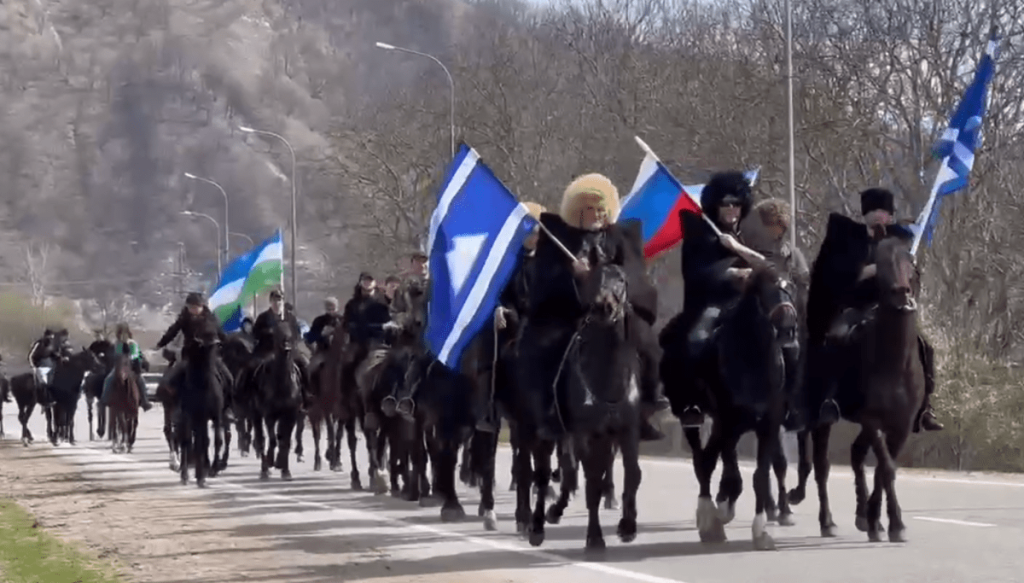
In April 2026, the Cherek District Court fined Alina Tayshakulova and Asiyat Kaigermazova 20,000 rubles each under reports concerning the organisation of a mass event on the Day of the Revival of the Balkar People. The car rally had been announced by the authorities.
The court rulings state that, on 28 March, Taysmakulova and Kaigermazova organised «demonstration involving around 50 vehicles using national attributes in the form of Balkar flags.» The event was coordinated in a WhatsApp group.
The rulings also state that, in the administrative reports, the police referred to a 31 March response from the republican Ministry for Nationalities and Public Projects, which said that the women had not submitted notification of a public event.
The accused admitted their guilt in court. The court found them guilty of violating the established procedure for organising or holding a meeting, rally, demonstration, procession, or picket, and sentenced each of them to an administrative fine of 20,000 rubles, according to the court decisions.
At the same time, the car rally on 28 March had been officially announced by the republican and municipal authorities. In particular, the administration of the Cherek District reported on it in its Telegram channel on 25 March. The cars gathered near the building of the Cherek District administration and then proceeded toward the Blue Lakes.
«The annual car rally will take place on 28 March. The official opening will begin at 09:00 on the square near the district administration building,» the Cherek District administration stated on its Telegram channel.
«One of the largest events was the traditional car rally through the Cherek Gorge, which brought together more than 100 motorists from different districts of Kabardino-Balkaria, guests from Krasnodar and Stavropol Krais, as well as from Rostov Region,» the press service of the Head of Kabardino-Balkaria, Kazbek Kokov, reported on 28 March.
Notably, the Supreme Court of Kabardino-Balkaria also upheld the decision of the Nalchik City Court, which found lawful and justified the refusal by the republic’s authorities to approve a mass procession along Nalchik’s main street for the Circassian Day of Remembrance, scheduled for 21 May.
https://zona.media/news/2026/04/08/probeg
According to the Caucasian Knot, Taysmakulova and Kaigermazova organised their car rally involving 50 vehicles by creating an open WhatsApp group titled «28 March,» which 315 people joined. Participants in the procession were informed of the route, Kashkhatau and Lower Blue Lakes, and the vehicles participating in the demonstration were also identified, according to the rulings of the Cherek District Court of 31 March and 1 April.
Tamara Gerieva, Executive Director of the Council of Elders of the Balkar People, told a Caucasian Knot correspondent that all activists of her organisation were outraged by the court decisions in the administrative cases against Taysmakulova and Kaigermazova.
She suggested that the young women had been punished as a warning to others, so that «no one would dare to hold such events without authorisation.» Gerieva noted that when she herself had submitted applications to hold public events, officials had refused her under various pretexts.
https://www.kavkaz-uzel.eu/articles/422355
The case concerning the killing of Aslan Kambiev was sent for reconsideration
On 1 February 2022, in Nalchik, on Lermontov Street, Aslan Kambiev, a multiple prize-winner and winner of Russian and European judo and sambo championships, sustained a gunshot wound during an altercation. On 8 March 2022, he died at the Sklifosovsky Institute in Moscow.
On 24 February, the Nalchik City Court found Ruslan Kudaev, a resident of the village of Psygansu, guilty in the case concerning Kambiev’s killing. Kudaev was found guilty under Article 108 of the Criminal Code of the Russian Federation, murder committed in excess of the limits of necessary defence, and was released from punishment namely one year and ten months of restriction of liberty, due to the expiration of the limitation period for criminal prosecution. The charge of unlawful acquisition of a firearm under Part 1 of Article 222 of the Criminal Code of the Russian Federation was also dropped.
The Supreme Court of Kabardino-Balkaria, which acquitted the defendant Ruslan Kudaev and recognised his right to rehabilitation in the case concerning the killing of athlete Aslan Kambiev, ignored witness testimony. The Fifth Cassation Court overturned the acquittal of Ruslan Kudaev in the case concerning the killing of Russian sambo and judo champion Aslan Kambiev and returned the case for a new hearing before the Supreme Court of Kabardino-Balkaria. The court of first instance committed numerous violations.
In April 2026, the Supreme Court of Kabardino-Balkaria reconsidered the appellate case of Ruslan Kudaev, who was accused of killing judoka Aslan Kambiev. Kudaev’s acquittal was overturned, and the murder case was sent for a new hearing before the court of first instance.
The reconsideration of Aslan Kambiev’s case by the Supreme Court of Kabardino-Balkaria, following the annulment of the previously issued verdict by the Fifth Cassation Court, had been scheduled to take place as early as 3 March. At that time, Judge Atakuev stated that it had not been possible to assemble a quorum of three judges because almost all judges of the Supreme Court had, in one way or another, been involved in the consideration of the case. Lawyer Pogosyan then suggested that the court was awaiting the outcome of the consideration of a complaint against the cassation court’s ruling.
https://www.instagram.com/p/DXWpEcfjUAJ
A prisoner from Kabardino-Balkaria, together with other natives of the Caucasus, declared a hunger strike in the Taganrog pre-trial detention centre.
Ten Muslim prisoners in the Taganrog pre-trial detention centre refused food and water in protest against the systemic violation of their rights.
On 16 June 2024, prisoners in Rostov pre-trial detention centre 1 took detention centre staff hostage. During the assault, the prisoners who had taken the hostages were killed, and the hostages were freed.
In October 2024, human rights defenders reported that at least seven prisoners in the pre-trial detention centre in Taganrog, including Magomed Alkhanov and Magomed Khanilaev, were subjected to torture in connection with the security forces’ intention to obtain confessions in the case concerning the riot in Rostov pre-trial detention centre. It was also reported at that time that Muslim prisoners in the Taganrog pre-trial detention centre were being prohibited from practising their religion.
Muslim prisoners in the Taganrog pre-trial detention centre have been on a dry hunger strike since late March. According to the detainees, they were unlawfully deprived presonal belongings, hygiene products, walks, and phone calls, the human rights project Memorial reported, citing relatives of the one of the hunger strike participants.
The first to declare a hunger strike, on 27 March, was Zaur Dzuev, a native of Nalchik, who is accused of participation in a terrorist community. Later, nine other people joined the hunger strike, including Magomed Khanilaev, a native of Dagestan, who was transferred to the Taganrog pre-trial detention centre together with several other Muslims after the hostage-taking in Rostov pre-trial detention centre 1.
The prisoners’ personal belongings, including hygiene items, were confiscated back in January and have still not been returned. The detainees also told their relatives that the administration of the facility had deprived them of access to the bathhouse and regularly placed them in a punishment cell on fabricated pretexts.
Among the hunger strike participants, Aslan Alikperov, Ramazan Albekov, Gegam Rostomyan, and Ramazan Orlov were also named. According to entries in Rosfinmonitoring’s register of terrorists and extremists, Albekov was born in Chechnya, Orlov in Stavropol, and Rostomyan is originally from Armenia.
According to human rights defenders, violations of the rights of Muslims in Federal Penitentiary Service facilities are systemic in nature. Prisoners and their relatives report the confiscation of personal belongings, including religious literature and prayer rugs, restrictions on access to hygiene and walks, as well as bans on observing fasting and performing religious rites. In some cases, the use of physical force has been reported. Ethnic and religious discrimination is felt especially strongly by natives of the North Caucasus republics.
Svetlana Gannushkina, head of the Civic Assistance Committee, believes that one of the reasons for violations of the rights of Muslims in Federal Penitentiary Service facilities is the large number of security officers with a military background who went through the wars in Chechnya. According to her, participants in military operations often remain traumatised, while insufficient attention has been paid to their rehabilitation, which affects their attitude toward convicts from the North Caucasus.
These cases point to a broader problem related to conditions of detention in Russian correctional facilities and violations of prisoners’ rights.
In Taganrog, all of this worsened with the start of the full-scale military operations in Ukraine, when the FSB took control of the Taganrog pre-trial detention centre.
Ukrainian prisoners of war were also held in Taganrog pre-trial detention centre 2. Ukrainian journalist Viktoria Roshchyna was held there before her death. According to the recollections of Ukrainians released from captivity, guards at the detention centre use rubber batons, wooden mallets, and electric shock devices for torture.
In late March 2026, it became known that Polish citizen Krzysztof Galos had died in the Taganrog pre-trial detention centre. He had been detained for «opposing the special military operation» i the occupied part of Ukraine’s Zaporizhzhia Region. Mediazona reported that one Ukrainian prisoner of war told the outlet Vot Tak that Galos had been killed after looking out of his cell window and seeing securing officers without balaclavas. After a prolonged beating, the man died.
https://zona.media/news/2026/04/07/golodovka-taganrog
Resident of the KBR detained in terrorism financing case
According to the security forces, the suspect collected funds and subsequently transferred them to the bank accounts of members of international terrorist structures hiding from law enforcement agencies outside Russia.
The regional Investigative Committee opened a criminal case on elements of the offence under Part 4 of the Article 205.1 of the Criminal Code of the Russian Federation. The maximum penalty provided by law for this offence is life imprisonment.
The amounts involved and the accounts of which terrorists structures the money was transferred to were not specified.
https://tass.ru/proisshestviya/26994895
It should be noted that in the summer of 2024, 50 Indigenous peoples’ organisations were designated as extremist in the Russian Federation. These included peaceful human rights initiatives such as the International Committee of the Indigenous Peoples, the public organisation «Circassian Committee» Congress, the foreign non-profit organisation «Circassian Cultural Centre» Republic of Georgia, the public association «Council of United Circassia» Foundation, as well as the «Caucasian Union.»
Later, in November 2024, all of these organisations, we as more than one hundred others, amounting to a total of 172 organisations protecting the rights and the culture of Indigenous peoples, were designated as terrorists:
In addition, in 2024, the Southern District Military Court of the Russian Federation issued a decision designating a group of agents of the Main Intelligence Directorate of Ukraine as a terrorist organisation.
https://www.interfax.ru/russia/983505
Thus, the accused could have financed any of the above-mentioned initiatives, including the peaceful among them.
In recent times, courts in the Russian Federation have preferred to conceal the specific circumstances of cases under the above-mentioned articles, since when the actual words or actions of the accused are published, the absurdity of the charges brought against them often becomes evident.
Resident of Kabardino-Balkaria suspected of inciting hatred or enmity
The Investigative Committee of Kabardino-Balkaria opened a criminal case against a local resident. The grounds for opening the case were an online publication that investigators deemed to constitute incitement to hatred or enmity.
According to the investigation, in November 2024, the 54-year-old suspect posted a publication on a channel in one of the messaging apps containing statements that incited hatred and enmity toward a group of persons on ethnic grounds.
A linguistic examination confirmed that the published materials contained calls for violence and discrimination on ethnic grounds. The actions of the suspect were identified by officers of the Russian Federal Security Service Directorate for Kabardino-Balkaria.
The investigation did not specify what kind of publication was involved or in which messaging app it was posted. The agency also did not indicate the preventative measure imposed on the suspect.
The specific circumstances of the case are likely not being disclosed because they could demonstrate both the groundlessness of the charges and the discriminatory nature of justice. In recent years, courts and law enforcement agencies have left even the most aggressive nationalist actions of the «Russian Community» unpunished, while in cases of everyday discrimination by representatives of the Russian Federation’s «titular nation,» the police, as a rule, simply refuse to accept complaints. At the same time, representatives of other ethnic groups are punished as harshly as possible for criticizing the «titular» group.
Resident of the KBR accused of «financing extremist activity»
In Kabardino-Balkaria, a local resident is being charged under the article on «financing extremist activity» over a money transfer made five years ago. His name has not been disclosed, and it is unknown to whom exactly he allegedly transferred the money.
According to the official version, in 2021, a resident of Nalchik transferred money through an ATM to a certain «non-profit organisation, knowingly aware that its activities on the territory of the Russian Federation had been banned by a court and recognised as extremist.» The Ministry of Internal Affairs also did not disclose the amount of the transfer.
At the same time, as a rule, law enforcement agencies readily provide details in cases that are not shameful and are advantageous for the imperial authorities to publicise. Meanwhile, cases in which the charges and prosecutions are absurd, repressive, or discriminatory in nature remain without coverage.
It is known, however, that the suspect was detained «with the support of Rosgvardiya officers.» During a search of his home, bank cards, a mobile phone, and computer equipment were seized. As a preventive measure, the court imposed a written undertaking not to leave and maintain proper conduct.
A resident of the Republic fined for discrediting the army
In Nalchik, in April 2026, the city court fined a local resident 30,000 rubles for publicly discrediting the Armed Forces of the Russian Federation. According to the joint press service of the judicial system of the KBR, the comments posted in public Telegram channels served as the grounds for the penalty. The court established that these messages contained information discrediting the use of the army and the activities of Russian state bodies.
This is not the only such case in the region: in April 2025, Shakhin Shikhmuradov was fined the same amount; in June 2025, Timur Balkarov, received a similar fine; and in March 2026, the Elbrus District Court fined a local woman over a video in WhatsApp.
The cases are considered under Article 20.3.3 of the Code of Administrative Offences of the Russian Federation, which provides for a fine of 30,000 to 50,000 rubles for citizens for a first offence. Repeated actions within one year may lead to a criminal prosecution under Article 280.3 of the Criminal Code of the Russian Federation.
Residents of the Republic convicted on charges related to the operation of an «extremist community»
The Nalchik City Court of the Kabardino-Balkarian Republic imposed a preventive measure on a local resident charged under Part 1 of Article 282.1 of the Criminal Code of the Russian Federation, organisation of an extremist community, and on eight local residents charged under Part 2 of Article 282.1 on the Criminal Code of the Russian Federation, participation in an extremist community.
According to the preliminary investigation authorities, they are accused of committing a crime classified by law as serious, infringing on citizens’ constitutional rights and state security. The accused may abscond from the preliminary investigation authorities and the court, as well as continue engaging in criminal activity.
In early April 2026, the Nalchik City Court of the KBR imposed on them a preventive measure in the form of detention for a period of two months. The court rulings may be appealed and have not entered into legal force.
Six residents of the Republic added to the lists of «extremists and terrorists»
According to Gazeta Yuga on Telegram, Rosfinmonitoring updated the list of persons involved in extremist or terrorist activity, adding six more natives of Kabardino-Balkaria aged between 18 and 42. The list includes residents of Baksan, Prokhladny, and the Baksan District.
Inclusion on this list entails the freezing of bank accounts and restrictions on financial transactions. The list of persons involved in extremism is regularly updated, and natives of the North Caucasus Federal District, including Kabardino-Balkaria, are periodically added to it.
Resident of Kabardino-Balkaria convicted of high treason
According to the prosecution’s version, a Russian citizen living in Kabardino-Balkaria was engaged in espionage on behalf of an unspecified foreign state. Acting on instructions from «foreign intelligence,» he collected and transmitted information constituting a state secret., as well as other data that, according to the prosecution, could have been used against the security of the Russian Federation. The specific foreign state with which the accused allegedly cooperated was not indicated.
According to a statement published on the court’s website: «The case was heard in closed proceedings due to the nature of the information contained in the case materials.»
The court qualified the defendant’s actions under Article 275 of the Criminal Code of the Russian Federation, high treason.
The article on high treason, Article 275 of the Criminal Code of the Russian Federation, provides for imprisonment for a term of 12 to 20 years. In some cases, where other charges are also brought, it may provide for a sentence of up to life imprisonment.
By the verdict of the Supreme Court of the Kabardino-Balkarian Republic, the defendant was found guilty under Article 275 of the Criminal Code of the Russian Federation and was sentenced to 12 years’ imprisonment, with a fine of 100,000 rubles and restriction of liberty for one year.
The first three years of the sentence are to be served in prison, and the remaining nine years in a high-security correctional colony.
The court’s press service did not specify whether the accused pleaded guilty or how he obtained access to information constituting a state secret. According to the case file on the court’s website, the case had been heard since December 2025, and the verdict was handed down by Judge Bekir Makoev.
In early March, the same judge, Bekir Makoev, sentenced a resident of Kabardino-Balkaria to 13 years’ imprisonment, finding him guilty of high treason and preparation for sabotage. The court also did not disclose the name of the convicted person in that case.
In mid-February, the Southern District Military Court in Rostov-on-Don found Vitaly Gaiboronsky, a resident of Kabardino-Balkaria, guilty of attempting to carry out a terrorist attack at the Nalchik railway station and sentenced him to 20 years in prison.
https://zona.media/news/2026/04/27/tyumen
Detention for religious clothing
A man who had arrived in Dagestan from Kabardino-Balkaria with humanitarian aid was detained and taken to a police station in Kizilyurt. According to eyewitnesses, the reason was that the driver’s wife was wearing a niqab.
https://www.instagram.com/reel/DW_gd8uDRBi/?utm_source=ig_web_copy_link&igsh=NTc4MTIwNjQ2YQ==
Four years’ imprisonment for infecting 71 patients with HIV and hepatitis C
The Supreme Court of the Kabardino-Balkarian Republic upheld the sentence of a nurse at a private sanatorium in Nalchik who had been sentenced to four years’ imprisonment for infecting patients with infectious diseases. The nurse was found guilty for using non-sterile instruments, which led to infection with hepatitis C and HIV.
The Supreme Court of the KBR confirmed the legality of the original sentence and dismissed the defence appeal. The case caused a broad public outcry, as it was reported that the sanatorium’s management may have known about the violations but failed to take action.
Taking into account the nature and degree of public danger of the crime committed, the circumstances of the case, the personality of the offender, and the convicted woman’s attitude toward the offence, the court of first instance sentenced A. to four years’ imprisonment, to be served in a general-regime correctional colony, and deprived her of the right to engage in professional medical activity related to the provision of medical services to the public for a period of three years.
In addition, the court partially upheld the victims’ civil claims: the convicted woman was ordered to pay compensation for moral harm in the amount of 3,000,000 rubles to each victim. The remaining parts of the civil claims were left without consideration, while the plaintiffs retained the right to bring claims through civil proceedings.
The Investigative Committee of the KBR later stated that the employees had acted intentionally. The aim was to obtain material gain. The head of the sanatorium was aware of what was happening.
Law enforcement officers detained the director, a neurologist, and a nurse. A criminal case was opened against the three of them under the article on «violation of sanitary and epidemiological rules that negligently resulted in the mass illness of people.» The nurse was convicted under the article on «infecting another person with HIV.»
As Azret Khamizov, the investigator in charge of the case, told KP-Severny Kavkaz, none of the defendants admitted guilt. Only at the final stage of the investigation did some of them partially confess.
Later, the criminal prosecution of the sanatorium’s general director and doctor was terminated due to the expiration of the limitation period.
https://myseldon.com/ru/news/index/344339748?requestId=f0f6ef43-a8a2-4b79-8915-5d187b75eda1
https://www.stav.kp.ru/daily/27773.5/5234595
Residents of the KBR complained of lack of access to subsidised medicines
Residents of Kabardino-Balkaria expressed concern over disruptions in the provision of subsidised medicines, with the problem being particularly acute for patients with diabetes mellitus. People with chronic illnesses, in particular diabetes mellitus, are facing the greatest difficulties. Improper procurement planning is cited as the reason for the current situation.
The Prosecutor’s Office of the KBR launched an inspection into the provision of medicines to beneficiaries. Reports indicate the presence of expired medicines, around 12,200 items, which is linked to violations in procurement. Problems with the supply of medicines had already been recorded in the region earlier, including for children requiring the intervention of human rights defenders.
Activists reported that the problem of the inaccessibility of medicines is most acute in the republic for people with diabetes mellitus and oncological diseases. In particular, patients are forced to wait several weeks for vital medicines to become available in pharmacies.
Administration Employees in Tyrnyauz came under investigation following complaints from residents of an apartment building
Officials in Tyrnyauz ignored complaints from residents of apartment building No. 79 on Elbrus Avenue, whose walls had become covered with fungus and mould due to roof leaks.
The investigation concluded that employees of the city administration had ignored the residents’ complaints for a long time, failing to ensure proper maintenance of the building or eliminate conditions dangerous to people.
The investigation is being conducted under the article on negligence, Part 1 of Article 293 of the Criminal Code of the Russian Federation, which provides for up to one year of corrective labour or up to three months’ arrest. The agency did not specify whether there are specific suspects in the case, noting only that an expert examination has been ordered and that «investigative actions are being carried out.»
In March, a similar criminal case over officials’ inaction was opened in Nartkala. Since early 2019, a building on Kabardinskaya Street had experienced «numerous roof leaks, destruction of brickwork, and damage to the walls from fungus and mould.»
https://www.instagram.com/p/DXRfeM-kfea
Victim of beating unable to secure punishment for attackers
On the afternoon of 17 June 2024, a resident of Kabardino-Balkaria stopped his stalled Gazelle van on the roadside on Kanukoev Street. From a passing Nissan SUV, which, according to R., belonged to one the managers of Ekologistika LLC, someone shouted something at him. The vehicle then stopped, and four people jumped out. Three of them attacked R. and immediately began punching him. After the beating they fled. At the Republican Clinical Hospital, the man was hospitalised with multiple fractures of the nasal bones, a closed traumatic brain injury, a concussion, and numerous bruises across his body. According to the medical report, his health had sustained moderate harm.
According to Mara R., the criminal case was not opened for a long time and was initiated only after complaints were submitted to Moscow. The police also showed no particular enthusiasm in searching for the attackers. They were able to identify only 46-year-old Zalim K., who had delivered the largest number if blows, and his relative Arsen M. The case was opened under the article on intentional group infliction of moderate harm to health, Article 112 of the Criminal Code of the Russian Federation. However, after it was transferred to the Investigative Department of the Investigative Committee of the Russian Federation for the KBR, the charge was reclassified to a much milder one, under Article 115 of the Criminal Code of the Russian Federation, «intentional infliction of minor harm to health.» The reference to a group attack also disappeared. Only one defendant remained in the case: Zalim K. The victim submitted complaints to the Prosecutor’s Office, the republic’s Minister of Internal Affairs, and the head of the Investigative Department of the Investigative Committee of the Russian Federation. However, the case was transferred to the magistrates’ court, to Judge Alla Shormanova, in precisely this form.
According to Marat R., the delays and biased treatment continued in court. The victim is convinced that the accused is dragging out the proceedings so that the limitation period expires and he can thereby avoid liability, while the judge is not preventing him from doing so. There have already been 25 court hearings, and the case has been adjourned 12 times for various reasons, including the accused’s health condition, although throughout this period he submitted only two certificates that do not exempt him from appearing in court, replacement of lawyers, as he has changed four of them, and failure to appear in court. At the same time, according to Marat R., the defendant behaves rudely toward him, insults him directly in the courtroom, and the judge ignores all of this, makes no remarks, and treats the defence side very loyally. Because of this, Marat R. doubts that an objective decision will be issued.
https://t.me/mvd_kabardino_balkaria/23306
Serviceman convicted of simulating combat injuries
In April 2026, the criminal case against Russian Ministry of Defence serviceman Khozumov ended with a conviction. He was found guilty of committing offences under Part 4 of Article 159.2, Part 3 of Article 159.2, and Part 3 of Article 339 of the Criminal Code of the Russian Federation.
The criminal case was transferred to the Nalchik Garrison Military Court from the Donetsk Garrison Military Court due to a change in territorial jurisdiction.
It is alleged that Khozumov, acting in accordance with the role assigned to hum as part of an organised group, committed self-mutilation four times in the territory of the so-called “donetsk people’s republic” by deliberately sustaining mine-blast injuries using homemade explosive devices, in order to create the appearance of having received combat wounds while participating in hostilities.
Having committed self-mutilation, Khozumov, using his official position, sought medical assistance each time and, in each case, provided false information about having sustained wounds during combat clashes with the enemy.
Medical workers, having been misled regarding the circumstances in which Khozumov had sustained the wounds, in each case prepared the necessary documents for Khozumov to receive a social payment.
As a result, funds in the amount of 3,000,000 rubles were transferred to Khozumov’s bank account four times, totalling 12,000,000 rubles, as lump-sum payments for injuries sustained. Khozumov disposed of these funds at his own discretion, keeping 1,500,000 rubles for himself in the first instance and 1,050,000 rubles in each subsequent instance, for a total of 4,650,000 rubles.
Khozumov transferred the remaining funds to other members of the organised group.
Khozumov also committed self-mutilation twice under the circumstances described above and, after obtaining the necessary medical documents from medical institutions concerning wounds he had allegedly sustained during combat clashes, submitted two applications to a state institution of the Khanty-Mansi Autonomous Okrug-Yugra for lump-sum payments in connection with each of the two injuries.
Having been misled regarding the circumstances in which Khozumov had sustained the wounds, officials in each case prepared the necessary documents for Khozumov to receive a social payment.
As a result, funds in the amount of 1,000,000 rubles were transferred to Khozumov’s bank account as lump-sum payments for each injury sustained, and Khozumov disposed of these funds at his own discretion.
The court found that, through his unlawful actions, Khozumov caused damage to the state, represented by the Russian Ministry of Defence, in the amount of 12,000,000 rubles, and to the state institution of the Khanty-Mansi Autonomous Okrug-Yugra in the amount of 1,000,000 rubles.
The court also determined that Khozumov, being a serviceman, committed self-mutilation in March 2024 under the circumstances described above and thereby evaded the performance of military service duties by causing himself an injury in the form of mine-blast trauma, «committed during a period of mobilisation and martial law,» since after the self-mutilation Khozumov was undergoing inpatient treatment from 8 to 21 March 2024 and did not perform his military service duties.
Defendant Khozumov fully admitted his guilt in the acts charged against him.
For the cumulative offences, Khozumov was sentenced to a final penalty of actual imprisonment for a term of eight years in a general-regime correctional colony.
In addition, the court ordered that 1,000,000 rubles be recovered from the convicted man as compensation for material damage caused by the crime in favour of the state institution of the Khanty-Mansi Autonomous Okrug-Yugra.
The civil claim brought against Khozumov by a representative of the Ministry of Defence of the Russian Federation, seeking recovery of 132,000,000 rubles in favour of the Ministry of Defence of the Russian Federation, was dismissed. At the same time, the court recognised the civil claimant’s right to satisfaction of the civil claim brought against Khozumov in the part concerning recovery of 12,000,000 rubles, and referred the issue of the amount of compensation under this civil claim for consideration in civil proceedings.
Serviceman sentenced to five years in a high-security colony for attempting to resign due to objective family circumstances
In April 2026, the criminal case against Russian Ministry of Defence serviceman Ermolaev ended with a conviction. He was found guilty of committing an offence under Part 3 of Article 30 and Part 5 of Article 291 of the Criminal Code of the Russian Federation. His actions were qualified as an «especially grave corruption offence against authority, carrying increased public danger, committed in a territory where martial law has been introduced.» Ermolaev had attempted to resign in order to care his young child after his wife, the child’s mother, had died.
This criminal case was transferred to the Nalchik Garrison Military Court from the Donetsk Garrison Military Court due to a change in territorial jurisdiction.
It is alleged that Ermolaev, while at the temporary deployment point of his military unit in a territory where martial law had been introduced, wished to resign from military service on family grounds and, having received no responses from the command to his reports on this matter, agreed in January 2025 to accept assistance from a fellow serviceman. The fellow serviceman stated that he had the ability to help if Ermolaev resign is Emolaev transferred, through him, funds in the amount of at least 1,760,000 rubles to an authorized official.
In accordance with the agreement reached, in 2025 Ermolaev transferred funds totaling 1,760,000 rubles from his bank account to the account of the above-mentioned fellow serviceman, who did not have the relevant authority to carry out the purposes of the bribe, had no ability to do so, and did not intend to take any actions in Ermolaev’s favour.
The fellow serviceman appropriated the funds received from Ermolaev and disposed of them at his own discretion. As a result, Ermolaev’s giving of a bribe to an official was not completed due to circumstances beyond Ermolaev’s control.
The court recognized the reason for which Ermolaev had attempted to resign as a «circumstance mitigating punishment» and sentenced him to five years and six months in a high-security correctional colony. He was therefore taken into custody in the courtroom and placed in a pre-trial detention centre. By a separate court ruling, the convicted man’s young child was placed in the custody of the guardianship and trusteeship authority at the child’s place of residence.
A group of servicemen convicted of receiving payment for fictitious injuries
In April 2026, the criminal case against Russian Ministry of Defence servicemen Colonel B., Senior Lieutenant O., and Junior Sergeant K., whose full personal details were not disclosed by the resources of the KBR judicial system, ended with a conviction. They were found guilty of committing an offence under Part 4 of Article 159.2 of the Criminal Code of the Russian Federation.
The criminal case was transferred to the Nalchik Garrison Military Court from the Lugansk Garrison Military Court due to a change in territorial jurisdiction.
It is alleged that Colonel B., being an official who, by virtue of his military position as head of the personnel department of a military unit, was vested with authority to exercise organisational and administrative functions in the Armed Forces of the Russian Federation, and acting with mercenary intent, decided to commit fraud in the receipt of payments.
In October 2024, he recruited Senior Lieutenant O. as an accomplice, who, in turn, recruited Junior Sergeant K. as the perpetrator of the crime. K. was to apply to military officials for the payment and, after receiving it, divide the funds among the accomplices.
Acting in accordance with the above-mentioned agreement, B., using his own official position, organised the preparation of fictitious documents, with O. assisting him, stating that K. had sustained an injury in October 2024 while participating in a military operation.
In turn, by submitting these fictitious documents, K. deceived officials of the military field hospital, who entered information into the relevant system indicating that K. had sustained an injury and that a payment of 3,000,000 rubles should be made to him. This payment was transferred to K.’s bank account on 28 October 2024.
The court found that, through the above-mentioned joint actions, B., O., and K., acting as accomplices to the crime, stole funds from the Ministry of Defence of the Russian Federation by deception in the amount of 3,000,000 rubles, «that is, on an especially large scale,» and disposed of them at their own discretion, dividing the money among themselves.
Servicemen B., O., and K. were sentenced to actual terms of imprisonment of varying lengths in a general-regime correctional colony. The details were also concealed by the resources of the KBR judicial system.
Official losses during the invasion of Ukraine
…amounted to at least 4,460 killed fighters from the North Caucasus Federal District and 4,590 from the Southern Federal District by the end of April 2026, according to representatives of the authorities and security agencies. The largest number of deaths still comes from Dagestan -1,904. The deaths of 939 fighters from Stavropol Krai, 582 from North Ossetia, 387 from Kabardino-Balkaria, 263 from Chechnya, 194 from Karachay-Cherkessia, and 191 from Ingushetia have also been confirmed.
Among the regions of the Southern Federal District, the largest number of deaths, 1,766, comes from Volgograd Region. The deaths of 886 fighters from Rostov Region, 842 from Krasnodar Krai, 734 from Astrakhan Region, 225 from Kalmykia, and 137 from Adygea have also been acknowledged.
At the same time, the real losses among combatants from the North Caucasus may be significantly higher than those officially acknowledged. This situation is characteristic of all regions of the North Caucasus Federal District, but is especially relevant for Chechnya. In February 2023, Ramzan Kadyrov called on regional leaders not to disclose the number of those killed.
In April 2026, ten people were sentenced by the Nalchik Garrison Military Court to actual terms of imprisonment for unauthorised abandonment of their unit during the period of mobilisation*
In particular:
- Ruslan Murzakaev was found guilty of committing an offence under Part 5 of Article 337 of the Criminal Code of the Russian Federation, the Nalchik Garrison Military Court reported on its VKontakte page
According to the verdict, Murzakaev failed to report for duty at his military unit at the scheduled time on 9 February 2024. On 31 December 2025, he was detained by a police officer in Prokhladny. In court, the serviceman fully admitted his guilt. The court sentenced him to five years’ imprisonment. Murzakaev will serve his sentence in a general-regime correctional colony.
- Vladimir Baskakov was found guilty under Part 5 of Article 337 of the Criminal Code of the Russian Federation, the Nalchik Garrison Military Court reported on its VKontakte page. According to the court, Baskakov, without valid reasons, «on 30 October 2025, that is, during the period of mobilisation,» voluntarily left his military unit in Ingushetia without authorisation.
«On 8 December 2025, Baskakov voluntarily arrived at the military unit, and from 30 October to 8 December 2025 Baskakov spent his time at his own discretion at his place of residence,» the publication states. The defendant was sentenced to five years’ imprisonment in a general-regime correctional colony.
- Andrey Omelchenko was found guilty under Part 3.1 of Article 337 of the Criminal Code of the Russian Federation, the Nalchik Garrison Military Court reported on its VKontakte page.
According to the court, Omelchenko, without valid reasons, «on 25 December 2025, that is, during the period of mobilisation,» failed to report for duty at his military unit in North Ossetia at the scheduled time. On 12 January 2026, the defendant voluntarily appeared at the military investigative department in Nalchik. «And from 25 December 2025 to 12 January 2026, he spent his time at his own discretion at his place of residence and evaded military service,» the publication states.
The court sentenced Omelchenko to one year’s imprisonment. He will serve his sentence in a high-security correctional colony.
- Savarbek Kartoev was found guilty under Part 5 of the Article 337 of the Criminal Code of the Russian Federation, the Nalchik Garrison Military Court reported on its VKontakte page. According to the court, Kartoev, without valid reasons, failed to report for duty at his military unit in Rostov Region at the scheduled time on 15 July 2025, «that is, during the period of mobilisation.»
On 21 November 2025, Kartoev voluntarily reported to the administrator of the village of Sredniye Achaluki in the Malgobek District of Ingushetia. «And from 15 July 2025 to 21 November 2025, he spent his time at his own discretion at his place of residence,» the publication states.
The court sentenced Kartoev to five years’ imprisonment. He will serve his sentence in a general-regime correctional colony.
- Ibragim Mutaliev was found guilty under Part 5 of Article 337 of the Criminal Code of the Russian Federation, the Nalchik Garrison Military Court reported on its VKontakte page. According to the court, Mutaliev, without valid reasons, left his place of service without authorisation on 1 September 2025, «that is, during the period of mobilisation.»
On 19 December 2025, Mutaliev was detained by a police officer at a checkpoint in the Lesken District of Kabardino-Balkaria. «And from 1 September 2025 to 19 December 2025, he spent his time at his own discretion at his place of residence,» the publication states.
The court sentenced him to five years’ imprisonment. He will serve his sentence in a general-regime correctional colony.
- Rustam Aflatov was found guilty of committing an offence under Part 5 of Article 337 of the Criminal Code of the Russian Federation, the court’s press service reported on the social network VKontakte.
According to the court, on 10 November 2025, Aflatov failed to report for duty at a military unit stationed in Astrakhan Region. On 28 January of this year, he voluntarily appeared at the military commandant’s office in Mozdok. The court sentenced him to five years’ imprisonment, to be served in a general-regime correctional colony.
- Ali Dzhambekov was found guilty under Part 5 of Article 337 of the Criminal Code of the Russian Federation, the Nalchik Military Court reported on its VKontakte page.
According to the court, Dzhambekov, without valid reason, «on 27 June 2023, during the period of mobilisation,» failed to report for duty at his military unit. The court’s statement indicated that the serviceman was absent from the unit for two years and seven months, staying at his place of residence and registration, but was detained only when he voluntarily returned to service.
«On 28 January 2026, Dzhambekov voluntarily arrived at a military unit stationed in the Republic of Ingushetia, and from 27 June 2024 to 28 January 2026 Dzhambekov spent his time at his own discretion at his place of residence and registration,» the publication states.
The defendant was sentenced to five years in a general-regime correctional colony.
- Abdul-Kerim Temirkhanov was found guilty under Part 5 of Article 337 of the Crinimal Code of the Russian Federation, the Nalchik Garrison Military Court reported on its VKontakte page.
According to the court, Temirkhanov, without valid reason, «on 3 June 2025, during the period of mobilisation,» failed to report for duty at his military unit. On 31 December 2025, Temirkhanov was found by a police officer at his place of residence, and «from 3 June to 31 December 2025, he spent his time at his own discretion at his place of residence,» the publication states.
The serviceman was sentenced to five years in a general-regime correctional colony.
- Valery Gorbatshchenko was found guilty under Part 5 of Article 337 of the Criminal Code of the Russian Federation, the Nalchik Garrison Military Court reported on its VKontakte page.
According to the court, Gorbatshchenko, without valid reason, «on 18 September 2025, during the period of mobilisation,» left his place of service without authorisation, namely a military unit in Rostov Region.
«On 12 February 2026, Gorbatshchenko voluntarily arrived at a police department in the town of Prokhladny, Kabardino-Balkaria, and from 18 September 2025 to 12 February 2026 he spent his time at his own discretion at his place of residence,» the publication states.
The serviceman was sentenced to five years in a general-regime correctional colony.
- A serviceman surnamed Aidarov was found guilty under Part 5 of Article 337 of the Criminal Code of the Russian Federation, the Nalchik Garrison Military Court reported on its VKontakte page.
According to the court, the serviceman without valid reason, «on 20 February 2025, during the period of mobilisation,» failed to report to his military unit at the scheduled time.
«On 7 March 2026, Aidarov was found by police officers in the village of Kizlyar, Mozdok District, Republic of North Ossetia-Alania, and from 20 February 2025 to 7 March 2026 Aidarov spent his time at his own discretion at his place of residence,» the publication states.
«The defendant was sentenced to actual imprisonment for a term of five years in a general-regime correctional colony,» the court reported. The court’s press service did not indicate the convicted man’s first name.
https://vk.com/public215822488
In total, in April 2026 alone, ten people in Kabardino-Balkaria were sentenced to actual terms of imprisonment for unauthorised abandonment of their unit during the period of mobilisation.
At the same time, on 21 September 2022, Vladimir Putin announced partial mobilisation and on 28 October of the same year the Minister of Defence reported to the president on its completion, although no corresponding decree followed. Lawyers concluded that a presidential decree was not required to end partial mobilisation, Putin’s press secretary explained.
Importantly, all of the incidents described above occurred much later than 28 October 2022, that is, after the completion of partial mobilisation.
On 24 September 2022, Parts 2.1, 3.1, and 5 of Article 337 of the Criminal Code of the Russian Federation, concerning unauthorised abandonment of a unit or place of service during the period of mobilisation, were introduced. The amendments provide for imprisonment for a term of up to 10 years. The tightening of laws after the announcement of mobilisation led to harsher sentences for absence from a military unit.
Activists against the «Special Military Operation»
Many national activists have spoken out against the participation of their people in the invasion of Ukraine Thus, the prominent Circassian activist Ibragim Yaganov was the first to state this, saying that «this is not our war.» In March 2026, Aidamir Kazanokov voiced similar conclusions:
«Circassians are not allowed to be a people, but they are allowed to be expendable material.
In Nalchik, Kabardino-Balkaria, Circassians are prohibited from holding rallies, processions, and any forms of self-organisation. We are not allowed to be a people in our own home: we are not allowed to hold Adyghe Dzhegu, traditional games; we are not allowed to fully mark 14 March, Circassian Language Day; we are not allowed to celebrate 25 April, Circassian Flag Day; we are not allowed to honour the memory of those who fell for the freedom of Circassia on 20 May; we are not allowed to join a procession on 21 May, the anniversary of the end of the Russo-Circassian War of 1763-1864.
But under the same national-ideological and religious sauce, one may go to someone else’s war. One may die for the interests of a state that destroyed our country, scattered our people, and still prohibits us from restoring historical memory and developing our own culture.
The only question is: why are we not allowed to live as a people, but allowed to die as a resource?»
https://t.me/The_Circassian_Times/14514
He also noted: «Recently, calls to join volunteer battalions have been heard increasingly often. Newspapers, advertisements for contract service, and interviews with frontline soldiers create the impression that young people should increasingly aspire to go to war.
The head of the Elbrus volunteer unit calls on people to follow him and speaks of «comfortable conditions» at the front. When a combat zone is described as a «sanatorium with a religious orientation,» it creates a sense of absurdity. Halal food and prayer rooms are decent living conditions, but can they be an argument for taking part in an extremely severe military conflict?
The national environment, language, and faith should unite and preserve a people, not serve as attractive packaging for drawing people into a combat zone.»
https://t.me/The_Circassian_Times/14515
Conclusion
The events documented in the report for Apri 2026 in Kabardino-Balkaria represent a visualisation of a persistent trajectory toward the consistent and permanent violation of basic human rights. A troubling aspect of the repression has been the increasing number of judicial prosecutions of national activists in the context of a policy of prolonged cultural colonialism.
Particular attention should be paid to violations of the rights of Muslims in Federal Penitentiary Service institutions. According to lawyers and human rights defenders, one of the reasons for these violations is the large number of security officers with a military background who went through the wars in Chechnya. Participants in military operations often remain traumatised, while insufficient attention has been paid to their rehabilitation, which affects their attitude towards convicts from the North Caucasus.
These cases point to a broader pattern related to conditions of detention in Russian correctional facilities and violations of prisoners’ rights. The practice of unjustified restrictions in penal colonies has remained relevant for many years.
Depriving prisoners of personal belongings, hygiene products, walks, and communication without lawful grounds constitutes a serious violation of rights and is often used as a form of pressure. In cases where such measures are applied selectively to Muslims or natives of the North Caucasus, this may amount to discrimination on religious or ethnic grounds.
It is also necessary to emphasize the number of cases involving charges of abandoning a unit during the period of mobilisation, as well as attempts by servicemen to «buy» for themselves the right to live peacefully. This is direct evidence that residents of the Kabardino-Balkarian Republic, despite the threat of imprisonment, are trying in every possible way to avoid involvement in the war against Ukraine. Contract soldiers from the republic were among the first in the Russian Federation to refuse en masse to be senf to the front, and public gatherings against the declared military mobilisation were actively held in the republic’s capital. Human rights defenders and national activists of the republic demand an end to sending residents to war, as this effectively leads to the «extermination of the gene pool.» Kabardino-Balkaria is a republic where the systemic and growing tendency to ignore generally accepted standards for the protection of citizens’ rights and freedoms requires close attention from the international community.