Report on Human Rights Violations in the Republic of Komi
May 2026
Introduction
The present report is dedicated to the analysis of the human rights situation in the Republic of Komi as of May 2026. The document records the systematic violation of fundamental freedoms guaranteed both by the Constitution of the Russian Federation and by Russia’s international obligations under the UN Charter and applicable conventions. The practice of persecution has shifted from initial administrative protocols to monitoring previously initiated criminal cases and a general routinisation of processes.
Source Base
The conclusions and factual part of the report are based on a comprehensive monitoring of open-source data, including:
• Official acts: Published decisions of regional and federal courts, registries of Rosfinmonitoring, and official statements by officials of the law enforcement agencies of the Republic of Komi.
• Legal and regulatory analysis: Assessment of the impact of new federal laws (in particular, Article 13.53 of the Code of Administrative Offences of the Russian Federation and legislation on countering terrorism) on law enforcement practice in the region.
• Verified evidence: Reports from independent media, data from human rights organisations, and the findings of investigations by independent experts.
• Cross-checking: In order to ensure maximum reliability, each incident underwent a cross-verification procedure through several independent channels of information.
Subject Matter and Limitations of the Report
The present report does not constitute an exhaustive inventory of all legal violations in the region. Its purpose is to focus on key incidents as of May 2026, which most clearly illustrate sustained patterns of systematic disregard for international standards of justice.
The Policy of Linguicide against the Komi Language
The concept of linguicide in the Republic of Komi is understood as a complex of measures by the federal centre and supervisory authorities aimed at the Russification of the region, the systematic displacement of the national language from the public sphere, and persecution for its use.
The actual teaching of the language is in deep decline. Official statistical figures showing a 90% coverage include “regional studies” lessons and introductory elective courses where the Komi language is not spoken, but local lifestyle and history are simply studied. There is not a single school in the republic where physics, chemistry, or history are taught in the Komi language.
According to the latest All-Russian Population Census, only 17% of the population of the Komi Republic freely speak the language. In the capital, Syktyvkar, this indicator is even lower — only 10% of the townspeople speak Komi. The profession of a Komi language teacher has been made unprestigious, salaries are low. Young specialists after graduating from institutes leave for other fields, and in the villages the subject is often taught by elderly teachers who have no one to pass the workload on to.
In the materials of the human rights dossier, the following key aspects and documented facts illustrating this process have been recorded:
1. Displacement of the language from official and educational spaces
- Restriction of status: despite the fact that Komi is the second state language of the republic, its status has in fact been reduced to a formality. Education in the national language is systematically reduced, and the language itself is systematically displaced from the administrative, public and official spheres.
https://vperedgazeta.ru/obrazovanie/nasha-istoriya-uhodit-v-drevnost-14-5-2026.html
- Demographic context: Harsh Russification and the cutting of the national educational base have become one of the main reasons for the ethno-demographic catastrophe, in which the number of people who, during the population census, indicate that they are Komi has decreased from 191,245 people in 1926 to 127,089 people according to the 2020–2021 census (although the overall share of the ethnic group within the republic in 1926 was 92.25%).
2. Use of the Language as a Form of Political Resistance
A unique precedent has emerged in Komi, where asserting the right to speak one’s native language has come to be perceived by law enforcement agencies as a political challenge to the system.
• The Case of Aleksey Ivanov: A local activist made a point of communicating with representatives of the authorities and law enforcement agencies exclusively in the Komi language. Following his detention at a protest rally, he demanded that an interpreter be provided to him and that the protocols be translated into the Komi language, which is directly guaranteed by the legislation of the republic. This demand paralysed the work of the court and provoked a harsh reaction from the repressive apparatus. Subsequently, a criminal case was initiated against Ivanov for an anti-war picket, and he left the country.
3. Judicial Prosecution for Publications in the Komi Language
Supervisory authorities use administrative pressure to restrict the distribution of printed and digital content in the national language:
• Fines for independent media (the case of the “7×7” online magazine): Roskomnadzor fined the Syktyvkar-based publication “7×7” 20,000 roubles through the court under Article 13.21 of the Code of Administrative Offences of the Russian Federation. The pretext was that the magazine’s platform hosted posts by blogger and national activist Nikolay Udoratin, which were written in the Komi language (a state language of the republic). The agency accused the publication of a “violation of the procedure for distributing media” on the grounds that when the media outlet was registered in 2010, Russian was specified as the sole language of broadcasting. Although the lawyers subsequently managed to secure the cancellation of the fine, the precedent itself demonstrates the authorities’ attitude towards publications in the indigenous language as a legal offence.
https://www.interfax.ru/russia/689567
4. Pressure on Defenders of Language Rights
• Activists of the public movement Doryam asnymos (Protect Ourselves) regularly face severe pressure from the prosecutor’s office and law enforcement agencies. The organisation has consistently advocated for the preservation of the Komi language, the development of culture, and the protection of the rights of the indigenous peoples of the North.
• Representatives of the movement (in particular, historian and lawyer Nikolay Udoratin) are regularly summoned for interrogation by the prosecutor’s office and the FSB, being accused of “inciting inter-ethnic strife” and covert “separatism” for demanding compliance with the principles of federalism and an end to the destruction of the language environment.
The imposition of linguistic and cultural linguicide on the socio-economic problems of the region (resource colonialism and forced mobilisation) has meant that the protection of national identity and language has become the main frontier of anti-colonial resistance for Komi civil society.
Forced Collections for the War against Ukraine
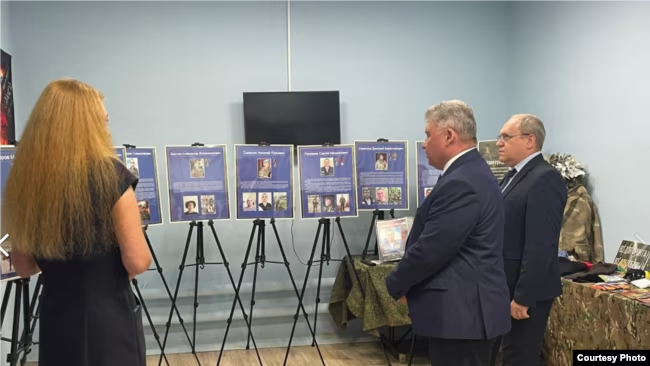
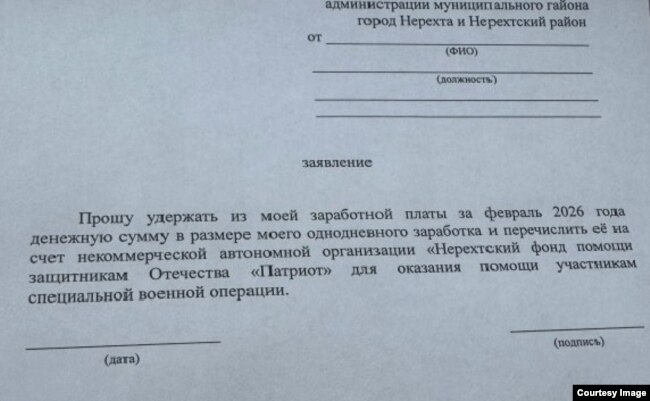
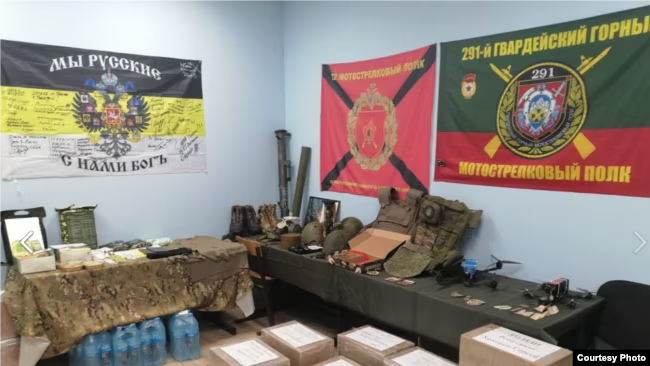
This is a large-scale, coordinated practice which in the Republic of Komi (as in many other regions of the RF) bears a semi-official, forced character. The authorities operate through administrative pressure, using the mechanism of so-called “voluntary-compulsory” charity.
The confirmed facts and schemes through which the leadership of the republic imposes a war tax on business are as follows:
1. The Mechanism of “Buffer” Funds
The main official instrument for collecting money from large, medium, and even small businesses in Komi is the “Pobeda” (Victory) charitable fund (in a number of other documents, it is referred to as the Mariupol or republican aid fund; no official website exists), operating with the full support of the administration of the head of the region.
• How it works: “urgent recommendations” signed by officials are handed down directly from city administrations (Syktyvkar, Ukhta, Vorkuta) and from ministries to the heads of commercial enterprises, retail chains, logging companies, and utility contractors.
• In these letters, businessmen are “asked” to transfer specific sums (depending on the company’s turnover) to the fund’s accounts for the “humanitarian needs of military personnel”, the procurement of uniforms, drones, or the reconstruction of sponsored territories (for instance, Mariupol).
2. Public Blackmail and Harassment of “Dissenters” by the Leadership of Komi
https://www.svoboda.org/a/reklamschiki-pozhalovalis-na-glavu-komi-iz-za-z-bannerov/32694219.html
The fact that the authorities force businesses to pay and publicly punish those who refuse is confirmed by a high-profile scandal in Syktyvkar, which officially entered the public domain.
• The ex-Head of Komi, Vladimir Uyba, publicly launched into threats against local entrepreneurs. He accused businesses of a “lack of patriotism” and a thirst for profit because one of the merchants refused to display posters of SMO [Special Military Operation] contract soldiers on his billboards for free and removed them after the paid period had expired.
• Uyba explicitly stated: “He is not respected at all… For him, profit is more important”, making it clear that the commercial activities of enterprises that do not support the war with resources will be blocked by the authorities.
• The Outdoor Advertising Association of the Republic of Komi was then forced to make excuses and publish reports proving that they had already displayed over 400 military banners at their own expense in order to avoid inspections and the revocation of licences.
3. Sectoral Extortion: The Timber Industry Complex and Housing and Communal Services
The greatest pressure is exerted on two spheres: logging (the main sector of Komi’s economy) and companies dependent on government contracts.
• Timber for the front line: from the logging enterprises of the republic (in Udorsky, Priluzsky, and Kortkerossky districts), officials demand, in an ultimatum form, the shipment of sawn timber, beams, and roundwood for the needs of the Ministry of Defence (the construction of dugouts and trenches). Businesses are obliged not only to allocate wood at their own expense but also to pay for the logistics to the front. A refusal to provide this “timber tax” automatically entails the termination of forest lease agreements by the Ministry of Natural Resources of Komi under any bureaucratic pretext.
• Public procurement as a hook: contractors carrying out road repairs, heating network maintenance, or public space improvement in the cities of Komi are coerced into purchasing expensive equipment (thermal imagers, generators, quadcopters) according to lists sent from the administrations. If a company director refuses to “help the fighters”, they begin to face problems with the acceptance of completed works, and payments under government contracts are frozen.
4. Extortion at the Municipal Level (Pechora, Inta, Vorkuta)
The mayors of Komi’s cities hold regular “closed meetings” with the local council of entrepreneurs. No official minutes are kept at these meetings, but the rules of the game are explained to the merchants in plain terms: if a business wants to operate without unscheduled inspections by Rospotrebnadzor, the Ministry of Emergency Situations (fire inspection), and the tax authority, it must make its monthly contribution. For small shops, car repair shops, and cafes, this translates into an obligation to purchase canned meat, walkie-talkies, or thermal underwear, which are then centrally packaged under the branding of the “United Russia” party or city administrations.
In 2022–2024, the financing of the war by business in the Republic of Komi ceased to be voluntary. The authorities have built a system of soft economic terror: those who pay into the funds and supply resources for the SMO receive a green light for government contracts; those who try to stay on the sidelines face public harassment, inspections by regulatory bodies, and the threat of their business being destroyed.
If we speak specifically about the most recent news of the past few months and the current period of 2025–2026, the vector of state pressure on business in Komi has noticeably shifted. The approach itself has changed: instead of one-off scandals involving posters and stickers, the system has transitioned towards the institutional and compulsory formalisation of business obligations.
Instead of emotional demands to “help”, strict regulatory requirements are now being introduced. According to recent publications by independent channels and regional media over the latest period, new trends can be clearly traced:
1. A Tax in the Form of Workplaces and Forced Quotas
https://komiinform.ru/news/291008
One of the most recent regulatory mechanisms of pressure has been recorded in the official sector, but is being actively criticised by independent labor market analysts.
• The essence of the coercion: the authorities of the republic have drafted a bill that obliges commercial enterprises (with more than 100 employees) and large individual entrepreneurs to introduce mandatory quotas for hiring those returning from the front. For businesses, this means a virtual loss of autonomy in personnel policy: companies are forced to hire people according to state assignments, regardless of their actual qualifications and alignment with business objectives. A refusal to meet the quotas threatens the business with large administrative fines and inspections by the labor inspectorate.
2. Change of the Head of the Region: The End of the Era of Uyba’s Open Feuding with Business
The most important change in the political landscape of Komi is the resignation of Vladimir Uyba from the post of the Head of the Republic, which took place at the end of 2024.
• Independent political scientists (in publications by the outlets “7×7 — Horizontal Russia” and “Club of Regions”) noted that one of the reasons for his early departure was precisely the protracted conflict with local elites and the commercial sector. Uyba’s style – with his public insults directed at entrepreneurs, accusations of them profiteering, and threats over their refusal to display Z-symbology – created excessive public noise and harmed stability in the region.
• The new head of the republic changed tactics: public floggings in Telegram channels ceased, but the extortion became quiet and systemic. Communication with businesses has now been moved to the level of closed specialised committees and “councils of industrialists”, where the distribution of the financial burden for procuring equipment for the front takes place without unnecessary witnesses or media scandals.
3. Polar Trend: Benefits for “Their Own” and the Suffocation of Independents
https://vk.com/wall-11948594_220780
In parallel, in 2025–2026, a substitution mechanism has been launched: whilst independent business is being suffocated by taxes and inspections, loyal merchants are being granted preferences.
• The state is actively pumping grants and subsidies into new commercial structures opened by combat veterans, creating a preferential environment for them. At the same time, the old, traditional small and medium-sized business of the republic (especially in the services and logistics sector) that attempts to distance itself from the military agenda faces an increasing tax burden and a complete lack of support from the authorities.
Summary:
The most “novel” aspect of the situation in Komi is that the coercion of business has become commonplace, systemic, and quiet. The regional authorities no longer throw tantrums on camera over removed banners; they simply introduce quotas, utilise tax control, and create conditions under which only business that is fully integrated into the state military machine can operate legally in the republic.