
Report on Human Rights Violations in Kabardino-Balkaria
August 2026
Khava Beshtoeva
A comprehensive analysis of materials from independent media, monitoring internet resources and official statements by citizens for August 2026 testifies to an irreversible trend towards large-scale restriction of human rights and freedoms by state authorities and security agencies in Kabardino-Balkaria, Karachay-Cherkessia and Adygea. The precedents documented during the reporting period indicate the coordinated nature of law-enforcement practice, the key elements of which have become politically motivated pressure on public opinion leaders, direct repression against the human rights community, fabrication of accusatory materials and systematic violation of the right to a fair trial. The scale and depth of the recorded violations of fundamental constitutional guarantees underline the critical necessity of consolidating the efforts of independent human rights institutions for monitoring the situation and protecting citizens in the republics of the macro-region.
An analysis of the human rights situation indicates that the greatest number of systemic human rights violations falls on the Kabardino-Balkarian Republic:
Cycle of persecution under “anti-war” articles
- For a video published in WhatsApp the Nalchik City Court found resident of Nalchik Shakhin Shikhmuradov guilty of discrediting the armed forces of the Russian Federation and fined him 30 thousand roubles.
According to the case materials, he filmed a video in which he called for public actions aimed at discrediting the army and then sent the clip to a group in the messenger.
https://www.kavkaz-uzel.eu/articles/425420 - For a video published in WhatsApp the Nalchik City Court found Azamat Balkizov guilty of discrediting the armed forces of the Russian Federation and fined him 30 thousand roubles.
According to the case materials, resident of Nalchik Azamat Balkizov posted in the messenger a video whose content the security forces considered to be discrediting the army. They drew up a protocol against Balkizov and sent the materials to the court.
https://www.kavkaz-uzel.eu/articles/425443 - For a post published on Instagram the Urvan District Court found Islam Zhanov guilty of discrediting the armed forces of the Russian Federation and fined him 30 thousand roubles.
According to the case materials, on 18 March 2022 resident of Urvan District Islam Zhanov published in the community “Positive Nalchik” on Instagram a post that was assessed by the security forces as aimed at discrediting the army.
https://www.kavkaz-uzel.eu/articles/425479 - For reasons not made public the court in Nalchik fined local resident Eduard Udovydchenko, finding him guilty of discrediting the military.
Law-enforcement officers drew up a protocol on discrediting the army against resident of Nalchik Eduard Udovydchenko and then sent the materials to the court. The Nalchik City Court found Udovydchenko guilty under Article 20.3.3 of the Code of Administrative Offences of the Russian Federation “Discrediting the armed forces of the Russian Federation” and fined him, as reported in the case card published on the court’s website. At the same time the court materials do not indicate for what the security forces drew up the protocol against Udovydchenko, nor do they provide details of the case.
https://www.kavkaz-uzel.eu/articles/425902
The law-enforcement practice under Article 20.3.3 of the Code of Administrative Offences of the Russian Federation (discrediting the Armed Forces of the Russian Federation) in the Kabardino-Balkarian Republic during the reporting period demonstrates a stable cycle of persecution of citizens for expressing opinions in the digital space. At the same time, in a number of cases the pretext for persecution is the distribution of video recordings inside closed or semi-private groups in the WhatsApp messenger. The imputation of “public actions” for activity in private messenger chats blurs the very legal concept of publicity and invades the sphere of the secrecy of personal correspondence.
The fact of retrospective persecution reveals cases of imposition of fines for publications from 2022, indicating the continuing practice by the security forces of monitoring archival records of many years’ standing. The qualification of old publications as continuing offences creates for citizens a situation of permanent legal vulnerability.
The described conveyor-belt nature of the consideration of cases under Article 20.3.3 of the Code of Administrative Offences of the Russian Federation in the region forms an atmosphere of total self-censorship among the population, restricts the freedom of speech guaranteed by the Constitution of the Russian Federation and requires human rights institutions to conduct enhanced monitoring in order to prevent the automatic transfer of these administrative cases into the plane of criminal prosecution under repeated articles.
Exceptions:
- The Nalchik City Court returned to the security forces a case of discrediting the army because of violations.
According to the case materials, the security forces in Nalchik drew up a protocol on discrediting the army against local resident Pavel Ulimbegov and sent the materials to the court. However, the judge refused to consider the case and returned it to the security forces.
“In order to eliminate the identified shortcomings and violations <…> the protocol and other materials of the case attached to it are subject to return, since the incorrect formalisation of the case materials, and accordingly their incompleteness, cannot be remedied during consideration,” is stated in the case card published on the court’s website.
The case materials do not contain information about the reason for which the security forces drew up the protocol against Ulimbegov.
https://www.kavkaz-uzel.eu/articles/425636
Lawyer and blogger Ilya Remeslo was returned from a psychiatric hospital back to a pre-trial detention centre
It will be recalled that native of Nalchik, pro-government lawyer and blogger Ilya Remeslo published posts with sharp criticism of Vladimir Putin in March 2026. Later he was hospitalised in City Psychiatric Hospital No. 3 named after Skvortsov-Stepanov in Saint Petersburg. In the media and Telegram channels it was discussed that this could have been an attempt to avoid criminal prosecution.
https://meduza.io/feature/2026/03/19/bloger-i-donoschik-ilya-remeslo-vystupivshiy-protiv-putina-okazalsya-v-psihiatricheskoy-bolnitse
On 17 July Remeslo was detained on charges of spreading fakes about the army motivated by political hatred; on the same day a court in Moscow remanded him in custody for two months.
https://meduza.io/feature/2026/03/19/bloger-i-donoschik-ilya-remeslo-vystupivshiy-protiv-putina-okazalsya-v-psihiatricheskoy-bolnitse
At the end of July Ilya Remeslo was transferred from the pre-trial detention centre to Moscow to the National Medical Research Centre of Psychiatry and Narcology named after V. P. Serbsky for the conduct of a forensic psychological-psychiatric examination.
https://www.kommersant.ru/doc/8845129
On 24 August 2026 TASS, citing the defence lawyer of the accused Sergei Badamshin, reported that Ilya Remeslo had been transferred from the Serbsky Institute to a pre-trial detention centre.
https://www.zaks.ru/new/archive/view/268415
Remeslo was transferred back to Pre-trial Detention Centre No. 7 of the city of Moscow. In the institute an inpatient psychological-psychiatric forensic examination was conducted in respect of the blogger, as a result of which he was found to be of sound mind.
https://www.instagram.com/reels/DcjFzpMzIVD/
In the end the native of Nalchik, blogger Ilya Remeslo, failed to achieve recognition of the arrest in the case of spreading fakes about the army as unlawful.
The Moscow City Court recognised as lawful the decision of the Basmanny Court of Moscow on the arrest of blogger Ilya Remeslo, accused of spreading fakes about the armed forces of the Russian Federation, TASS reported.
“The decision of the court of first instance is to be left unchanged, and the appellate complaints are to be left without satisfaction,” the court’s decision states.
The hearing was held in closed session and lasted about 20 minutes; journalists were allowed in only for the announcement of the final decision. Remeslo tried to say something to journalists while awaiting the outcome, but the sound on the broadcast from the pre-trial detention centre was switched off.
After the end of the hearing Remeslo was disconnected from the video link, but then it was decided to reconnect him because the judge had not asked whether the decision was clear to him. “Thank you for the attention to my case. Russia will be free!” the blogger declared.
The blogger will remain in the pre-trial detention centre at least until 16 September 2026, while the materials of his case are being prepared for transfer to the Basmanny Court of Moscow.
https://www.dw.com/ru/kritikovavsego-putina-blogera-remeslo-otpravili-v-sizo-posle-ekspertizy-u-psihiatrov/a-78491205
The extension of the arrest of the well-known pro-Kremlin blogger and lawyer Ilya Remeslo, who himself for a long time specialised in complaints and denunciations against opposition figures, has become a vivid example of the operation of the launched “flywheel of repression,” which has now begun to absorb even the Z-patriots themselves.
The situation with his arrest and referral for psychiatric examination demonstrates important changes in state policy of control over the information field:
- Manipulation of punitive psychiatry: The referral of Ilya Remeslo to a psychiatric inpatient facility for the conduct of a comprehensive examination after he “allowed himself criticism” is a revival of Soviet practices of isolation. In the legal system this is used by the administration of the security forces for psychological pressure on the accused, the undermining of his authority and the creation of a barrier to full defence.
- Elimination of the “monopoly on criticism”: This case shows that the status of a speaker loyal to the state no longer guarantees inviolability. As soon as Z-bloggers go beyond the framework of topics rigidly agreed with the Kremlin (whether criticism of the Ministry of Defence, corruption, supply or strategy in the Special Military Operation), they are instantly equated with the systemic opposition. Against Remeslo exactly the same instruments were applied (including the article on “fakes about the army” and the extension of detention) that he himself approved in relation to other citizens.
- Exemplary process for the milieu: The detention of Remeslo in custody (extended by the Basmanny Court until 10 October), despite his past services to the system, is intended to become a signal for the entire community of military bloggers and “patriotic” opinion leaders. The state clearly makes it understood that any unauthorised reflection or criticism of the actions of the authorities from inside the Z-camp will be suppressed as harshly as possible, up to complete deprivation of liberty.
Cycle of persecution for activism and human rights activity
The Supreme Court of Kabardino-Balkaria left the sentence of Akhmed Pogorov unchanged
In November 2025 the Nalchik City Court, in closed session, delivered a verdict on the co-chairman of the World Congress of the Ingush People Akhmed Pogorov, sentencing him to nine years’ imprisonment in a general-regime colony. The politician was charged with organising violence against representatives of the authorities during the protests in Magas and participation in an extremist community. In addition to the prison term, the court deprived him of state ranks and awards; however, according to the testimony of relatives and close associates, this step in no way shook the deep respect and authority that Pogorov enjoys among the residents of Ingushetia.
In August 2026 the Supreme Court of Kabardino-Balkaria, having examined the appellate complaint of the former Minister of Internal Affairs of Ingushetia Akhmed Pogorov, recognised the decision as lawful and left the nine-year term in force. The defence side categorically disagrees with this decision, insisting that during the examination of the case concerning the Ingush protests and the extremist community the court of first instance committed fundamental procedural violations.
Akhmed Pogorov is a former head of the Ministry of Internal Affairs of Ingushetia and one of the leaders of the World Congress of the Ingush People. For a long time he was on the federal wanted list because of clashes between civil activists and security forces at the March rally in Magas in 2019. Even before the court decision was delivered, Rosfinmonitoring entered Pogorov in the register of extremists and terrorists. Representatives of the human rights community called this step a gross violation of the presumption of innocence, which from the outset predetermined the harsh accusatory bias of the entire process.
The lawyer detailed the gross procedural violations that accompanied the judicial proceedings. The most precedent-setting was the fact that after Pogorov was removed from the courtroom the hearings continued without his participation for eight months and ten days, during which 108 court sessions took place in the absence of the accused. In addition, the defence declared a restriction of the right to defence, since the convicted person was never given the opportunity to study the materials of his criminal case in full in order to prepare for the appellate process. According to the conviction of the lawyers, the verdict of the Nalchik City Court was in fact copied from the judgment of the Kislovodsk City Court of 2021 that was delivered in respect of the other leaders of the Ingush opposition. At the same time the materials concerning Pogorov himself were initially isolated into separate proceedings, and their independent examination dragged on for almost two and a half years.
It will be recalled that the key figures of the Ingush protest – seven civil activists – had earlier been convicted of creating and participating in an extremist community. In December 2021 the court sentenced Akhmed Barakhoyev, Musa Malsagov and Malsag Uzhakhov to nine years’ imprisonment each; Ismail Nalgiyev, Bagudin Khautiyev and Barakh Chemurziyev received eight years each, and Zarifa Sautieva seven and a half years in a colony.
The defence of the political prisoners attempted to challenge in the Supreme Court of the Russian Federation the harsh restrictions imposed on the activists after their future release; however, the highest instance refused to accept the complaint for consideration.
The origin of this large-scale political persecution was the events of 26 March 2019, when a mass rally, initially approved by the authorities, began in Magas. Despite the fact that the agreed time expired in the evening, the demonstrators decided to remain on the square overnight, after which on the morning of 27 March 2019 the security forces undertook a harsh forcible dispersal of the peaceful action.
Akhmed Pogorov became the eighth defendant in the “Ingush case” sentenced to a lengthy term of imprisonment.
https://www.svoboda.org/a/sud-ostavil-v-sile-prigovor-eks-glave-mvd-po-ingushetii-ahmedu-pogorovu/33825256.html
An analysis of the judicial process in respect of Akhmed Pogorov and other leaders of the Ingush protest reveals gross, unprecedented departures from the standards of fair justice and the principle of adversarial proceedings. The conduct of 108 court hearings over a period of more than eight months in the absence of the defendant who had been removed from the courtroom deprived him of the fundamental right to personal participation in the judicial examination and to direct defence against the charge brought. The situation was aggravated by the restriction of access to the case materials before the appellate examination, as well as by signs of textual borrowing (plagiarism) of the judicial decision from earlier judgments in the “Ingush case,” which calls into question the independence, objectivity and impartiality of the court of first instance.
The refusal of the Supreme Court of the Russian Federation to consider the complaint against the post-penitentiary restrictions for already convicted activists consolidates the practice of indefinite administrative pressure on civil leaders even after they have served their main sentence. Taken together, these facts make it possible to qualify the persecution of the leadership of the World Congress of the Ingush People as a coordinated campaign aimed at suppressing the lawful right of citizens to peaceful assemblies and to the expression of disagreement with the actions of the executive power.
Activists and human rights defenders appealed to the Prosecutor General of the Russian Federation with a call to protect the scholar Larisa Tupzokova from absurd accusations
Larisa Tupzokova is a professional journalist, philologist and teacher of the Circassian language. In October 2025 she stated that law-enforcement officers organised searches in the parental home on the territory of Adygea and subjected members of her family to interrogations within the framework of the investigation of a criminal case concerning extremist activity. Somewhat earlier, at the end of September, Tupzokova, who currently resides in Georgia, received information that a criminal case under an extremist article had been officially initiated against her in the Russian Federation. These events were preceded by the appearance on the internet (approximately one month earlier) of a forged web resource of the Circassian Cultural Centre in Tbilisi, previously recognised as extremist, on which various publications were distributed in the name of Larisa Tupzokova.
In August 2026 an open appeal by representatives of the Circassian activist community, addressed to the Prosecutor General of the Russian Federation, was published on the official portal of the Kabardino-Balkarian Human Rights Centre, with a demand to pay attention to the continuing persecution of Larisa Tupzokova.
“We, representatives of the Circassian public, figures of science and culture, address you in connection with a flagrant case of unlawful criminal prosecution which has already received a wide public resonance both in the Russian Federation and beyond its borders. We are speaking of the case against the recognised scholar-philologist, teacher of the native language, poet and translator Larisa Tupzokova, who is charged with participation in the activity of an organisation recognised as extremist,” the appeal states.
The authors of the appeal emphasised that the defence counsel of Larisa Tupzokova was finally given the opportunity to study the materials of the criminal case. A detailed analysis of these documents clearly demonstrated that “the criminal prosecution is completely devoid of a factual basis and rests on deliberate distortions of reality.” “This process is not the fruit of an honest investigation, but a premeditated fabrication of an indictment with the aim of transferring into the criminal plane the absolutely lawful educational activity of a specialist whose only ‘fault’ consists in the preservation of native culture and language. The text of the decision on bringing as an accused is overflowing with factual inaccuracies, each of which is easily annulled by official state acts. First of all, the investigative bodies deliberately distort the legal status of the Circassian Cultural Centre in Tbilisi (entered in the Russian Federation in the register of extremist structures), of which Tupzokova was an employee. The security forces position it as a ‘foreign non-governmental non-commercial organisation,’ although in reality this centre is a legal state institution integrated into the structure of the Ministry of Culture of Georgia, which is directly proved by official governmental data and is not subject to doubt. Moreover, the Supreme Court of the Russian Federation imposed a ban on an extremist association with a completely different name; however, the investigation stubbornly ignores the objective facts and continues to advance its erroneous legal qualification,” the human rights defenders stated.
In addition, Tupzokova is attributed the status of senior research fellow, which she in reality never held, and it is also asserted that she continues her activity in the centre to this day. However, proceeding from the official contract and the order on dismissal of 27 August 2024, she was an ordinary specialist and terminated the employment relations long before the Supreme Court of Russia in June 2024 delivered the decision on the ban of the organisation as extremist. In fact her work in this institution ceased as early as the autumn of 2023. From this it follows that the participation in the activity of the structure after it received the status of extremist that is imputed to her is chronologically impossible and is completely refuted by documents. Equally absurd appears the situation with the imposition on Tupzokova of responsibility for the creation of the project Circassian Media. The investigative bodies, deliberately or out of negligence, name her the founder of this platform, despite the fact that the author and head of the project is a completely different person,” the human rights defenders summarised, separately pointing out that “in the materials of the investigation not a single concrete reference is given to articles, interviews or media materials that would contain calls to unlawful activity.”
“Not a single quotation is given, it is not indicated whether a linguistic or political-science examination of these materials was conducted, the evidence is not named on the basis of which the investigation draws such serious conclusions. Such construction of the accusation is a direct violation of the principle of concreteness and substantiation provided for by the criminal-procedure law,” they noted.
The authors of the appeal emphasised that even personal data have been distorted: thus, in the decision it is asserted that Tupzokova has no minor children, whereas she is the mother of three children, one of whom is a citizen of the Russian Federation, and this fact is confirmed by birth certificates.
“Also the investigation asserts that she left Russia in 2017 in order to carry out extremist activity; however, it is documented that she has resided in Georgia since 2011 in connection with the conclusion of marriage with a citizen of Georgia, which is certified by the marriage certificate of 10 February 2012, and all her subsequent trips to the Russian Federation were exclusively of a personal character. The assertion that she is hiding from the investigation also does not correspond to reality, since she has not changed her place of residence, has not changed passport data, and her contact telephone number has remained unchanged since 2011 and was available in the public space. The investigation had every opportunity to contact her, but preferred to follow the path of an in-absentia arrest and declaration as wanted, which is a clear abuse of procedural rights,” the appeal states.
The complete absence in the case materials of substantive evidence, specialised expert conclusions and even elementary quotations from the incriminated statements directly testifies to the fact that the objective side of the imputed crime was constructed artificially. The entire mass of the accusation is based on a systematic and deliberate substitution of real facts – beginning with the official status of the organisation itself and the post occupied by the accused, ending with the distortion of information about her family status and the exact dates of relocation abroad, the human rights defenders summarised.
“Each significant point of the accusation is refuted by official documents which Tupzokova has already transferred to her lawyer and which are ready to be presented at any moment. The absence in the case of concrete evidence, expert conclusions and even simple quotations of the incriminated statements testifies to the fact that the objective side of the crime has simply been constructed artificially. To us, as representatives of the public, the true reason for what is occurring is obvious. This is not a struggle against extremism, but a politically motivated action aimed at the discrimination of the Circassian national movement and the criminalisation of scholars and cultural figures who preserve the native language and historical memory,” the authors of the appeal indicated.
The human rights defenders particularly emphasised that Larisa Tupzokova is one of the most authoritative representatives of the Circassian intelligentsia, whose educational works have earned deep recognition both in the homeland and among the numerous foreign diaspora. Numerous appeals in her support that have arrived from Circassian associations and prominent public figures from different countries of the world clearly demonstrate the international scale and the obviousness of the injustice with which the researcher has been confronted.
About 30 well-known human rights defenders and civil activists representing Adygea, Kabardino-Balkaria, Karachay-Cherkessia and Krasnodar Krai came forward with a consolidated demand to immediately close the criminal case against Tupzokova in connection with the complete absence of the very event of the crime. The authors of the collective statement separately highlighted her invaluable contribution to the cause of the preservation and development of the native language, and also warned that this persecution risks turning into a dangerous precedent for repressions against any other persons who in different years legally interacted with the Circassian Cultural Centre in Tbilisi.
“We are compelled to state that this criminal case is an example of the crudest judicial and investigative error bordering on falsification. The criminal prosecution is carried out for actions which the accused did not commit, and the very plot of the case does not correspond to the factual circumstances under any of the key elements of the corpus delicti,” they indicated, noting that a “dangerous precedent arises when cultural activity, scientific research and literary creativity may be arbitrarily declared a crime.”
“We address you as the highest official of the procuracy bodies of the Russian Federation, authorised to exercise supervision over the precise and uniform execution of the laws in the course of inquiry and preliminary investigation. We are convinced that the referral of this criminal case to court will entail not simply a judicial error, but the conscious legitimisation of knowingly false accusations, which is inadmissible both from the positions of strict observance of the law and from the point of view of the fundamental principles of justice. In this connection we request you immediately to conduct a verification of all the circumstances set out in the appeal, to give a proper assessment of the actions of the investigators who committed the crudest factual errors and ignored the obvious documentary evidence. We also request that you take the measures of prosecutorial response provided for by law and terminate the criminal prosecution of Larisa Tupzokova in connection with the absence of both the event of the crime and the corpus delicti in her actions. We are convinced that only your direct intervention is capable of stopping the flagrant arbitrariness and restoring the trampled justice,” the authors of the appeal stated.
It was signed by the chairman of the Kabardino-Balkarian branch of the “Russian Association of Victims of Political Repressions” (Nalchik) Marks Shakhmurzov, the chairman of the Kabardino-Balkarian Regional Human Rights Centre (Nalchik) Valery Khatazhukov, retired police colonel, honorary employee of the Ministry of Internal Affairs of the Russian Federation Ramazan Achmizov, public figures Ruslan Gvashev (settlement of Lazarevskoye, Sochi), Albert Adamokov and Mukhamed Cherkesov (Cherkessk), Ruslan Achmiz (Maykop), Alik Shashev, Ismel Meshev and Azamat Shormanov (Nalchik), Honoured Worker of Culture of the Republic of Adygea Abid Gissa (Maykop), teacher of the Adyghe language Dakhanagu Achokh (Tuapse), artist Zaudin Tokov (Nalchik), People’s Artist of the Republic of Adygea and Honoured Artist of the Karachay-Cherkess Republic Abdyullakh Bersirov, and Honoured Doctor of the Russian Federation Bayzet Skhalyakho.
https://zapravakbr.ru/obrashchenie-cherkesskoi-obshchestvennosti-k-generalnomu-prokuroru-rf-s-prizyvom-zashchitit-uchenuyu-larisu-tupcokovu-ot-absurdnyh-obvinenii/
https://www.svoboda.org/a/doroga-domoy-zakryta-za-chto-presleduyut-cherkesskuyu-zhurnalistku/33837706.html
The criminal prosecution of L. Tupzokova bears signs of the artificial construction of the corpus delicti and gross violation of the standards of legality on the following grounds:
- Violation of the principle of chronological succession: The imputation of participation in the activity of an “extremist organisation” (Article 282.2 of the Criminal Code of the Russian Federation) is chronologically impossible, since Tupzokova’s employment relations with the Circassian Cultural Centre in Tbilisi were officially terminated in August 2024, that is, long before the entry into force of the decision of the Supreme Court of the Russian Federation on the recognition of the organisation as extremist. The law does not have retroactive force (Article 10 of the Criminal Code of the Russian Federation).
- Falsification of the objective side of the crime: The accusation is built on the substitution of the legal status of the organisation (a state institution of the Ministry of Culture of Georgia is positioned as a foreign NGO) and the attribution to the accused of someone else’s authorship (the Circassian Media project), posts and questionnaire data. In the case materials concrete facts, quotations or expert conclusions confirming the commission of unlawful acts are completely absent.
- Use of digital falsifications (spoilers): The initiation of the case was preceded by the creation of a fake website-double of the organisation, which indicates a coordinated campaign for the fabrication of digital evidence and the creation of false pretexts for persecution.
The persecution of Larisa Tupzokova bears a pronounced political character and is directed at the criminalisation of lawful international cultural-educational activity. The case creates a dangerous precedent of “collective guilt” for any representatives of the Circassian intelligentsia and diaspora who have ever collaborated with cultural institutions of Georgia.
Unlawful actions of the security forces in respect of the human rights defender Valery Khatazhukov
Border control at the international airport of Mineralnye Vody held the head of the Kabardino-Balkarian Human Rights Centre Valery Khatazhukov for more than two hours, subjecting him to interrogation about his professional activity and contacts in Turkey.
The human rights defender was returning from Istanbul, where he was undergoing complex medical treatment – an operation for the removal of a malignant neoplasm. As Khatazhukov himself noted, he answered in full the standard questions of the officers of the border service about the purposes of his visit abroad and provided official extracts from the Turkish hospital. However, the security forces did not limit themselves to the verification of the medical certificates and proceeded to questioning about the internal work of the human rights organisation, and also attempted to find out whether Turkish citizens had visited him in the ward.
In connection with the unlawful pressure and excess of powers on the part of the officers of the agency in Mineralnye Vody, Valery Khatazhukov sent an official complaint addressed to the Prosecutor General of the Russian Federation.
Representatives of the agency categorically refused to state their surnames and to show service documents, referring only to the conventional identification code “VN-0071,” and justified the two-hour holding by an abstract reference to the conduct of a military operation. In the text of the official complaint published on the portal of the Human Rights Centre of Kabardino-Balkaria, Khatazhukov emphasises that no lawful procedural decisions on his administrative detention were adopted by the security forces, just as there were no objective signs of the commission by him of any offence.
The head of the centre qualified such actions of the officers of the border service as a direct trampling of Articles 22, 23 and 24 of the Constitution of the Russian Federation, which guarantee citizens freedom, personal inviolability, protection of private life and establish a strict prohibition on the collection of confidential information about a person without his personal approval. The forced collection of information about professional human rights activity and personal connections completely goes beyond the framework of the purposes of border control regulated by federal legislation, and the very deprivation of freedom of movement had no lawful grounds for detention. Upon confirmation of the indicated facts what occurred must be assessed as a criminally punishable excess of official powers.
In his appeal Khatazhukov demands the initiation of an official investigation for the identification of the personal data of the officials hiding under the cipher “VN-0071.” As an evidentiary base official copies of medical certificates from the Istanbul oncological centre are attached to the statement.
Such harsh filtration measures at the international airport of Mineralnye Vody have acquired a systemic character, regularly affecting both permanent residents of Kabardino-Balkaria and representatives of the Russian Circassian diaspora arriving from Turkey and other states, the head of the centre states. According to his deep conviction, such selective and biased attention of the security structures to citizens returning from abroad not only violates their lawful rights but also inflicts serious reputational damage on the Russian Federation, discrediting its status as a state governed by the rule of law.
https://zapravakbr.ru/valerii-hatazhukov-bolee-dvuh-chasov-v-aeroportu-mineralnye-vody-posle-operacii-v-stambule-sotrudniki-pogranichnoi-sluzhby-vypytyvali-moi-svyazi-v-turcii-i-podrobnosti-svyazannye-s-moei-pravozashchitn/
https://memorialcenter.org/ru/news/v-minvodah-pogranichniki-uderzhivali-70-letnego-pravozashhitnika
The chairperson of the Committee “Civil Assistance,” Svetlana Gannushkina, commenting on the situation, noted that there is “a rather large flow of complaints that people are not allowed through the border in Russia, in general, without any grounds. An eighty-year-old woman was not allowed through even though she regularly lived in Russia with her daughter – a Russian citizen. According to them, she represents a ‘danger to the defence capability of the Russian Federation.’ Imagine, a grandmother who is a threat to defence capability. They also did not allow a student who was studying in the Russian Federation to return. In response to our new appeals they finally answered: ‘We recommend repeating the attempt to enter the Russian Federation after the end of the Special Military Operation,’” she related.
A representative of the Human Rights Centre of Kabardino-Balkaria, Zaur Shokuev, considers that the probability that in the course of a prosecutorial verification concrete officials involved in this incident will be identified is, as practice shows, extremely small.
In the opinion of the human rights defender, the significance of the prosecutorial assessment is determined not by the private character of the incident, to which Khatazhukov points in his statement, but by the systemic nature of the practice of the border guards.
The activist from Nalchik Olga Begretova complained of forced fingerprinting at the airport of Mineralnye Vody in November 2022. The investigation did not find violations in the actions of the border guards. Begretova applied to the military court in Pyatigorsk with a demand to oblige the investigation to initiate a case against the officers of the border service; however, the court recognised as lawful both the actions of the border guards and the refusal of the investigation to investigate the incident. After that the activist demanded that the refusal of the republican Directorate of the Federal Security Service to provide the information collected about her be recognised as unlawful. The Nalchik City Court, referring to state secrecy, refused the claim; the Supreme Court of Kabardino-Balkaria left this decision in force. In November 2024 Begretova demanded that a verification be conducted in order to eliminate the contradictions in the statements of representatives of the Border Directorate of the Federal Security Service for Kabardino-Balkaria. She received no answer and complained to the Military Investigative Directorate of the Investigative Committee for the Southern Military District about the inaction of the 55th Military Investigative Department.
https://www.kavkaz-uzel.eu/articles/426133
The incident with the forced holding and interrogation of V. Khatazhukov at the airport of Mineralnye Vody contains signs of a gross violation of the constitutional rights of a citizen and excess of official powers by officers of the Border Service of the Federal Security Service of the Russian Federation. The described incident requires the conduct of an official verification by the bodies of the military procuracy for the establishment of the identities of the officers and the legal qualification of their actions. The practice of unfounded filtration measures in respect of activists undermines the constitutional foundations of a state governed by the rule of law.
Death of the Circassian repatriate Nurdin Karaf and the refusal of the security forces to hand over the body to the relatives
Resident of Nalchik Khalid Karaf, who had come to Russia as a repatriate from Syria, his wife and daughter were summoned to the Federal Security Service after the man tried to find out the fate of his missing son. Khalid was threatened that his son and he himself would be “sent to the Special Military Operation as assault troops,” and later he was informed that his son was dead.
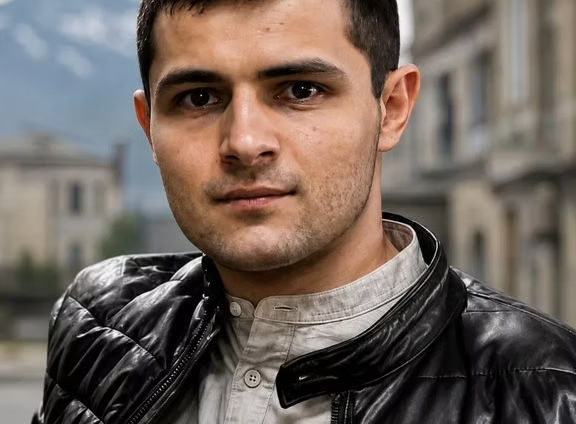
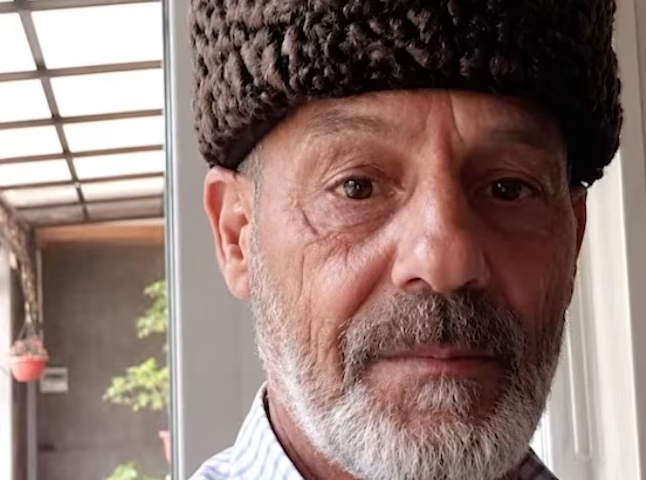
In the opinion of the father, the reason for the detention of Nurdin could have been his own posts and comments on social networks. “I wrote and write the truth,” Karaf emphasised.
Late in the evening of 5 August one of the activists of a Circassian organisation, speaking on condition of anonymity, informed a correspondent of the “Caucasian Knot” that Khalid Karaf, his wife and daughter had been summoned to the Federal Security Service. There the members of the family were told that Nurdin Karaf was dead.
During this period the father of Nurdin, according to reports, was forced to record a video in which it is asserted that his son voluntarily served as a contract soldier in the Russian armed forces. Circassian activists familiar with the case resolutely reject this assertion. They assert that Nurdin was not a contract soldier and that the recorded statement of his father was made under compulsion. Therefore they assert that the video cannot be regarded as a voluntary or reliable account of the military status of Nurdin or the circumstances of his disappearance.
“As far as I know, now they will try to make Khalid record a refutation of his statements about the disappearance of his son. He himself is trying to achieve that the body of his son be given to him,” the activist emphasised.
https://sovanews.tv/2026/08/17/propavshij-sirijskij-cherkes-mog-byt-zamuchen-do-smerti-v-rossijskoj-armii-zayavlyayut-aktivisty
https://www.kavkaz-uzel.eu/articles/425525
According to information of the internet resource “justicefornorthcaucasus.info,” according to sources close to the Russian special services, Nurdin was in fact forcibly mobilised by the Russian military and was to be sent to fight on the Ukrainian front. The sources indicate that he resisted being sent to the war and was subsequently delivered to a mobilisation camp, the location of which remains unknown.
It is reported that Nurdin was subjected to cruel torture in the camp. It is believed that he died as a result of the torture to which he was subjected because of his resistance to forced mobilisation.
Subsequently his family was informed of his death and shown photographs of his body. However, the handing over of the body of Nurdin Karaf to the relatives was refused. A report of the forensic medical examination or a transparent official explanation of the circumstances and the exact cause of his death were not made public; an alternative autopsy is not possible in view of the absence of access to the body.
Sources familiar with the case expressed concern that the body may be kept for a prolonged period. Such a delay may lead to the fact that possible traces of torture — especially damage to soft tissues — and other forensic evidence will deteriorate or become more difficult to identify, which potentially places under threat the independent establishment of the cause and circumstances of the death of Nurdin.
The report of the refusal to hand over the body intensified the negative resonance in Circassian communities. Suspicions also arose that the delay may be directed at obstructing the conduct of an independent pathologico-anatomical examination and preventing the effective documentation of injuries that could establish the cause of the death of Nurdin.
Circassian activists call for the immediate return of the body of Nurdin to his family, for the preservation of all possible evidence and for an independent investigation of his forced mobilisation, the reports of torture and the death.
Reports of torture, deaths during detention and other serious human rights violations in Russian places of detention have repeatedly been documented by human rights organisations. Against this background the assertions about the death of Nurdin Karaf and the reports of the compulsion of his family require an independent and transparent investigation.
Human rights defenders and experts published an appeal demanding that the authorities and security agencies of the Russian Federation observe the Law of the Russian Federation “On Burial and Funeral Business,” according to which relatives have an unconditional right to receive the body of the deceased for the conduct of rites at least, as well as an official medical certificate of death with indication of the exact cause and the results of the forensic medical examination and the ensuring of the possibility of a repeated independent examination.
They called for the observance of the norms of International Humanitarian Law, in particular the “Geneva Conventions,” in the event that even if the official bodies insist on the version that Nurdin Karaf was a contract serviceman – the state is obliged to facilitate the search, identification and respectful return of the remains of the fallen to their families.
They accentuated the fact that if the version of the human rights defenders about forcible holding and torture is confirmed, the refusal to hand over the body will be regarded by international law as a continuation of inhuman treatment of the family of the deceased.
The team of “Ombudsman Media” together with the International Circassian Center for Support and Assistance (USA) note that, despite the fact that Russia has left the Council of Europe and no longer executes new judgments of the European Court of Human Rights, the special procedures of the United Nations Organisation still remain a key legal lever at the international level.
In this connection an appeal was prepared to the Working Group of the United Nations on Enforced or Involuntary Disappearances (WGEID), after the consideration of which the United Nations may send an official request to the government of the Russian Federation with a demand to clarify the fate and to hand over the remains.
A complaint was also formulated to the Special Rapporteur of the United Nations on extrajudicial, summary or arbitrary executions, who may initiate communication with the authorities of the Russian Federation, and to the Special Rapporteur of the United Nations on the situation of human rights defenders for the protection of the parents of Nurdin and the activists who are subjected to pressure.
A letter setting out the situation of Nurdin Karaf was sent to the Human Rights Committee of the United Nations (HRC UN), which has repeatedly recognised the non-handing over of bodies to relatives as a violation of the article prohibiting torture (in the context of the mental sufferings of the family).
Appeals were also sent to key international human rights organisations. First of all to Amnesty International & Human Rights Watch, which have well-established mechanisms of reaction to reports of torture and deaths in closed institutions. It is important that their verification of the case opens the doors to world media.
In addition, to the World Organisation Against Torture (OMCT) / International Federation for Human Rights (FIDH), which specialise in legal assistance to victims of torture and pressure on state bodies through international institutions.
As regards legal actions inside the Russian Federation, despite the bias of the system, the passage through the internal instances, unfortunately, remains obligatory – this is necessary for the fixation of the facts, the obtaining of official refusals (documents) and the subsequent transfer of the case to the United Nations. The family of Nurdin Karaf was informed of the necessary aggregate of actions in this direction.
https://cherkesusa.com/api/reports/cf598fe3-63a4-4891-b1ec-63e20f25a102/download
Cycle of persecution on charges of extremism
Real prison terms for participants of the mythical “Sharia patrol”
It will be recalled that in July 2024 residents of Tyrnyauz suspected of participation in “Sharia patrols,” which allegedly demanded that residents of the republic observe moral-ethical frameworks, were detained by the security forces. In June 2025 the case of the ten accused was sent to the Elbrus District Court.
In August 2026 the Elbrus District Court in Kabardino-Balkaria announced the sentence on the ten defendants in the criminal case of the “Sharia patrol.” Eight of them — Damray Bayzulayev, Azamat Zhashuyev, Tamaz Zvanbaya, Murman Ivechiani, Timur Kardanov, Aslan Nakhushev, Shamil Rakhayev and Zeytun Temmoyev — were charged with participation in an extremist community.
Nazhmudin Liyev, in addition to this article, was charged with public calls to extremism via the internet. Askhat Chechenov was considered by the accusation to be the organiser of the extremist community. In addition, Chechenov, like Liyev, was charged with public calls to extremist activity.
The court found all the defendants guilty. The organiser of the “Sharia patrols” was sentenced to seven years and six months of strict regime with restriction of freedom for two years. He was also forbidden to administer internet sites and to participate in the work of religious public organisations for three years after release.
Nine participants of the community received from three and a half to four and a half years in a general-regime colony with restriction of freedom for one year, the press service of the Elbrus District Court reported today on its website.
“How does some ‘Russian Community’ differ from the ‘Sharia patrols’? By the fact that the ‘Russian Community,’ obviously, has a certain roof and acts jointly with the security forces. And here there were no security forces, but at a certain moment they turned their attention to this group. Now they are fighting this phenomenon, along the way increasing the reporting on the struggle against extremism,” human rights defender of the “Memorial” centre Alexander Cherkasov commented on the situation in a report of Radio Liberty.
https://tass.ru/proisshestviya/28002801
https://www.svoboda.org/a/borjba-za-nravstvennostj-ili-ekstremizm-v-naljchike-sudyat-shariatskiy-patrulj-/33463773.html
At the same time four of the ten convicted in the case of the “Sharia patrols” filed appellate complaints against the sentence of the Elbrus District Court. Their defence calls the sentence unlawful and unfounded, raises the question of its cancellation and the full acquittal of the convicted persons.
It is noteworthy that even those who were numbered among the victims relate that the “extremist activity” of the convicted persons amounted to conversations in a room for the study of the Arabic language at the mosque.
Thus, resident of Tyrnyauz Babayev related that for behaviour improper in the opinion of the “Sharia patrol”: alcoholism, drug addiction, disorderly connections, the guilty were punished by a remark and obliged regularly to attend the mosque for the performance of the morning and evening namaz.
The court of first instance considered this an intentional crime against the foundations of the constitutional order of the Russian Federation, stating that they called people to this, “guided by religious-extremist convictions and motives alien to the state, with the aim of propaganda of the exclusivity of the religion professed by them over the other religions,” it follows from the sentence.
https://www.kavkaz-uzel.eu/articles/425977
Eleven young residents of the republic were named a “terrorist cell”
According to data of the Federal Security Service, officers of the special service jointly with officers of the Ministry of Internal Affairs detained in Zolsky District of Kabardino-Balkaria supporters of an international terrorist organisation (ITO) banned on the territory of Russia.
“In Zolsky District of the Kabardino-Balkarian Republic 11 participants of a terrorist cell of one of the ITOs, who propagated radical ideology and also committed violent actions in respect of citizens who do not share their views, have been detained,” RIA Novosti quoted the message of the special service.
https://www.kommersant.ru/doc/8908587
The Southern District Military Court in Nalchik began visiting hearings in the case of 11 residents of Dagestan who prepared terrorist acts at facilities of the Armed Forces of the Russian Federation, the Ministry of Internal Affairs and the Federal Security Service in Dagestan
The Southern District Military Court commenced the examination of the criminal case in respect of 11 persons who planned terrorist acts in Dagestan, Interfax reports citing its source. The process is taking place in closed regime.
It will be recalled that on 15 April it became known that the case of the preparation of terrorist acts in Dagestan in 2024, whose defendants are 11 persons, had been received for examination by the Southern District Military Court in Rostov-on-Don. For the acceleration of the process it was decided to conduct the first hearing of the court in Nalchik.
According to the indictment, the defendants planned terrorist acts, acquired weapons and cartridges. In addition, in the summer of 2024 they acquired substances and objects for the manufacture of explosives.
As the target for the commission of the terrorist acts the accused designated a military unit of the Armed Forces of the Russian Federation in Kizlyar, as well as the buildings of the Ministry of Internal Affairs and the Federal Security Service in Dagestan. They manufactured improvised explosive devices and transported them to a cache; however, they were detained after officers of the Federal Security Service discovered the cache with weapons and explosives.
On the dock are Yamlikhan Aliyev, Samir Amayev, Kasum Akuyev, Alibek Alibekov, Murtazali Magomedov and Ali Aliyev (all entered by Rosfinmonitoring in the list of terrorists and extremists), as well as Magomed Muridbekov, Magomed Amayev, Shamil Abubakarov, Rustam Dyshniyev and Artur Akhmedov, Kommersant informs.
According to the version of the investigation, the preparation for the terrorist acts began in 2022. The organiser of the group was Yamlikhan Aliyev, who gathered like-minded persons, distributed roles and designated the objects of the future attacks. One of his closest associates the investigation considers Magomed Muridbekov.
The majority of the defendants had secondary or higher education, worked in construction, private security enterprises or engaged in business. Many were married and were raising children. The youngest defendant — Alibek Alibekov — is 20 years old.
Depending on the role the accused are charged with organisation of a terrorist community and participation in it, assistance to terrorist activity, preparation for a terrorist act, illegal trafficking in weapons and explosive substances, as well as illegal manufacture of explosive substances and explosive devices. Under the most grave articles of the accusation they face life imprisonment.
https://www.interfax.ru/russia/1111369
https://www.kommersant.ru/doc/8908913
In the conditions of the total militarisation of the force space of the North Caucasus any forms of conventional civil protest are in fact criminalised. Not having legal institutional channels for the expression of disagreement with the political and military course of the state, young people go into the shadows: they distance themselves from official structures controlled by the state, preferring to profess religion and to build communal connections in independent, informal spaces — the so-called “home mosques” and private groups for the study of theology.
The Russian force apparatus systemically exploits this forced departure of the youth into autonomy. Any independent public organisation or religious practice outside the official “clergy” is immediately re-qualified as a threat to national security. Federal force structures routinely mark this local peaceful isolation as the activity of an “extremist underground” or participation in “terrorist cells.” For the state this substitution of concepts solves the most important task: it allows the justification of mass arrests, the fulfilment of statistical plans on the struggle against terrorism and the preventive clearing of any potential foci of national-liberation sentiments.
Criminal prosecution for refusal to participate in combat actions: judicial practice and statistics of losses
In August 2026 14 persons were sentenced by the Nalchik Garrison Military Court to real terms of imprisonment for unauthorised abandonment of the unit during the period of mobilisation*
In particular:
- Kazimir Chotchayev, whom the court in Nalchik sentenced to five years’ deprivation of liberty, finding him guilty of absence from service for more than one month.
According to the case materials, serviceman Kazimir Chotchayev on 28 October 2025, that is “during the period of mobilisation,” did not appear at the established time for service in the military unit in Ingushetia, the press service of the Nalchik Garrison Military Court reported on its page on VKontakte.
On 15 December of the same year Chotchayev voluntarily arrived at the military unit, and from 28 October to 15 December he spent time at his own discretion at his place of residence. - Islam Guchev, whom the court in Nalchik sentenced to six years’ imprisonment, finding him guilty of unauthorised abandonment of the unit.
According to the case materials, serviceman Islam Guchev on 26 July 2025 unauthorisedly left the place of service and on 22 January of the current year was detained by a police officer at a post of the federal highway in Uspensky District of Krasnodar Krai. Then on 24 February Guchev again unauthorisedly left the place of service and on 8 June himself appeared at the police department of Prokhladny, the press service of the Nalchik Garrison Military Court reported on its page on VKontakte. - Temerlan Gegirov, whom the court in Nalchik sentenced to five years’ imprisonment, finding him guilty of evasion of the performance of military service.
According to the case materials, serviceman Gegirov on 3 February 2026 unauthorisedly left the place of service, the press service of the Nalchik Military Court reported on its page on VKontakte.
On 25 June Gegirov voluntarily arrived at the military investigative department in Nalchik, and from 3 February to 25 June he spent time at his own discretion at his place of residence. - Viktor Dudnik, who was convicted by the military court in Nalchik to five years for a two-month absence from the unit.
Viktor Dudnik on 16 April 2026 “during the period of mobilisation” did not appear at the established time for service in the military unit. On 19 June 2026 Dudnik was discovered by an officer of a law-enforcement body in Prokhladnensky District of the Kabardino-Balkarian Republic, and from 16 April to 19 June 2026 Dudnik spent time at his own discretion at his place of residence, the press service of the Nalchik Military Court reported on its page on VKontakte. - Amir Kostoyev, whom the Nalchik Garrison Military Court sentenced to five years in a colony, finding him guilty of unauthorised abandonment of the unit.
The court established that Kostoyev on 17 March did not appear for service at the temporary deployment point of the military unit. On 1 June he voluntarily arrived at the military investigative department in the stanitsa of Troitskaya of Sunzhensky District of the Republic of Ingushetia, the press service of the Nalchik Military Court reported on its page on VKontakte. - Yusup Yedokov, whom the Nalchik Garrison Military Court sentenced to six years in a colony, finding him guilty of evasion of the performance of military service.
The court established that Yedokov on 18 February 2026 during the period of mobilisation did not appear at the established time for service in the military unit in Rostov Oblast. On 22 April Yedokov was discovered in the city of Prokhladny of Kabardino-Balkaria, and from 18 February to 22 April he spent time at his own discretion at his place of residence, the press service of the Nalchik Military Court reported on its page on VKontakte. - Rustam Khushtov, whom the Nalchik Garrison Military Court sentenced to five years in a colony, finding him guilty of evasion of the performance of military service.
The court established that Khushtov on 1 December 2025, that is “during the period of mobilisation,” did not appear at the established time for service in the military unit in Stavropol Krai.
On 29 June 2026 Khushtov voluntarily arrived at the military commandant’s office in Mozdok in North Ossetia, and from 1 December 2025 to 29 June 2026 he spent time at his own discretion at his place of residence, the press service of the Nalchik Military Court reported on its page on VKontakte. - Contract serviceman Zolotorev, whom the court in Nalchik sentenced to 10 years’ imprisonment, finding him guilty of absence from service for more than a month.
According to the case materials, serviceman Zolotorev from 17 February to 22 June was absent from service in the military unit. The investigation considers that during this period he spent time at his own discretion, including at his place of residence, the press service of the Nalchik Military Court reported on its page on VKontakte.
In March 2024 Zolotorev concluded a contract with the Ministry of Defence and was conditionally released. Since he had not served the punishment under the last sentence, the Nalchik Garrison Military Court sentenced Zolotorev to 10 years’ deprivation of liberty in a strict-regime colony, finding him guilty of absence from service for more than one month. - Artur Ulbashev, whom the court in Nalchik sentenced to five years and one month’s imprisonment, finding him guilty of unauthorised abandonment of the unit.
According to the case materials, serviceman Artur Ulbashev on 16 January did not appear for service, and then on 4 February himself arrived at the military unit. On 24 February he again did not appear for service, and then on 26 June came to the military investigative department. The investigation considers that in both cases Ulbashev was at his place of residence and spent time at his own discretion, the press service of the Nalchik Military Court reported on its page on VKontakte. - Salim Zhigunov, whom the court in Nalchik sentenced to six years’ imprisonment, finding him guilty of absence from service for more than one month.
According to the case materials, serviceman Salim Zhigunov on 23 January 2025 did not appear within the established period for service. On 12 April 2026 he was discovered by a policeman in Nalchik. Then on 27 May of the current year Zhigunov again did not appear for service, and on 9 June himself arrived at the military investigative department, the press service of the Nalchik Military Court reported on its page on Vkontakte. - Danila Kopylov, whom the court in Nalchik sentenced to five years’ imprisonment, finding him guilty of absence from service for more than one month.
According to the case materials, Kopylov on 12 August 2025 did not appear for service at the established time in the military unit, the press service of the Nalchik Military Court reported on its page on VKontakte. On 4 June 2026 he voluntarily appeared at the military commandant’s office in Mozdok, and from 12 August 2025 to 4 June 2026 Kopylov spent time at his own discretion at his place of residence.
- Aslan Ansokov, whom the court in Nalchik sentenced to six years’ imprisonment, finding him guilty of evasion of service.
According to the case materials, Ansokov on 23 April 2026 did not appear for service at the established time in the military unit, the press service of the Nalchik Garrison Military Court reported on its page on VKontakte.
On 7 June he voluntarily appeared at the military commandant’s office in North Ossetia, and from 23 April to 7 June 2026 Ansokov spent time at his own discretion at his place of residence.
The Nalchik Garrison Military Court found Ansokov guilty of failure to appear on time for service of a duration of more than one month. In addition, in the course of the court hearings it became clear that the accused had already been convicted in 2025 for absence from the military unit. At that time the court appointed him a punishment in the form of deprivation of liberty for a term of three years suspended with a probationary period of two years.
Thus, the court appointed him under the aggregate of sentences a final punishment in the form of deprivation of liberty for a term of six years. The convicted person will serve the appointed term in a general-regime colony. - Serviceman Vazarov, whom the Nalchik Garrison Military Court sentenced to six years in a general-regime colony for the fact that he twice without a valid reason failed to appear for service in the military unit.
The Nalchik Garrison Military Court delivered a sentence on the serviceman by the surname of Vazarov, finding him guilty of the commission of crimes under Part 3.1 of Article 337 and Part 5 of Article 337 of the Criminal Code of the Russian Federation, the press service of the court reports on the official website.
The court established that Vazarov on 5 August 2025 unauthorisedly left the military unit which is located on the territory where martial law has been introduced. In addition, on 31 March of the current year he failed to appear on time without valid reasons for service in the military unit. In the first case on 9 September Vazarov was hospitalised in a treatment-and-rehabilitation centre, and in the second case on 21 April he himself came to the military investigative department stationed in Chechnya. That is, the time when he was absent from the military unit he spent at his place of residence. - Teymuraz Kadykoyev, whom the Nalchik Garrison Military Court sentenced to two years in a general-regime colony for the fact that he without a valid reason failed to appear for service in the military unit.
The Nalchik Garrison Military Court delivered a sentence on the serviceman by the surname of Kadykoyev, finding him guilty of the commission of crimes under Part 3.1 of Article 337, the press service of the court reports on the official website.
The court established that Kadykoyev on 30 June 2026 during the period of mobilisation did not appear at the established time for service in the military unit. On 27 July Kadykoyev voluntarily arrived at the military investigative department in Nalchik, and from 30 June to 27 July he spent time at his own discretion at his place of residence, the press service of the Nalchik Garrison Military Court reported on its page on VKontakte.
In total, only in July 2026 15 persons in Kabardino-Balkaria were sentenced to real terms for unauthorised abandonment of the unit during the period of mobilisation*.
In August 2026 it became known that from Ukraine the following will not return to Kabardino-Balkaria:
- Ramazan Basiyev (Prokhladny)
- Anzor Ashabokov (Prokhladny)
- Ruslan Abanokov (village of Internatsionalnoye)
- Zalim Zhantigolov (Terek)
- Viktor Chipizhny (village of Tambovskoye)
- Elnur Mirzayev (Nartkala)
Thus, at least 470 fighters from Kabardino-Balkaria have been officially recognised as killed on the Ukrainian front.
https://xn—-dtbbip9adlm.xn--p1ai/geroi
https://200.zona.media/
https://svo.rf.gd/
Activists against the Special Military Operation
Many national activists spoke out against the participation of their people in the invasion of Ukraine. Thus, the first to declare this was the leading Circassian activist Ibragim Yaganov, stating that “this is not our war.” In March 2026 similar conclusions were voiced by Aydamir Kazanokov:
“Circassians are not allowed to be a people — but they are allowed to be expendable material.
In Nalchik, in Kabardino-Balkaria, Circassians are forbidden rallies, processions and any forms of self-organisation. We are not allowed to be a people in our own home: we are not allowed to hold Adyge Dzhegu – traditional games, we are not allowed to fully celebrate 14 March — the Day of the Circassian Language, we are not allowed to celebrate 25 April — the Day of the Circassian Flag, we are not allowed to honour the memory of those who fell for the freedom of Circassia on 20 May, we are not allowed on 21 May to go out on a procession on the anniversary of the end of the Russo-Circassian war of 1763–1864.
But under the same national-ideological and religious sauce — it is possible to go to a foreign war. It is possible to die for the interests of the state that destroyed our country, scattered the people and to this day forbids us to restore historical memory and to develop our own culture. The only question is: why are we not allowed to live as a people — but allowed to die as a resource?”
https://t.me/The_Circassian_Times/14514
He also noted: “Recently calls to join volunteer battalions have been heard more and more often. Newspapers, advertising of contract service and interviews with front-line soldiers create the sensation that the youth should strive more and more to go to war.
The head of the volunteer subunit ‘Elbrus’ calls to follow him and tells about ‘comfortable conditions’ at the front. When the zone of combat operations is described as a ‘sanatorium with a religious bias,’ a sensation of absurdity arises. Halal food and rooms for prayer are worthy conditions for life, but can they be an argument for participation in the heaviest military conflict?
The national milieu, language and faith must unite and preserve the people, and not serve as a beautiful wrapping for attracting people into the zone of combat operations.”
https://t.me/The_Circassian_Times/14515
From the point of view of fundamental international law, the actions of the Russian Federation on the mobilisation of the population for an aggressive war have no legal force and are criminal in their essence.
- Fourth Geneva Convention (1949) — Article 51: According to the norms of international humanitarian law, the occupying power “may not compel protected persons to serve in its armed or auxiliary forces.” Any propaganda or pressure in favour of voluntary entry into the army is categorically forbidden.
- Hague Convention (1907) — Article 52: Directly forbids demanding from the population of occupied or annexed territories participation in military operations against their own homeland or third states.
- The right to refuse military service on grounds of conscience: Enshrined in Article 18 of the International Covenant on Civil and Political Rights (ICCPR). Compulsion to participate in combat actions contrary to the deep ethical, moral or religious convictions of a person is a direct violation of the right to freedom of thought and conscience.
Russia, being a signatory of these conventions, commits international crimes by involving the population of the territories occupied by it (as well as historically annexed republics with a vulnerable indigenous status) in the conduct of an aggressive war.
Conclusion
The events documented in the report for August 2026 in Kabardino-Balkaria represent a visualisation of a steady vector towards the successive permanent violation of basic human rights.
In August 2026 regular monitoring of law-enforcement practice and the observance of human rights in the Caucasian Republics, including in Kabardino-Balkaria, revealed a steady tendency towards the expansion of the scale and the toughening of the methods of repressive pressure on the part of law-enforcement and judicial bodies. The analysed period is characterised by the final formalisation of the “conveyor-belt” principle of persecution both for current manifestations of civil disagreement and within the framework of retrospective control of the digital space.
A key feature of the month became the introduction by the state of the practice of “double sentences” inside the penitentiary system for the indefinite isolation of disloyal convicts, as well as the demonstrative use of the updated legislation on citizenship as an instrument of ideological control. The force agencies continued artificially to construct criminal cases against the national intelligentsia, ignoring basic procedural norms, the principles of chronological sequence and the presumption of innocence.
In parallel an increase in pressure on the human rights community is recorded through extra-procedural holdings, informal interrogations and discriminatory filtration control at the transport hubs of the macro-region. The presented report records these violations in detail, distributed by key analytical blocks, and contains their independent legal assessment.
An alarming aspect of the repressions became the more frequent cases of persecution of activists, as well as of the civil population under “anti-war articles” and mass sentences for desertion (Article 337 of the Criminal Procedure Code) in the light of the policy of prolonged cultural colonialism.
In the Russian legal context “anti-war offences” first of all include criminal charges of the dissemination of “knowingly false information” about the Armed Forces (Article 207.3 of the Criminal Code of the Russian Federation) and repeated “discrediting” of the army (Article 280.3 of the Criminal Procedure Code), as well as the corresponding administrative offences. According to data of the human rights project “OVD-Info,” from February 2022 throughout the country more than 1,180 persons were subjected to criminal prosecution in connection with an anti-war position. Human rights organisations single out the North Caucasus as a region with an exceptionally high density of persecutions in anti-war cases. In the North Caucasus hundreds of administrative cases under Article 20.3.3 of the Code of Administrative Offences have been documented. Because of the legal mechanism of recidivism repeated administrative offences often grow into full-fledged criminal charges. The documented prison terms in these concrete districts number in the tens, mainly because of comments on social networks, solitary pickets or the distribution of anti-war literature.
Residents of both the Southern Federal District and the North Caucasian Federal District are regularly entered in national registers of political prisoners. In addition, in the southern regions a sharp growth is observed in the number of high-stakes criminal charges, including state treason, espionage and sabotage.
Political and anti-war persecutions in the North Caucasus have brightly expressed regional peculiarities. In addition to the standard laws on “fake news” and “discrediting,” the regional authorities actively use charges of extremism, terrorism and attacks on officers of law-enforcement bodies. In addition, punitive measures, as a rule, extend not only to individuals but also to the relatives of the accused.
Although summary regional judicial data for the Southern Federal District and the North Caucasian Federal District remain classified, human rights organisations invariably rank the North Caucasus among the regions with the greatest number of cases connected with desertion on the scale of the entire country. By the middle of 2025 more than 18,000 criminal cases of desertion had entered Russian courts. Leaked data from the databases of the Ministry of Defence showed that only in the Southern Military District more than 26,000 servicemen were classified as having unauthorisedly left the unit or the place of service.
Khava Beshtoeva,
Coordinator of human rights initiatives,
“International Circassian Center for Support and Assistance” (USA)