
Report on Human Rights Violations in the Karachay-Cherkess Republic
October 2026
Khava Beshtoeva
An analysis of open sources for October 2026, including data from human rights organisations, independent media and materials from court proceedings, reveals a persistent trend towards the systematic violation of the rights and freedoms of residents of the Karachay-Cherkess Republic.
The documented incidents record an acute crisis of the penitentiary system and supervisory institutions. Cases involving people from the region testify to arbitrariness on the part of the administrations of FSIN institutions: unjustified placement on preventive registers, concealment of documents, blocking of family ties, fabrication of disciplinary penalties, failure to provide medical assistance, and the prolonged holding of seriously ill convicts in punishment cells amid the inaction of the prosecutor’s office and Public Monitoring Commissions (ONK).
Simultaneously, the practice of retrospective prosecution in cases of financing of terrorism continues in the republic, relying on closed materials of operational-search activities and violating the presumption of innocence. The issue of the incomplete rehabilitation of the Karachay people also remains acute: 35 years after the adoption of the relevant law, state programmes for the support of culture and language remain curtailed against the background of attempts to revise assessments of the deportation of 1943–1957. Taken together with the growth of combat losses among natives of the KCR in the war in Ukraine and the shortage of social guarantees for their families, the situation in the region requires the intensification of human rights monitoring.
Incomplete Rehabilitation and the Struggle for the Preservation of the Historical Memory of the Karachay People
In the Karachay-Cherkess Republic the problem of the incompleteness of the legal, socio-economic and cultural rehabilitation of the Karachay people, who were subjected to total deportation in 1943–1957, persists. The occasion for the actualisation of this agenda was the 35th anniversary of the adoption of the Law of the Russian Federation of 18 October 1991 “On the Rehabilitation of Victims of Political Repressions” (adopted following the RSFSR Law “On the Rehabilitation of Repressed Peoples” of 26 April 1991), in connection with which the regional public organisation “Congress of the Karachay People” issued a programmatic statement on the need to defend historical truth.
An analysis of the position of national public associations, researchers and residents of the republic makes it possible to identify the following key aspects of the violation of collective and cultural rights:
• Threats of distortion of historical memory and revision of assessments of the Stalinist repressions. In its statement the Congress of the Karachay People called on the descendants of the deported (in the course of the eviction of 1943–1944 about 79 thousand Karachays were removed from their native places, of whom more than 43 thousand people, including 22 thousand children, died en route and in places of exile) systematically to study archival documents, collect eyewitness testimonies and preserve the names of public figures who fought for the restoration of the people’s rights. Against the background of intensifying tendencies in the Russian public space towards the whitewashing of Stalinism — including attempts to revise the decisions of the 20th Congress of the CPSU and to hush up the responsibility of the Soviet leadership for the deportations, as previously stated by the chairman of the Congress, Kady Khalkechev — the preservation of reliable historical memory becomes for society a form of counteraction to revisionism.
• Blocking of state mechanisms of rehabilitation and material compensations. Public figures have repeatedly pointed to the incomplete implementation of the norms of legislation on rehabilitation, including the disproportion of compensations for property lost during the eviction. At the same time institutional channels of interaction with the authorities remain curtailed: the specialised governmental commission on the rehabilitation of the Karachay people ceased its activity as early as 2009, and the calls of the Congress to resume its work (voiced, in particular, in May 2023) remain unanswered. Equally fruitless remain the multi-year petitions of public figures for the restoration of historical justice in respect of 23 Karachay front-line soldiers — participants in the Great Patriotic War who were nominated for the title of Hero.
• Long-term consequences for culture, language and historical heritage. According to the assessments of researchers (in particular, the historian Alan Kara) and representatives of the diaspora (the head of the Russian-Turkish Society of Education, Culture, Friendship and Interaction, Muhammad Karachay), the fourteen-year exile inflicted irreparable damage on the material and spiritual culture of the people. A significant part of historical and cultural objects was destroyed, the development of national science and the study of history were artificially hindered, and at present a critical reduction in the number of speakers of the Karachay-Balkar language among young people is being recorded. The absence of full-fledged state programmes for the return of museum collections, the restoration of historical toponymy and the support of national education consolidates the consequences of the discriminatory policy of the past.
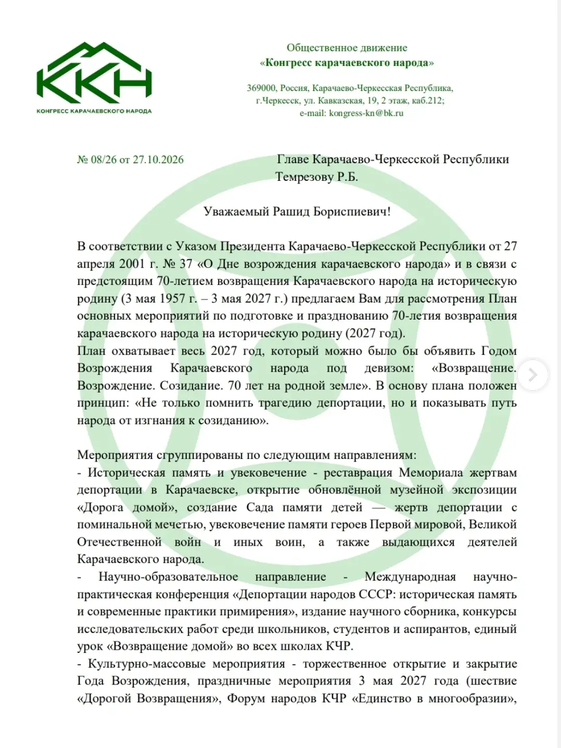
latviatoday.info/society/vozvraschenie-ne-otmenilo-posledstvii-v-karachaevo-cherkesii-pochtili-pamyat-zhertv-deportatsii
instagram.com/karachay_kongress
instagram.com/p/DfMS6vACMzD
The state’s failure to fulfil its obligations to complete the rehabilitation of a repressed people, the curtailment of specialised state commissions and obstacles to the preservation of cultural and linguistic heritage affect a complex of collective and individual human rights. In the situation under consideration, signs of violations of the following legal norms can be discerned:
• Non-fulfilment of national legislation on the rehabilitation of repressed peoples (RSFSR Law of 26.04.1991 No. 1107-1 “On the Rehabilitation of Repressed Peoples”, RF Law of 18.10.1991 No. 1761-1 “On the Rehabilitation of Victims of Political Repressions”). These normative acts guarantee the full restoration of political, social and cultural rights and historical justice, including the compensation of material damage and the restoration of cultural and spiritual heritage. The actual cessation of the work of the state commission on rehabilitation since 2009 and the ignoring of appeals by public organisations testify to the state’s failure to fulfil the legal obligations it has assumed.
• Violation of the right to the preservation of cultural identity, native language and historical heritage (part 2 of Article 26 and part 3 of Article 68 of the Constitution of the Russian Federation, Article 27 of the International Covenant on Civil and Political Rights, Article 15 of the International Covenant on Economic, Social and Cultural Rights, UN Declaration on the Rights of Persons Belonging to National or Ethnic, Religious and Linguistic Minorities). The state bears a positive obligation to create conditions for the preservation and development of the linguistic and cultural distinctiveness of peoples that have suffered from forced assimilation and deportations. The absence of systemic programmes for the revival of the Karachay-Balkar language, the return of museum valuables and the restoration of historical toponymy restricts the right to take part in cultural life and to use one’s native language.
• Violation of the right to historical truth and access to archival information (Articles 24 and 29 of the Constitution of the Russian Federation, Updated Set of Principles for the Protection and Promotion of Human Rights through Action to Combat Impunity). International standards in the field of transitional justice enshrine the inalienable right of peoples to know the truth about mass human rights violations committed in the past, as well as the obligation of the state to preserve the memory of the victims of repressions and to counteract the distortion or denial of historical facts.
Court Refuses to Satisfy Another Lawsuit by Former Senator from Karachay-Cherkessia Rauf Arashukov, Who Is Serving a Life Sentence
Systemic human rights violations in the penitentiary institutions of the Russian Federation, including arbitrariness in placement on preventive registers, restriction of access to materials of departmental inspections and the blocking of family ties, are clearly manifested in the case of former senator from the Karachay-Cherkess Republic Rauf Arashukov. Serving a life sentence in special-regime corrective colony No. 6 (“Black Dolphin”, Orenburg Region) under a sentence of the Moscow City Court of December 2022, Arashukov systematically encounters obstacles when attempting to challenge the actions of the institution’s administration in court.
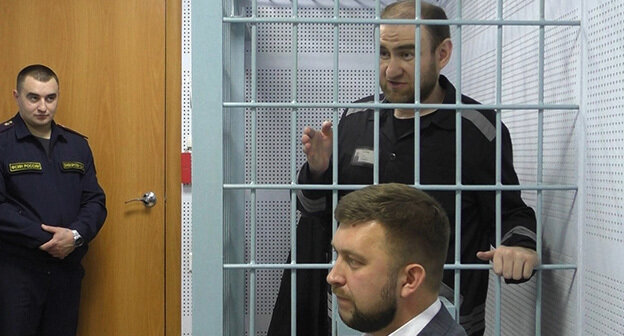
An analysis of the judicial proceedings surrounding the conditions of Arashukov’s detention makes it possible to identify the following systemic problems of the penitentiary system:
• Arbitrariness in placement on a preventive register and concealment of documents from the convict. On 13 October the Sol-Iletsk District Court of Orenburg Region refused to satisfy Arashukov’s administrative lawsuit seeking removal from the preventive register as a person “inclined to attack colony staff and law-enforcement officers” (this status was first assigned to him in 2023 and extended by a commission in March 2026). In support of the lawsuit the applicant pointed to gross procedural violations: the administration had not acquainted him with the commission’s decision, the minutes of the meeting or the report on preventive work, had not handed over copies of the documents and had not explained the factual grounds for the extension of the special status. Despite this, the court sided with the corrective institution, recognising the administration’s actions as lawful.
• Blocking of the right to maintain family ties. In the spring of 2026 Arashukov’s relatives were refused his transfer from Orenburg Region to a corrective institution on the territory of the Republic of Mordovia (closer to the family’s place of residence), which substantially complicates the realisation of the right to visits. In August the convict also sent an appeal to the State Duma and the Government of the Russian Federation with an initiative to increase the number of visits with under-age children for persons sentenced to life imprisonment.
• Everyday restrictions and accompanying criminal prosecution. At the end of April the court rejected Arashukov’s lawsuit seeking recovery from the colony of compensation in the amount of 100 thousand roubles for the non-issuance of purchased food products (in the course of the proceedings it emerged that the paid-for goods were absent from the shop at the institution). In addition, in January 2026 Arashukov was additionally sentenced to 10 years’ imprisonment and a fine of 120 million roubles on charges of attempting to transfer a bribe of 3 million roubles to staff of “Black Dolphin” for the creation of favourable conditions of serving the sentence.
This case illustrates the general tendency of a formal approach by the courts to the consideration of complaints against the actions of the administrations of FSIN institutions: even in the presence of an obvious violation of the convict’s right to become acquainted with documents affecting his legal status and regime of detention, judicial instances practically unconditionally legitimise the decisions of the penitentiary bodies.
kommersant.ru/doc/9006724
The practice of arbitrary placement of convicts on preventive registers while refusing to allow them to become acquainted with the justifying documents, as well as the refusal of transfer closer to the family’s place of residence, contradict the standards of treatment of prisoners and the guarantees of judicial protection. In the situation under consideration, signs of violations of the following norms of Russian and international law can be discerned:
• Violation of the right of access to information affecting rights and freedoms and of the principle of legal certainty (part 2 of Article 24 of the Constitution of the Russian Federation, Article 12 of the Penal Enforcement Code of the Russian Federation, United Nations Standard Minimum Rules for the Treatment of Prisoners – the Nelson Mandela Rules). The assignment and extension of the status of a person “inclined to attack” entails an intensification of the regime of supervision and additional restrictions for the convict. The concealment from the prisoner of the commission’s minutes, reports and factual grounds for the adoption of such a decision deprives him of the possibility of objecting to the administration’s unfounded conclusions and contradicts international standards of transparency of disciplinary and preventive procedures.
• Violation of the right to a fair trial and an effective remedy (Article 46 of the Constitution of the Russian Federation, part 3 of Article 123 of the Constitution of the Russian Federation, Article 14 of the International Covenant on Civil and Political Rights). The formal approach of the court, which rejects the plaintiff’s arguments about the non-provision to him of the case materials by the FSIN commission and does not verify the existence of objective evidence of his “inclination to attack”, violates the principle of adversarial proceedings and equality of the parties, rendering judicial control over the actions of the penitentiary system illusory.
• Restriction of the right to respect for family life and the maintenance of social ties (Article 38 of the Constitution of the Russian Federation, Article 73 of the Penal Enforcement Code of the Russian Federation, Articles 17 and 23 of the ICCPR, Rules 58 and 59 of the Nelson Mandela Rules). The refusal to transfer the convict to a corrective institution located closer to the place of residence of his relatives (to Mordovia), in combination with the strict legislative restrictions on the number of visits with under-age children for persons serving life sentences, hinders the preservation of family ties, which contradicts the aims of correction and resocialisation of convicts.
Continuing Pressure on Mountaineer Mikhail Semyonov
A telling example of the abuse of disciplinary penalties, failure to provide medical assistance and collective pressure in the penitentiary system is the persecution of 38-year-old master of sports in mountaineering from Teberda Mikhail Semyonov, who has Group II disability, severe consequences of a craniocerebral injury and serious cardiovascular diseases.
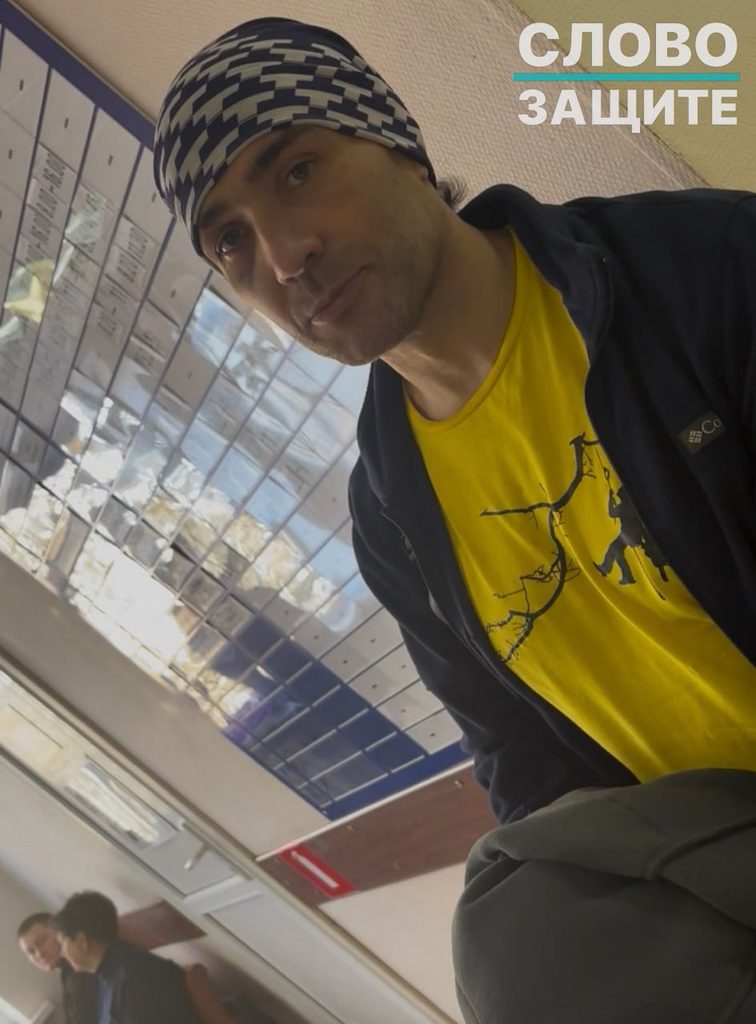
The chronology and key circumstances of the case point to the systematic violation of the convict’s rights at all stages — from the handing down of the sentence to the execution of the punishment:
• Context of the criminal case and unjustified detention. On 18 February 2026 the Karachay District Court sentenced Semyonov to one year in a settlement colony on charges of illegally crossing the Russian-Abkhaz border in the area of the Eastern Klukhori pass in April 2024. According to the convict’s wife Ekaterina Semyonova, the criminal prosecution is linked to the mountaineer’s conflict with representatives of the security agencies because of his criticism of illegal paid excursions in the border zone of the nature reserve. In July 2026 Semyonov was detained in Karachay-Cherkessia allegedly for violating the deadline for independently reporting to the colony, despite the existence of a valid reason (undergoing a programme of medical rehabilitation). On 10 September the Elektrostal City Court refused the defence’s application for the convict’s conditional early release.
• Fabrication of disciplinary penalties and prolonged detention in a punishment cell (SHIZO). From the moment of his detention in the pre-trial detention centres of Cherkessk and Moscow Region, and subsequently in settlement colony No. 3 (Elektrostal, Moscow Region), Semyonov encountered refusals to provide prescribed medicines and to call an ambulance. On 22 September the colony administration placed him in a punishment isolation cell (SHIZO). In October 2026 the convict was briefly removed from the isolation cell for hospitalisation, yet on the same day a new penalty was imposed for a “regime violation” — rising early and drinking tea at 05:20 a.m. (when the established time for rising is 06:00), caused by the need to have breakfast before departing for the hospital at 07:00. Immediately after discharge from the inpatient facility Semyonov was again placed in the SHIZO without the mandatory medical examination.
• Threat to life, signs of physical violence and the organisation of harassment. During his time in the punishment isolation cell Semyonov, deprived of necessary medications, repeatedly lost consciousness, and when he was briefly removed from the SHIZO in October a bruise under the eye was recorded. In addition, the institution’s administration resorted to the practice of collective punishment and the provocation of conflicts among prisoners: other convicts were restricted in their access to showers, laundry facilities and kitchen equipment, this being publicly explained by the complaints of Semyonov’s wife about the conditions of detention.
• Inaction of supervisory and human rights institutions. Appeals by Ekaterina Semyonova to the General Prosecutor’s Office and the central apparatus of the FSIN resulted only in the sending of formal notifications of the commencement of an inspection without the adoption of measures to protect the life and health of the convict. The regional Public Monitoring Commission (ONK) of Moscow Region did not conduct an actual verification of the complaints, limiting itself, according to the assessment of the applicant, to formal visits with access exclusively to prisoners loyal to the administration.
x.com/Slovozashite/status/2112469636901941346
kavkaz-uzel.eu/articles/427876
The conditions of Mikhail Semyonov’s detention in settlement colony No. 3, the systematic refusal of medical assistance despite the presence of Group II disability and severe chronic diseases, as well as the provocation of interpersonal conflicts among convicts, constitute a comprehensive violation of the norms of Russian and international law:
• Violation of the prohibition of torture, inhuman or degrading treatment (Article 21 of the Constitution of the Russian Federation, part 2 of Article 12 of the Penal Enforcement Code of the Russian Federation, Article 7 of the International Covenant on Civil and Political Rights, UN Convention against Torture). The prolonged detention in a punishment isolation cell of a person with Group II disability, consequences of a craniocerebral injury and heart diseases without a prior medical examination, which led to repeated losses of consciousness, is equated with inhuman treatment. The presence of a bruise under the eye after removal from the SHIZO requires an immediate and independent investigation into the possible use of physical violence.
• Violation of the right to the protection of health and medical assistance (Article 41 of the Constitution of the Russian Federation, Article 101 of the Penal Enforcement Code of the Russian Federation, Article 12 of the International Covenant on Economic, Social and Cultural Rights, Rules 24–27 of the Nelson Mandela Rules). The refusal to issue prescribed medicinal preparations, the failure to call an ambulance team in the event of a critical deterioration of the state of health, and placement in the SHIZO without a doctor’s authorisation grossly violate the standards of medical provision for prisoners, according to which the level of medical care in places of deprivation of liberty must be comparable to that available to the general public.
• Arbitrary imposition of disciplinary penalties (Articles 115 and 117 of the Penal Enforcement Code of the Russian Federation, Rules 37 and 39 of the Nelson Mandela Rules). The qualification as a “regime violation” of rising early (at 05:20 instead of 06:00) in order to take food before departing for a medical procedure at 07:00 contradicts the principle of proportionality and common sense, indicating the use of the disciplinary mechanism as an instrument of repression for the filing of complaints.
• Prohibition of collective punishments and incitement to violence (Article 13 of the Penal Enforcement Code of the Russian Federation, Rule 43 of the Nelson Mandela Rules). The restriction of the everyday rights of other convicts (access to showers, laundry facilities and the kitchen) with a direct reference to the complaints of Semyonov’s family is a form of collective punishment and the deliberate creation of a threat to the personal safety of the convict from fellow inmates, which directly contradicts the administration’s obligation to ensure the safety of persons held in corrective institutions.
• Ineffectiveness of public and prosecutorial control (Federal Law No. 76-FZ “On Public Control over the Ensuring of Human Rights in Places of Compulsory Detention”, Article 2 of the ICCPR). Formal replies from the supervisory agencies and the imitation of inspections by the ONK deprive the convict of effective remedies in conditions of a direct threat to his life and health.
A Resident of the KCR Accused of Financing Terrorism Because of Money Transfers to an Organisation Banned in Russia Will Appear in Court
In the Karachay-Cherkess Republic, as in neighbouring constituent entities of the North Caucasian Federal District, the active investigation and referral to court of criminal cases of a “terrorist” nature continues. A further example was the completion by the Second Department for the Investigation of Particularly Important Cases of the regional Investigative Committee Directorate of the investigation in respect of a local resident accused of financing terrorism (Article 205.1 of the Criminal Code of the Russian Federation).
According to the version of the investigative bodies and operational services, the accused, who allegedly held “radical views”, in 2015 and 2024 carried out money transfers for the needs of a “terrorist” organisation banned in Russia. In mid-July the defendant was formally charged; initially he was placed in custody, but subsequently in the course of the investigation the measure of restraint was changed to house arrest. At present the criminal case with an approved indictment has been referred to court for consideration on the merits.
According to an official report of the Ministry of Internal Affairs for the NCFD, the charges are based on a standard set of materials for this category of cases: the results of operational-search activities (OSA), banking documents and the testimony of witnesses. Such a construction of charges — especially in the part concerning the imputation of episodes of many years’ standing (2015) alongside recent transfers — requires close human rights attention against the background of systemic complaints by residents of the North Caucasus about the conveyor-belt fabrication of “terrorist” cases. As previously recorded in neighbouring republics (in particular, in collective appeals by citizens in Kabardino-Balkaria and assessments by independent experts for the NCFD), the security structures frequently use unverifiable OSA materials, the testimony of “classified witnesses” and the retrospective search for formal pretexts in order to fulfil departmental detection indicators.
interfax-russia.ru/south-and-north-caucasus/news/storonnika-radikalnyh-vzglyadov-budut-sudit-v-kchr-za-finansirovanie-terrorizma
kchr.sledcom.ru/news/item/2137390
The use of unverifiable operational materials and retrospective prosecution in cases of financing of terrorism are associated with serious risks of violation of basic procedural guarantees. In the context of this case the following legal problems can be discerned:
• Standards of the admissibility of evidence and the use of the results of OSA (Article 50 of the Constitution of the Russian Federation, Articles 75 and 89 of the Criminal Procedure Code of the Russian Federation, Article 14 of the International Covenant on Civil and Political Rights). The results of operational-search activities cannot automatically replace full-fledged procedural evidence and are subject to thorough verification as to their lawfulness and reliability. The investigation’s reliance on closed operational reports and the testimony of dependent or anonymous witnesses, combined with the accusatory bias of the courts, restricts the defence’s right to an effective challenge of the evidentiary base.
• Retrospective prosecution and observance of limitation periods (Article 78 of the Criminal Code of the Russian Federation, Article 15 of the ICCPR). The combining in a single charge of alleged financial operations with a gap of almost ten years (2015 and 2024) requires a strict legal verification of the existence of direct intent to finance precisely terrorist activity at the moment of the commission of each payment, as well as observance of the rules for calculating the limitation periods of criminal prosecution under the versions of the criminal law that were in force in 2015.
• Violation of the presumption of innocence in public statements by the agencies (Article 49 of the Constitution of the Russian Federation, Article 14 of the Criminal Procedure Code of the Russian Federation, Article 14 of the ICCPR). Assertions by the security structures about the defendant’s “holding of radical views” and “confirmed involvement”, published before the consideration of the case by the court on the merits, create prejudice against the accused and violate the principle of the presumption of innocence.
Chronicle of Losses
In the course of monitoring open official reports of municipal authorities of the Karachay-Cherkess Republic, new confirmed data on the deaths of local residents who took part in combat operations in the zone of the armed conflict on the territory of Ukraine and in the border regions of the Russian Federation have been recorded.
In October 2026 it became known that the following will not return to Karachay-Cherkessia from Ukraine:
Abazinsky District:
• Timur Ortanov – assault trooper, killed in the combat zone in Ukraine.
Karachay District:
• Marat Dzhukaev – contract soldier, native of the aul of Kumysh. Concluded a contract with the Ministry of Defence of the Russian Federation in August 2024 (after two previous refusals) and was killed on 3 January 2025 in the area of the village of Kurilovka in Kursk Region.
According to the results of the recording of public statements by representatives of the authorities and the security agencies, by the beginning of November the deaths of no fewer than 207 servicemen and volunteers from the Karachay-Cherkess Republic have been officially confirmed.
The figures cited reflect exclusively cases that have been publicly recognised by state structures (by means of reports of district administrations, the presentation of awards or obituaries). The actual number of fallen natives of the republic may be substantially higher in view of the closed nature of official statistics on losses. As in other regions of the North Caucasus, posthumous decoration does not guarantee the families of the fallen full social and material support from the state.
Conclusion
An analysis of the human rights situation in the Karachay-Cherkess Republic for the reporting period demonstrates the persistence of systemic problems in the sphere of observance of procedural guarantees, the rights of convicts in penitentiary institutions, and the protection of the collective and cultural rights of repressed peoples. Law-enforcement practice in the region is characterised by an accusatory bias, the information closedness of the security agencies and a formal approach by supervisory bodies to citizens’ complaints.
On the basis of the documented cases and monitoring data, the following key conclusions can be formulated:
• Systemic violation of the rights of convicts and arbitrariness of the penitentiary system. Cases involving people from Karachay-Cherkessia — both former senator Rauf Arashukov and master of sports in mountaineering Mikhail Semyonov — reveal a deep crisis of legality in FSIN institutions. Colony administrations use placement on preventive registers and confinement in punishment isolation cells on fabricated pretexts as an instrument of pressure and punishment for the filing of complaints. Particular concern is caused by the situation of Mikhail Semyonov, who has Group II disability and severe chronic diseases: the refusal to issue medications, detention in the SHIZO without a medical examination, signs of physical violence and the provocation of conflicts through the collective punishment of fellow inmates create a direct threat to his life and health amid the complete inaction of the prosecutor’s office and the ONK.
• Retrospective criminal prosecution and reliance on unverifiable OSA materials. In the republic the practice of investigating and referring to court cases of financing of terrorism, built on closed materials of operational-search activities and the retrospective imputation of episodes of many years’ standing (up to 2015), continues. The publication by the security agencies of press releases asserting the guilt of defendants before a court decision undermines the principle of the presumption of innocence.
• The incompleteness of the rehabilitation of the Karachay people and the threat to historical heritage. Thirty-five years after the adoption of legislation on the rehabilitation of repressed peoples, the state has still not fully fulfilled the obligations it assumed towards the Karachay people. The curtailment of the work of the specialised governmental commission since 2009, the absence of systemic support for the Karachay-Balkar language and historical toponymy, as well as intensifying attempts in the public space to revise the Stalinist repressions, cause justified concern among national public associations and researchers.
• Growth of human losses in the war and shortage of social guarantees. The continuing participation of residents of Karachay-Cherkessia in combat operations on the territory of Ukraine and in the border regions of the Russian Federation leads to a steady increase in the number of the fallen (no fewer than 207 officially confirmed cases by the beginning of November), while the real scale of the losses is concealed and the families of the fallen encounter bureaucratic obstacles in obtaining the due payments and benefits.
KHAVA BESHTOEVA